28 August 2023

Notes toward a review of 1762, steampunk novel


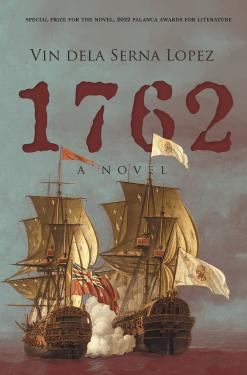
Vin dela Serna Lopez's 1762 (Ateneo de Manila University Press, 2023) was one of the books that caught my attention in the Philippine Book Festival in Manila last June. I gravitated toward it for various reasons. Its arresting cover was a vision in burgundy. Two ships floating on a "wine-dark sea", clearly at odds with each other with all that heavy smoke in between; the prominent number-title reverse-embossed in that ink-blot, blood-like burgundy font; and the reddish British flag of the left ship waving. The synopsis at the back revealed the novel's backdrop: British invasion of Manila in 1762 which lasted for two years. It was a historical event largely ignored in fiction.
https://unipress.ateneo.edu/sites/default/files/styles/new_book/public/1762_Front%20Cover.jpg?itok=WXbCt4LQ 

The novelist was scheduled to have an autograph signing in the Ateneo Press booth later that day. Thus I went around first on a book buying binge before coming back to the booth after lunch for an autograph. I snagged Vin's signature with this cryptic dedication.

How dare the author quote from Rizal's novel! The final words of Elias in the heartbreaking, penultimate chapter ("Christmas Eve") of the Noli. Yet this somehow made sense when I reached Chapter 4 ("Motto Stella") of 1762; and I now presume would make its full thematic connection to 1762 when I reach its end. (I am on page 140, Chapter 7 out of 33).

While I had my book autographed, I talked briefly with the novelist, telling him that the subject matter of his debut novel was something unexplored in fiction, with perhaps one exception which I mentioned to Vin: Linda Ty-Casper's first novel The Peninsulars (Bookmark, 1964), sadly still out of print.

In any case, here were my takeaways of 1762 after the first few chapters.

1. This historical novel was attempting to unpack and synthesize the entire Spanish colonial history of the Filipinas. 1762 was just a post-colonial launching pad or platform, so to speak, to question the innumerable failings and betrayals that accompanied all nascent Philippine revolutions. 

2. José Rizal was the guiding light of the novel. And I'm still feeling two ways about Chapter 4 which made for a provocative and weird (read: modernist) narrative approach. This chapter, written in the form of a play (disrupted from time to time by the main narrative thread), imagined a conversation between two novelists (Nicomedes and Amado, stand-in novelists whose identities were no surprise really from the moment you read their names) about the December 1896 execution of Rizal. It was a self-conscious commentary on selected moments in Philippine history, with betrayal and sacrifice and self-determination as running themes. I'm a bit ambivalent about this part because it somehow laid the history lessons too thickly: the primary reason I was both fascinated and repelled by Mike de Leon's 1999 meta-film Bayaning 3rd World. A time warp, a tear in the fabric of time, was deliberately opened here, but why rehash or repurpose an already familiar reading of history in a novel of history?

You are only rewriting what has been written before.

Nicomedes

I am no real historian, Nicomedes. I'm just a storyteller. Yet I have an obligation just the same

Amado   

I will reassess my view of this chapter once I finish the book, and confirm if this chapter was the lynchpin that held the themes together or just pure literary provocation or something else. (Cirilo F. Bautista used a similar dialectical device in The Trilogy of Lazarus). Needless to say, Rizal animated the novel's ideas (in the first chapter alone, set in a Spanish galleon, class distinction among passengers and the back and forth of the action in the steamship's upper deck and lower deck reminded one of the opening chapters of El Filibusterismo).

3. The first acts of this novel were immersive and transporting. It had moments of beautiful writing and subtle comic brilliance. It was a well-researched, well-developed, and well-dressed steampunk novel. A summer blockbuster that did not scrimp on the budget. 

Did I mention it was also a nautical war adventure and nation-mongering in the mold of Joseph Conrad's Nostromo? A theater of war with cinematic action sequences and imagery from the dramatic September 1762 Brentrance in Manila Bay to the Catholic capital's October capitulation two weeks later, the detailed reconstruction (and then destruction) of each rampart and church and bastion of Intramuros, the uniforms and clothing worn by soldiers and fighters from all sides, the maritime vocabulary, the catchy phrasing and seaworthy metaphors ("Busto suddenly found his troops cut off and forced to fend for themselves for the remainder of the night, repelling wave after wave of Sepoys and Lascars who kept bursting forth like ocean billows from their stronghold in Ermita."; "He passed them by with superficial indifference, passed by the sweep of the shore and the sea and the ships tarrying under the wisdom of unpredictable tides.").

The variety of war weapons used, the human and economic costs of war (sometimes graphic, often gruesome), the introduction of a fascinating cast of characters (an ensemble) and their blistering portraits and their Conradian motivations, the evocative language that bordered on Joaquinesquerie, with wayward phrases invoking irony and crackling with dissent and wit ("Archbishop Rojo cleared his throat of the phlegm of various possibilities."), the universal bottom-lines of a war economy, the natural history of empire, the looting and pillaging and rape (whether styled as 2022 Putinesque or 1762 British entry), political wrangling, prior to Brexit.

The Chinese settlers of the Parián, to whom Europeans had designated the epithet "Sangleys," were residing right in the shadows of imposing brass cannons protruding from a ravelin of the fortress city aptly called Intramuros, which had held the unimpregnated seat of Catholic authority in the Pacific since the end of the sixteenth century. Over four times larger than the Chinese district to its east, Intramuros was a gigantic brick and limestone metropolis defended by bastions thick as the illusions of a monarchist, parapets that crumbled like the ideals of a republican, and batteries that were as powerful yet as inconsistent as public opinion.

This period film was anything but grandiose production design and stirring musical score and snappy editing, although the battle scenes within the fortifications of Manila were assembled with the same frenetic pacing of some of Pepys's diary entries. The novelist wanted to move back the reckoning of popular Filipino revolutionary history to an earlier date, further expanding a conception of that history as embedded in a world war.1 

More than a rewinding of history (there's a breathless "rewind" scene of Rizal's execution), the novel fast forwarded to historical and timeless truths about human avarice and capacity for violence. If 1762's entrada was any indication, this first novel is bound to be a sui generis reading experience, a historical exercise that is romantic and disillusioning at the same time.

These were all tentative impressions for now. There was already, at the novel's onset, a preview or dry run of Philippine nationalism or nationalist tendencies, an early framing (or reframing) of a community imagined (or reimagined) in an age of globalization.2 There was, already, a novelistic excavation in the rubble pile of history. The story-teller as historian; the novelist as angel of history.3 Circa 1762. 


Notes: 

1. Read the novelist's impetus for writing the novel in "Why I decided to write a novel about Intramuros set in 1762" (link).

2. "[A nation] is imagined as a community, because, regardless of the actual inequality and exploitation that may prevail in each, the nation is always conceived as a deep, horizontal comradeship. Ultimately it is this fraternity that makes it possible, over the past two centuries, for so many millions of people, not so much to kill, as willingly to die for such limited imaginings." (Benedict Anderson, Imagined Communities: Reflections on the Origin and Spread of Nationalism). See also his analysis of Rizal's writings and final days and their connections to Western anarchist thinking in Under Three Flags: Anarchism and the Anti-Colonial Imagination aka The Age of Globalization: Anarchists and the Anticolonial Imagination.

3. In Walter Benjamin's formulation: "This is how one pictures the angel of history. His face is turned toward the past. Where we perceive a chain of events, he sees one single catastrophe which keeps piling wreckage upon wreckage and hurls it in front of his feet. The angel would like to stay, awaken the dead, and make whole what has been smashed." ("Theses on the Philosophy of History", in Illuminations, translated by Harry Zohn, edited by Hannah Arendt).


18 August 2023

Coming in translation from the Philippines

Jorge Luis Borges once said in a lecture, "Sometimes, looking at the many books I have at home, I feel I shall die before I have come to the end of them, and yet I cannot resist the temptation of buying new books. When I go, when I walk inside a library, I find a book on one of my hobbies ... I say to myself, "What a pity I can't buy that book because I already have a copy at home." In the digital age, Borges's book addiction will be compounded by a decision point for the reader of whether buying the Kindle version alongside the paperback. In the age of translation, the problem is more complicated. I already owned the book, it's right there on the top shelf, read it once or twice, and now you tell me it's being translated by that well-regarded translator and published by that reputable publisher and the translation is coming out in that awesomely badass cover design?

What to look out for in English translation in these islands post-2022? The list last year needs an update. Online detective work produced the following works of fiction. 

For me, the surprising thing about the works on the list was the sheer diversity of their themes and their experimental approaches. The texts played with forms and genres, expanding the notion of the novel and carrying forward the tradition of novel-writing into exciting, unexplored Filipino imaginary.

Some links go to the publishers' page in online stores, but I do not receive any commission or referral fees.

I'm sure I missed something, but here goes:


1. For B (or How Love Devastates Four Out of Every Five of Us) by Ricky Lee, translated by Noelle Q. De Jesus (Ateneo de Manila University Press).

That this appeared in translation at all was a miracle (although one could say that for any novel in this list). It should be hard to translate, given the highly colloquial and idiomatic register of the original Filipino (and Taglish: the Tagalog-English magic ginisa mix). I already sampled the first story. The translator's compositional choices suited the writer's emotive and cinematic style. Ricky Lee was the guru of Filipino film writing, scriptwriter of countless film classics. For B was his first novel: an episodic, experimental, and metafictional discourse on love and its devastation. Told in loosely linked stories, the novel unfurled like a melodramatic film treatment filtered through a relentless and heartrending brand of emo.

The publisher's page said it is Lee's first published English translation of his work. Not true, if we count the bilingual monograph Salome: A Filipino Filmscript (University of Wisconsin--Madison, Center for Southeast Asian Studies, 1993), translated by Rofel Brion.

2. Luha ng Buwaya (Crocodile's Tears) by Amado V. Hernandez, translated by Danton Remoto (Penguin Random House SEA)

I already listed this last year, but this translation of a classic 1962 novel will be appearing sometime this year. Amado V. Hernandez's novel masterfully dramatized the conflict between the landlord and the landless, through the specifics of its own time and place. What was brilliant about Hernandez's fierce novel was the way it did not end with an astute diagnosis of Filipino post-war agrarian soecity's ills. It also contained within it the practical ideas and strategies to fight the corrupt crocodiles in our midst.

Like his first novel Mga Ibong Mandaragit (The Preying Birds), also translated by Danton Remoto, the subject was land grabbing and the unjust tenancy system. But it resembled more Lazaro Francisco's The World Is Still Beautiful (translated by Mona P. Highley) in terms of action and plot. F. Sionil José, in his five Rosales novels, also dealt partly with the same concerns about class and agrarian conflicts, but I prefer the approach taken by Hernandez and Francisco in their respective novels.

Cover above was taken from the catalog of Penguin Random House SEA.


3. The Ravaged World: The Short Fiction of Rosario de Guzman-Lingat, translated by Soledad S. Reyes (Ateneo de Manila University Press)

This is the second translated short story collection and the fifth translated book of Rosario de Guzman-Lingat! All were meticulously completed and curated by Soledad S. Reyes. Going through Lingat's novels and stories--What Now, Ricky?; The Death of Summer; The Cloak of God; Ang Balabal ng Diyos / Ang Silid ng Makasalanan; The Locked Door and Other Stories--one was struck by the thematic variety of her works. Her three translated novels and one novella, for example, were all different plot-wise. 


4. Dili Pwede Mogawas ug Ubang Mga Sugilanon / Can’t Go Out and Other Stories by Elizabeth Joy Serrano-Quijano, translated from Cebuano by John Bengan (Ateneo de Davao University Publication Office, 2022)


This was published late last year. For samples of Serrano-Quijano's stories, see "The Pregnant Woman from Zamboanga" in World Literature Today, "I am Robin Nabaro" in Anomaly, and the title story "Can't Go Out" in Words Without Borders.

* * *

Back in June, during the Philippine Book Festival at the World Trade Center in Pasay City, the National Book Development Board (NBDB) announced the winners of its Translation Subsidy Program. These fictional works were among the winning books that will be translated and published in the next two years or so. The cover pages were those from the original language.


5. The Vanished, translation of Ang Nawawala by Chuckberry J. Pascual. Publisher: 19th Avenida Publishing House

Reviews in Goodreads described this as an anthology of detective stories, all featuring Bree, a gay receptionist who solved various cases of missing objects. A supposedly fun, genre-defying book with social and political commentaries. I'm already sold, but the book is sold out? I'm trying to find a copy. The copies in Shopee and Lazada have vanished. Just the perfect case for Bree.

I'm not sure who will be translating, possibly the author himself who is an accomplished translator from English to Filipino. His translation credits include four works of fiction by Cristina Pantoja-Hidalgo: Sa Bayan ng Nagngangalit na Buwan (Where Only the Moon Rages), Kundiman ng Panahong Naiwan (Ballad of a Lost Season), Catch a Falling Star (Filipino Edition), and Mga Kuwentong Bayan para sa Gabing Maulan (Tales for a Rainy Night). He also did the Filipino translation of Ilustrado by Miguel Syjuco.


6. The Abyss Beneath Our Feet, translation of Ang Bangin sa Ilalim ng Ating mga Paa by Ronaldo Vivo Jr.. Translator: Mark Frederick Bulandus. Publisher: 19th Avenida Publishing House. 

The second book of a projected trilogy called Dreamland, The Abyss Beneath Our Feet embodied the precarious state of living under a police state, where every breath one takes clouded the atmosphere of state-sponsored "violence, corruption, and criminality" (as per Resil B. Mojares). In 1998, the British novelist and screenwriter Alex Garland wrote a noir novel set in Manila called The Tesseract. It was a novel of pure noir atmosphere, palpable with suggestions and dark meanings as the protagonist meandered the unlighted streets, fell into a manhole, and, literally covered in muck and filth, escaped into the night. Ronaldo Vivo Jr. took Garland's exercise of unraveling a tesseract one step further. He leveled up the elements of a noir novel, immersing both characters and readers into a typical nightmare, breathing life into the dark suggestions and quivering meanings. In vivo (within the living organism), experiments were done on the body of human beings. In Vivo's novel, state violence was made flesh and bone. The violent work was played out and performed (unraveled) directly on the body of the individual and the body politic. His is the violent novel that could jolt readers out of their comfort zones and reveries and make them trip directly into a live electrical wire.


7. Arkipelago by Januar Yap. To be published in translation by Advaux.

https://lzd-img-global.slatic.net/g/ff/kf/S31ad29ac0f344e34bd62a862a1f80ac90.jpg_720x720q80.jpg_.webp

SunStar Cebu described this Cebuano novel as "a composite novel, talks of lost ships, immortal dwarves, invisible texts, fugitive birds, all in a dizzying interaction with history and politics. ... “Arkipelago” mixes elements in history, pop culture, urban legends, indigenous and foreign myths, while its seafaring narrative covers an expansive setting from Culion Island, Bucas Grande in Surigao to as far as Benham Rise."

Trust not the author, but in his own words: 

The novel is launched by a chapter that is set in a striptease joint that features a surreal balancing contest among its dancers. A stripper is identified by a number corresponding to a year of political shift in Philippine history — from colonial regimes to uprisings. The distinct choreography depicting each regime and its life story alludes to circumstances in history as well. It ends with the elopement of the diminutive gigolo and the club’s most prized dancer.

A chapter establishes the connection between a present-day fishing expedition and the transport of lepers from Cebu to an asylum colony in Western Philippines almost a century earlier.

There is the recurring characterization of the village savant shapeshifting through the chapters — there’s the suicidal mad writer who dons a [José] Rizal suit; the perennial and persistent nuisance candidate of presidential elections who retires to an obscure island; the mysterious warden in an isolated base far off East of the archipelago; a professor in perpetual soul-searching; the boat captain who hangs onto his ancient map; among others. Each of them thinks broadly of the nation from where he is in the archipelago, claiming space as though the capital didn’t matter. They are storytellers whose tales have the consciousness of an existence of the “other” islands and the seas between. The seas are nothing but a bridge that connects their tales.

Again: sold. It had me at "seafaring".

It's not clear to me what language this will be translated in and who the translator will be. One of Januar Yap's stories, "The Savant", appeared in English translation by John Bengan in Ulirát: Best Contemporary Stories in Translation from the Philippines (2021). (Cebuano book in Lazada).


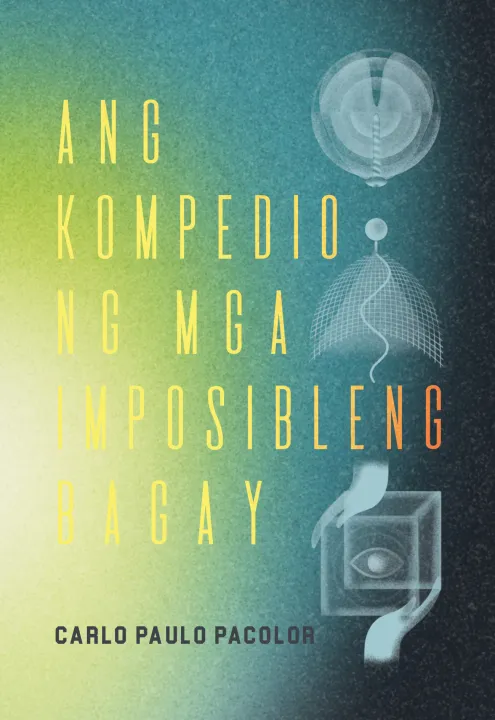
8. Ang Kompedio ng mga Imposibleng Bagay (A Compendium of Impossible Things) by Carlo Paulo Pacolor. Publisher: Everything's Fine.

https://lzd-img-global.slatic.net/g/p/fe5f2e203306d4ae6abcc8dada9df4b5.jpg_720x720q80.jpg_.webp

Synopsis in Lazada:

Someone locks oneself inside an apartment unit using a mysterious lock purchased from a Chinese merchant. Many years later, a demolition crew finds someone mysteriously locked inside one of the rooms in the apartment complex they were about to blow down. A video game player has finally figured out the game’s puzzle but ended up dying in extremely peculiar circumstances. Diamonds and pearls emerges from the mouth of a call center worker during a tense team party. A fortune teller discovers her heart burning along with everything else around her. The seismologist records the strongest earthquake in history but no one else have seemed to notice. These and other stories of the improbable from the brilliant mind of Pacolor, finally put to print after many years, are written in a fierce poetic style that heightens the reader’s sense of bewilderment.

This is giving me the vibe of The Lives of Things by José Saramago. Carlo Paulo Pacolor is a performance artist and their stories appear to be performative pieces based on titles alone: "The Boy Who Wanted to Be a Cockroach" and "When He Wakes Up, Mushrooms Are Sprouting from His Nose". Mash these titles and they sound like Kafka (when he woke up, he turned into a cockroach) and Gogol (the nose). Both stories appear in Ulirát: Best Contemporary Stories in Translation from the Philippines, translated by Soleil David and Erika M. Carreon, respectively. 

Center for the Art of Translation published a piece (trans. Soleil David) from the compendium of impossible things here.

* * *

Plus, three novels that will be hard to miss, all from the same translator.

9. Colon: A Novel by Rogelio Braga. Translator: Kristine Ong Muslim. Publisher: the87press

The plot, as described in Goodreads, had the heft and sweep of an epic and a sobering reckoning for readers unfamiliar with the subject of the Moro, the wicked problem of the neverending wars and struggles in Mindanao, and the painful collisions of past and present. Colon's backdrop was the Marcos dictatorship. What was it like to be a Moro during those times of martial rule? Several online reviews made a case for reading a powerful narrative laying bare the raw and festering wounds in the south. Rogelio was reclaiming the silenced story of the Moro with nuance, power, and poignancy. Book link


10. Book of the Damned by Amado Anthony G. Mendoza III. Translator: Kristine Ong Muslim. 


Winner of the 2023 PEN/Heim Translation Fund Grant, the novel sounded irresistible from the compelling press release. 

From the judges’ citation: Charting President Caesar Repaso’s dictatorship in the Philippines and its aftermath through multiple voices and narrators who may or may not be invested in the truth, A. A. Mendoza III’s Book of the Damned shrewdly fuses the figure of the artist with that of the dictator to problematize the vexed question of how the making of history is both at odds and complicit with the recording thereof. Disorienting, exhilarating, and endlessly compelling throughout, Kristine Ong Muslim’s masterly translation brilliantly recreates a labyrinthine construction of intertexts, archival data, historical facts, gossip, white lies, and ceaseless back-and-forths through the past, the present, and the hereafter. A spellbinding and essential addition to the canon of post-dictatorship literature.

The best writers grappled with the ethical dimension of power. They explored the acts of collaborators and all the conspirators. An excerpt from the novel (here) read like the pages of a literary manifesto, including the cry and the dedication. Aklat ng mga Naiwan is already a cult book, hard to find and slippery. It is the first in a trilogy, one of the building blocks to complicity and conditioning of memory toward national delusion or some such historical and everyday tragedies in the Philippines.

The novelist, Arlo Mendoza, is also an accomplished translator from several languages, notably in Indonesian. His translation into Filipino of Eka Kurniawan's Mga Himutok sa Palikuran at Iba Pang Kuwento (Frustrations in the Toilet and Other Stories) recently won the Best Translated Book in the Philippine National Book Awards.


11. Asinkrono: A Novel by Mesándel Virtusio Arguelles. Translator: Kristine Ong Muslim.  

The first foray into novel writing by the peerless poet Ayer Arguelles, Asinkrono was bound to be a milestone after two decades of Ayer's fearless poetry writing. One online review made mention of its fragmentary nature, with chapters written as a play, memoir, screenplay, prose poetry, and story outline. I can't find the original novel in any online book shops, except here. If his innovative erasure poetry is any indication, this work will be just as exhilarating for allowing readers to excavate and exact their own meanings from the remnant of a deconstructive and reconstructive process.


15 August 2023

Tokyo Fiancée


I'm in the middle of reading Tokyo Fiancée (Europa Editions, 2009) by the Belgian novelist Amélie Nothomb, translated from French by Alison Anderson. The original title was Ni d'Eve ni d'Adam. "With my six thousand yen I could buy six golden apples at the supermarket", said page 7. "Adam surely owed that much to Eve." The publishers, who wanted to exoticize the Japanese connection and deemphasize the forbidden fruit, owed much to the reader.

What's propelling me to read a Nothomb novel--my third this year after First Blood (her most recently translated) and Life Form; eighth novel so far since I started deciphering her ideograms in translation--was the question of language. A Nothomb novel was always ever a questioning of absolutes, of the default role of language in miscommunication, how language acquisition--often at the center of her books; see, for example, The Character of Rain) was more nuanced than we care to observe and how the clash of cultures was a post-Babel myth.  

In the past I had learned English, Dutch, German and Italian. There was one similar feature to all these living languages: I could understand them better than I could speak them. This was perfectly logical: you observe behavior before you adopt it. Linguistic intuition operates even when competency has not yet been attained.

Nothomb's main characters were polymaths. They knew many languages. They had "linguistic intuition." This trait made her characters great readers of manners and people. When they read something in a foreign language (say, Japanese), they understand it not because they have a photographic memory of Japanese "characters" (ideogram) but because they have a photographic understanding of signs and symbols, the constituent parts of language. Declared her novelist-character in Life Form: "I am capable of going a very long way in the name of my semantic convictions. Language, for me, is the highest degree of reality."

Ever the ironist, the novelist was chill in her approach to narration. Her scenes were comic set pieces perfectly timed to explode in punchlines. In their economy of exposition, her novels, in translation, were stand-up comedies. I always ended up reading her novels in tears.

Of the three Nothomb novels I read so far this year, Tokyo Fiancée was proving to be a favorite comfort food (although First Blood possibly contain the raison d'etre of the novelist's literary enterprise). In the story of two interracial lovers (Belgian female and Japanese male) trying to reconcile their feelings through learning each other's language and culture, the novelist managed to insert commentary on other novelists like Yukio Mishima and Marguerite Duras.  

Her fictional defense of Duras was a spirited defense of the other. 

“You have to have the nerve of someone like Duras to get away with it.” 
“Oh, really? Is that what it means?” asked Rinri. 
“Yes. It is a book that exalts love as the victim of barbarity.” 
“Why does the author say it in such an odd way?” 
“That’s Marguerite Duras. The charm of it is that you feel things without necessarily understanding them.” 
“But I didn’t feel anything.” 
“Yes you did, you were angry.” 
“That’s how she wants you to react?” 
“It’s what she likes, it’s the right attitude. When you finish one of her books you go away feeling frustrated. It’s as if there’s been an interrogation where very little was made clear. You’ve glimpsed things through frosted glass. You leave the dinner table and you’re still hungry.”
“I’m hungry.” 
“So am I.”

I could not read this with a straight face. Though this did not dampen my interest in adding to my reading list Duras's screenplay (or watching) Hiroshima mon amour. And yes, no matter how the novelist subverted that literary assessment later, I recognized in that reaction of reading a difficult novel the same anger and frustration I felt when reading Duras's The Lover. Angry, frustrated. Like reading Invisible Cities by Italo Calvino even, like reading Clarice Lispector's Near to the Wild Heart, like watching a ponderous film by Lav Diaz. One was angry and frustrated because one was stupefied and repulsed at the same time. Maybe because one has recognized the folly of reading or watching a masterpiece.

The hunger felt by an interracial couple after discussing the screenplay about an interracial couple was masterfully juxtaposed with the eating of a Japanese delicacy. 

Okonomiyaki is the specialty of Hiroshima. They serve it at huge open air dives, on gigantic griddles spewing smoke out into the night. Although it was relatively cool that evening, the cook was sweating profusely into the cabbage pancake he was preparing before our eyes. Drops of sweat contributed to the masterpiece. Never had we eaten such delectable okonomiyaki.

The food, like a difficult masterpiece novel, was a labor of love. "It would be impossible to overstate how fervently I devoted myself to the cause of French literature," thus the narrator ended her literary task after reading to her Japanese lover a few more passages from the French screenplay.


https://images-na.ssl-images-amazon.com/images/S/compressed.photo.goodreads.com/books/1675856205i/73320535.jpg 


22 March 2023

Yuri Herrera's fables of grimreaperies


Sometime before 2013, before the publication of La transmigración de los cuerpos, Yuri Herrera rode a time machine, arriving in the year of the COVID-19 epidemic. He carefully observed the hygiene protocols, the atmosphere of fear, the characteristic panic and panorama of paranoia. He took notes; he had to register the bite of the present. He must have the pall of the moment and the virulence down pat. Research was key to novel writing. Because verisimilitude. And then he came back from when he was transmigrated. And then he reported what he had seen. 

***

Ditto with the translator. Lisa Dillman took a wild ride into the future, steeping herself with the language of the times, as if sipping a potent ale, and then marinating the words in her belly.

Dolphin's son died, and so did the Castro's daughter. And each family has the other one's corpse.

For a second Gustavo's eyes popped out of their sockets.

Shoot-out?

Now the Redeemer was the one to enjoy letting the information steep a few seconds, as he took a sip of his beer.

Coincidence.

Gustavo narrowed his eyes.

Those things just don't happen, he said.

Only in novels. And only in Shakespeare.

Anyway, the translator had been marinating the words of the novelist about a queer retelling of corpse switching. Queer because it was a skewed modern adaptation and really it's a bit steeped in literary theory too. 

But oh grief, such universal feeling accompanied the telling, and the power of prose proposed a lot of profundities for a straightforward story of hostage corpse exchange. Translator Lisa must have studiously combed urbandictionary(dot)com for any low hanging colloquialisms to fit Yuri's narco-state lingo. And she had neologisms to match: "In the faint light of his fitful sleep he saw Óscar’s outstretched hand, pointing, and suddenly sat up in bed because he knew somehow it contained a clue to how this grimreapery had begun."

***

The novel began in medias res, when the Redeemer was about to have sex with a neighbor. His copulation-to-be, however, was cockblocked every which way. As he desperately searched for condoms, his attempts at sex were sandwiched by the story of body swapping of two young ones who died in the throes of malevolent proboscises that kidnapped the lives of people. The vector culprit was no anteater or bat or raccoon dogs.

***

The villain in Yuri's story was an insect, a carrier of the virus. But really they were just a vehicle for crepuscular truths about human foibles and fables. Yuri's world was a symptomatic reflection of our asymptomatic selves. 

***

Reading The Transmigration of Bodies (And Other Stories, 2016) in the year 2023 was a rereading of our fabled era. What the world underwent in the last three years was a palpable fiction and virulent novel, alive with the illogic sequence of events. The body count was high; the truths we learned kept the stories alive. We, the living, were survived by our dead.

***

In Yuri's world, language was slang. The characters' names were their referents, their jobs, their surfaces, their cons. The gestures and thoughts of his characters were caricatured, almost giving them a legal standing: "Óscar glanced at him for a single second: long enough to draw up, read through, sign and notarize a confidentiality clause between the two of them." His way with words signed, sealed, and delivered the fate of his characters. His plot resolutions: deus ex makina.

The death-drenched landscape of Transmigration (and really in all three novels) was an ongoing struggle of living. 

[H]e went to the Big House door to make sure it was actually locked but first stepped out on the street. Still an overcast morning, he thought. Afternoon, he corrected himself. We’re still alone, not even anyone to offer wrong directions. And then he thought he heard a muffled sound to his left, but didn’t bother to turn and look to see what it was, since nothing but the lingering trace of silent complaint seemed possible in that bleak and stricken city. Or because his black dog wasn’t there to remind him that anything was possible.  

That "black dog" was metaphorical, an amulet of sorts. Something our protagonist, the Redeemer, could latch onto as he went through the motions of mediating between two warring families. All kinds of job in Yuriland were dangerous.

***

The apocalyptic landscape was subbing for a nightmare in hell. A Borgesian idea, this flavor of nightmare that suffused Yuriland in the trio of novels, a dreamworld trilogy of sorts. The emphasis on the word "flavor" was Borges's, or his translator's.

***

I no longer have my copy of Borges's Seven Nights (New Directions, 1985), translated by Eliot Weinberger, which contained his lecture on dreams and nightmares. I will recycle the general idea from a previous post.

In the lecture of Borges on "Nightmares" (from the book Seven Nights, and also collected in Everything and Nothing), Borges mentioned that, although we might wish otherwise, in dreams what is important is not the images but the impressions produced by them: "The images are minor; they are effects." And also two ideas: first, dreams are part of waking life; and the other idea, the splendid one, the belief of the poets: that all of waking is a dream. Borges then mentioned that there is no difference between these two ideas. He gave some brilliant examples from literature and if I recall it right, an example in real life. Borges ended this lecture, first delivered in Argentina, with a speculation about the particular horror of nightmares, which is beyond the horror of the waking life, and which can be expressed by any story, a horror that has something more to it (the flavor of the nightmare).

Borges’s theological/supernatural speculation at the end of his lecture is also scary: "What if nightmares were cries from hell? What if nightmares literally took place in hell? Why not? Everything is so strange that even this is possible."

That essay gave me the shivers. 

***

Placeholder: It is likely I would hate Yuri's third novel if I read it before the pandemic. Ditto Mario Bellatin's pitch perfect Beauty Salon (Deep Vellum, 2021), in an earthshaking translation by Shook. (I was shookt.) The uncomfortable sense of fatality behind these works might be too visceral and hysterical without the grounding of real nightmare unfolding before one's eyes. 

Maybe not: The language in Trasmigration was inoculated with wit and grit. The code words were downright contagious.

Well you know. Unhappy people aren't the problem. It's people taking their unhappy on you.

*

She was wearing makeup but it couldn't hide the sneer of someone who swallowed bile every day as tho it were water.

*

We never know how much we actually hate one another, the Redeemer thought, until we're locked in a room together.

*

There were even fewer cars out now. On one avenue, where trying to cross normally meant taking your life in your hands, the only thing on the street was the fear of penned-up people. As if everyone’s prejudices about everyone else had suddenly been confirmed.

***

So many fiery aphorisms in Yuri's books, filtered through slang. The sketches of wit were quick and efficient.

It was He who answered. No mask. He smiled poignantly. A smile that said I’ll always love you but my promises are in the pawnshop. He was a sad, handsome little devil. He looked at the Redeemer like an electrician who’d come when the lights weren’t broken.

The novels' page counts themselves were skimpy. The efficiency and economy of words was as curt and sincere as a drug transaction, tho the word "cartel" did not appear in the translated novels.

He was spine-chilling, the Heir, with his impeccable solid-colored shirts, never a single stain, tho his eyes foretold explosion. The man contained himself as if always on his best behavior.

That last passage was from Kingdom Cons (And Other Stories, 2017) where the Artist had a similar talent as the Redeemer's: a streak of code-switching. Given the ways language was handled in the novels (almost functioning as the bylaws of the novel's kingdom), this was not a surprise. Yuri's singular kingdom operated in code words. Once more from Kingdom Cons:

What was all that about having been here before, in another life? About God having a chosen path for each of us, since the start of time? For a while, the idea kept the Artist up nights, until he beheld an image in the Palace that freed him: an exquisite apparatus, a turntable with diamond stylus that played thirtythrees and belonged to the Jeweler, who one weekend forgot to turn it off, and, when he noticed two days later, found it no longer worked. 

That’s it, thought the Artist. That’s all we are. Contraptions that get forgotten, serve no purpose. Maybe God put the needle on the record and then went off to nurse a hangover.

You hack away with the language and what do you get? Epidemic novel alias The language of mortality alias In your face truth and death alias World's end succeeding grim signs. A world where God himself had a hangover. That flavor of shit was scary.


06 March 2023

Eka Kurniawan's revolutions


Mga Himutok sa Palikuran at Iba Pang Kuwento (Graffiti in the Toilet and Other Stories) by Eka Kurniawan, translated from Indonesian to Filipino by Amado Anthony G. Mendoza III (Savage Mind Publishing House, 2021)


And then the storm of shit begins.

- Roberto Bolaño, By Night in Chile


According to the book's introduction by Carlos M. Piocos III, the selections in Mga Himutok sa Palikuran at Iba Pang Kuwento were taken from Eka Kurniawan's two short story collections in Indonesian where seven out of 11 stories are still untranslated in English. The only collection that appeared in English so far was Kitchen Curse (Verso, 2019), translated by Benedict Anderson, Maggie Tiojakin, Tiffany Tsao, and Annie Tucker. 

Masterful irony was on display in each one, more so in "Alingasaw" (Stench) where the pile of corpses (victims of summary execution) became a normalized scene in the city of Halimunda. This story, told in one breathless sentence, was not only a story from/of Halimunda but the stories of human rights abuses anywhere in the world. While the specifics of the story was Indonesian, Eka's smelly portrait of "stench" universalized the injustice and helplessness during the height of authoritarian, military governments. They are happening now (in real time) in many areas of the world (as we speak). The story critiqued the cycle of impunity that accompanied every unforgivable massacre. Why are people so forgiving and forgetful of the dark past? Is amnesia a kind of gene being transferred from one generation to the next to silence and immunize us from the storm of shit?

In "Ang Kasaysayan ni Baliw" (History of Crazy), we read about the effects of war on a crazy mind. In a few efficient words, we witnessed how a "crazed state" operates to steal the only things left of a person with mental disability. His life, his dignity.

In these and in the titular story, we particularly saw how Amado Anthony G. Mendoza III approached the translation of Eka's words and transcoded to Filipino the latter's idiomatic turns of phrases. From the translation of the title alone, "Himutok" is an expression of frustration, hence "Himutok sa Palikuran" can mean "Frustrations in the Toilet". The translation, like the source material, was full of angst. Rightly so, for Eka's themes required a fist pumping approach and a breathless pace plus a dissenting voice.

We saw how Eka dealt with the topic of colonialism in the Dutch East Indies through unusual and surprising angles. In "Pambobola para kay Marietje" (Pulling Marietje's Leg), Eka privileged the voice of a soldier from Europe (a serial liar) to explain the psyche of frontier mentality, racism, and barbarism behind conquest. In "Sinong Nagpadala sa Akin ng Bulaklak" (Who Brought Me Flowers), the unrequited love story of a cruel administrator of Boven Digoel prison camp, a man who lacked for love ("isang taong kulang sa pag-ibig"), was foil for the political and personal story in the background. The prison administrator got a taste of his own medicine when he learned he can never be with the woman he learned to love (the one who gave him flowers since, according to her, he lacked for love) because of a life-changing decision of his: his order to exile her parents in the prison camp.

Love, of course, was the casualty of big bad regimes. In "Peter Pan", "Ka-Date" (The Date), and "Kuwentuhan Bago ang Romansa" (Discourse Before Lovemaking), the protagonists failed to salvage their love stories. Their futures were stolen from them because the dictator-strongman created the social conditions and hierarchies that upend and defeat normal lives. Love, time, the freedom to love and to live freely: these were all stolen from them by the dictator-strongman. The stories were emblematic of the stolen futures and stolen freedoms that permeate an era that snuffed all desire to live, an era that placed the shackles of regimented life and feudalism to the youth. And yet the characters who lost their life force had to resist to the very end in any way they can.

Consider the paradox: the dark ages of repression breed the most innovative and revolutionary literature. There's nothing like shitty times to inspire the writer to sharpen his pencil or stretch his fingers as he typed away the drafts of his frustrations and bloodless revolts. This was the case for Eka whose stories dealt with the turbulent empire, colony, and (recent) dictatorship. His pages were graffito of execrable disparities between the powerful and powerless in troubled times, and the smelly outcomes of those reeking regimes, when our leaders lacked for love and fucked everything up.

State violence was the story collection's fulcrum: the acts of the scalawag, hoodlum, military police state. The "spirit of revolt", the critical spirit behind the stories, was the inventive unfurling of alternatives to the official histories and narratives of oppression, a resistance against the closure and forgetfulness that follow heinous crimes against humanity. These powerful stories of revolutions were reckonings and excavations of truth and conscience, wherein Eka (and the reader with him) was reclaiming love, freedom, sovereignty, sanity from oppressors.

Corollary: I must read Eka's novels next.