Showing posts with label reading list. Show all posts

09 January 2020

With every flow of the currents


Which novels written in Tagalog language deserve to be translated?  This was not easy to answer if, like me, one's reading of Tagalog novels was limited.

We could turn to prominent critics and translators like Soledad S. Reyes and Virgilio S. Almario whose literary criticism on the subject was extensive and authoritative. However, I have not yet encountered an essay from these two critics which discusses which Tagalog novels are most worthy of being translated and shared to a global audience.

An indirect answer to the question, however, could be find in an essay by Almario in Unang Siglo ng Nobela sa Filpinas (One Hundred Years of the Novel in the Philippines), published ten years ago. He came up with a "suggested reading list of novels for high school students" (mga nobelang kailangang ipabása sa mataas na paaralan).


In the tradition of The Modern Novel and (the now retired) The Untranslated, I submit the list of books made by Almario. These are the 15 novels translators should be considering for their translation project, readers should waste their time with, and publishers should be commissioning.

Pinaglahuan (Vanishing Point) (1909) by Faustino Aguilar
Isa Pang Bayani (Another Hero) (1915) by Juan Arsciwals
Sampagitang Walang Bango (A Sampaguita Flower Without Fragrance) (1918) by Iñigo Ed. Regalado
Ang Bulaklak ng Kabaret (Cabaret Flower) (1920) by Ruperto Cristobal
Ilaw sa Hilaga (Northern Lights) (1932) by Lazaro Francisco* [review]
Ang Huling Timawa (The Last Free Man) (1936) by Servando de los Angeles
Ang Ginto sa Makiling (Gold in Makiling) (1947) by Macario Pineda*
Timawa (Wretched) (1953) by A.C. Fabian
Ang Tundo Man May Langit Din (Even Tondo Harbors a Heaven) (1959) by Andres Cristobal Cruz
Dugo sa Bukang-Liwayway (Blood at Dawn) (1965) by Rogelio Sikat
Sa mga Kuko ng Liwanag (In the Clutches of Light) (1967) by Edgardo M. Reyes*
Kung Wala Na ang Tag-araw (The End of Summer) (1969) by Rosario de Guzman Lingat*
Canal de la Reina (1972) by Liwayway Arceo*
Panakip-Butas (Poor Substitute) (1972) by Benjamin Pascual
Ginto ang Kayumangging Lupa (Gold Is the Hue of Brown Earth) (1975) by Dominador Mirasol
[translation of titles are mine]

Almario readily admitted that this is just a "starting list" and it is “incomplete”. He further stated that novelists such as Francisco, Pineda, Reyes, Lingat, and Arceo – those marked with asterisks above – "have to be represented by their other brilliant works so that they could be better appreciated as the leading Tagalog novelists of the 20th century" (nangangailangan ng iba pa niláng nobela upang higit na maipakilála ang kanilang talino bílang mga pangunahing nobelista ng ika-20 siglo). He then considered adding to the list Edgardo M. Reyes's other notable novels:

Sa Kagubatan ng Lungsod (In the Urban Jungle) (1964)
Laro sa Baga (Play With Fire) (1921)
Ang Mundong Ito Ay Lupa (This World Is of the Earth) (2005)

Almario, however, deemed his original list "sufficient enough" for readers to trace the development of the Tagalog novel in its first hundred years of existence.

Kabílang sa listahan ang pangunahing mga nobela sa bawat pitlag ng mga daloy nitó at maaring ipagparangalan sa lipunan ng mga dakilang nobela sa daigdig. Mapapansin ding naghinto ang aking listahan sa panahon ng Batas Militar. Kung itutuloy ang pagtugaygay, mahalagang isaalang-alang ang ambag nina Lualhati Bautista, Jun Cruz Reyes, Jose Rey Munsayac, Abdon M. Balde Jr, Luna Sicat, at Alvin Yapan.

(The list contains novels deemed excellent with every flow of their currents and that can stand alongside the great novels of the world. One may note that my reading list ends with the Martial Law period. If the investigation of the novel must continue beyond this, it is important to note the significant contributions of Lualhati Bautista, Jun Cruz Reyes, Jose Rey Munsayac, Abdon M. Balde Jr, Luna Sicat [Cleto], and Alvin Yapan.)

Half a dozen novels from the list were already available or forthcoming in English translation.

Light in the North (1932) by Lazaro Francisco, translated by Marne Kilates (forthcoming)
The Last Timawa (1936) by Servando de los Angeles, translated by Soledad S. Reyes (Ateneo de Manila University Press, 2019)
The Gold in Makiling (1947) by Macario Pineda, translated by Soledad S. Reyes (Anvil Publishing, 2012) [review]
Timawa (1953) by A.C. Fabian, translated by Soledad S. Reyes (Ateneo de Manila University Press, 2019)
The Death of Summer (1969) by Rosario de Guzman Lingat, translated by Soledad S. Reyes (De La Salle University Publishing House, 2013)
Canal de la Reina (1972) by Liwayway Arceo, translated by Soledad S. Reyes (Ateneo de Manila University Press, 2019)

Note that three of these novels appeared in translation in the previous year – The Last Timawa, Timawa, and Canal de la Reina. I have read these three in either original Tagalog or translation. All were rendered in English by the same translator and brought out by the same publisher.


Another novel by Lazaro Francisco – The World Is Still Beautiful (1932) – also came out last year from the same university press. It is likely I will post reviews of these four in this blog.


Note that, in an assumed historical or linguistic context, "Tagalog" language and "Filipino" language may be interchangeable. Any error about this assumption was entirely mine. A recent essay by Almario (lengthy PDF) gave scholarly insight on this.

29 March 2017

Snapshot


Preparing for a few days journey by ship. Books to bring.

A shipwreck! Anthony of Times Flow Stemmed made me reconsider my priority reading list drafted a lifetime ago (on the first year of this blog). What my desert reading looks like I leave to a combination of fortuitous circumstances.


Inter Ice Age 4 – Kobo Abé
The Writing on the Wall – Miklós Bánffy 
Frost – Thomas Bernhard
Selected Non-Fictions – Jorge Luis Borges
Hydriotaphia and The Garden of Cyrus – Sir Thomas Browne
Sakhalin Island – Anton Chekhov
Scenes from Provincial Life – J. M. Coetzee
The Last Samurai – Helen DeWitt
The Lover – Marguerite Duras
The Maias – Eça de Queirós
Visitation – Jenny Erpenbeck
The Siege of Krishnapur – J. G. Farrell
Mysteries – Knut Hamsun
Amerika – Franz Kafka
A Time for Everything – Karl O. Knausgaard
Satantango – László Krasznahorkai
Nada – Carmen Laforet
Women in Love – D. H. Lawrence
Payback – Gert Ledig
Joseph and His Brothers – Thomas Mann
Wittgenstein's Mistress – David Markson
Oleza – Gabriel Miró
The Sea of Fertility – Yukio Mishima
The Lonely Passion of Judith Hearne – Brian Moore
The Man Without Qualities – Robert Musil
The Adventures and Misadventures of Maqroll – Álvaro Mutis
But for the Lovers – Wilfrido S. Nolledo
Hygiene and the Assassin – Amélie Nothomb
At Swim-Two-Birds – Flann O'Brien
The Book of Disquiet – Fernando Pessoa 
The Gray Notebook – Josep Pla
The History of the Siege of Lisbon – José Saramago  
Silent Catastrophes – W. G. Sebald
The Case of Comrade Tulayev – Victor Serge
And Then – Natsume Sōseki
Indian Summer – Adalbert Stifter
Toddler-Hunting and Other Stories – Kōno Taeko
Petals of Blood – Ngũgĩ wa Thiong’o
Territory of Light – Yūko Tsushima
Poemas Humanos – César Vallejo
The Aesthetics of Resistance, vol. 1 – Peter Weiss
The Vivisector – Patrick White
The Waves – Virginia Woolf

01 August 2016

Women in Translation Month: Novels from the Philippines


Women in Translation (WIT) Month, celebrated every August, is an opportunity to take stock of one's reading habits and focus on the women. I once made a survey of novels translated from Philippine languages. The list has since grown (see Annex below). This post enumerates the Filipina novelists who were already translated. So far, their number could only be counted by the fingers of two hands.

First, some general statistics:

  • To date, a total of 23 novels were translated from Spanish or a Philippine language into English. 
  • Majority of the English translations (and retranslations)—86% (20 out of 23 novels)—appeared only in the last 10 years (2006-2016).
  • All English translations save for the two José Rizal novels (91%) were published and distributed in the Philippines. Hence, they can only be accessed by a small readership. The novels of Rizal are available in Penguin Classics edition. A very limited number (3 or 4) are available in a digital format (Kindle or Kobo).
  • Looking at the publication year in original language, 10 of the novels were published in original language between 1885 to 1947, eight of them appeared after the war (1960-1975), and only five (21%) were by contemporary novelists (1991-2013). 
  • Only four languages were represented: nine were translated from Tagalog/Filipino; six from Spanish; and four apiece from Cebuano and Hiligaynon.

Gender-related statistics:

  • Of the 23 translations into English, nine (39%) are by women novelists.
  • The 23 translated novels were written by 15 individuals, only four (26%) of whom were women.
  • About 60% of the "primary and latest" translators were women.  
  • Of the nine novels by women, seven (77%) were translated by women. 
  • The novels by women were translated mainly from Tagalog (4), Cebuano (3), and Hiligaynon (2). None were translated from Spanish.


9 TRANSLATED NOVELS BY WOMEN WRITERS FROM THE PHILIPPINES


Magdalena G. Jalandoni (1891-1978)

15817201

1. Juanita Cruz, tr. Ofelia Ledesma Jalandoni (University of the Philippines Press, 2006). 

2. The Lady in the Market, tr. Edward D. Defensor (U.P. College of Iloilo, 1976). 


Jalandoni was a very prolific female writer in Hiligaynon language. She also wrote in other languages and was considered a proponent of feminism. I recently bought a copy of Juanita Cruz, translated by her niece. The Lady in the Market was out of print and only available in libraries.

Austregelina Espina-Moore (1919-2000)

3016849630168559

3. Ang Inahan ni Mila (Mila's Mother), tr. Hope Sabanpan-Yu (National Commission for Culture and the Arts, 2008).

4. Diin May Punoan sa Arbol (Where a Fire Tree Grows), tr. Hope Sabanpan-Yu (USC Press, 2010). 

18749517 


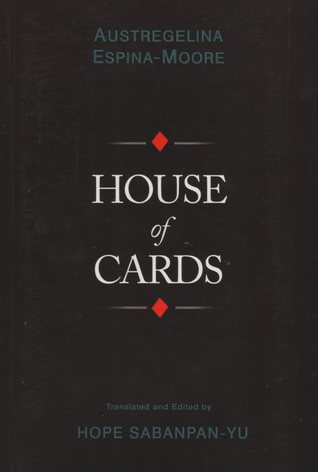
5. House of Cards, tr. Hope Sabanpan-Yu (National Commission for Culture and the Arts, 2013).

Austregelina Espina-Moore (aka Lina Espina-Moore) wrote several novels in Cebuano and three novels in English: House of the Lotus; A Lion in the House; The Honey, the Locusts. I have already read the three translations above and will probably post about them in this blog. They are all available from the Cebuano Studies Center.


Rosario de Guzman Lingat (1924-1997)


2529321820498352


6. The Death of Summer, tr. Soledad S. Reyes (De La Salle University Publishing House, 2013)

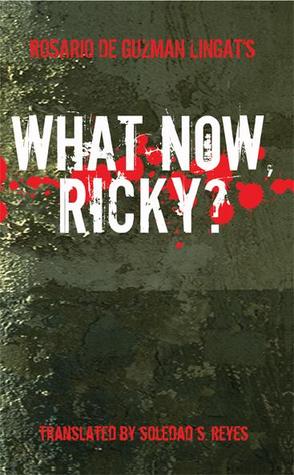
7. What Now, Ricky?, tr. Soledad S. Reyes (Anvil Publishing, 2013) 

20659135

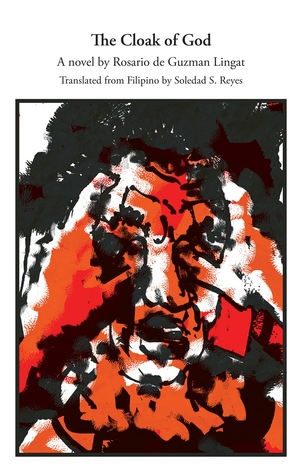
8. The Cloak of God, tr. Soledad S. Reyes. (De La Salle University Publishing House, 2013)

Lingat's novelistic voice was one of the most profound during the Marcos dictatorship. What Now, Ricky? [review] recently won for its translator Soledad S. Reyes the triennial award A.L. Becker Southeast Asian Literature in Translation Prize (yes, there's such an award). Reyes also wrote a biography of the writer, Rosario de Guzman Lingat, 1924–1997: The Burden of Self and History. An article by Reyes about Lingat's fiction can be read here (pdf).

Of the three translated novels, the best is probably The Cloak of God [review], which I also read in its original Tagalog.

Luna Sicat Cleto (1967-    )   

30174783

9. Typewriter Altar, tr. Marne L. Kilates (University of the Philippines Press, 2016)

Luna Sicat Cleto is the only contemporary Filipina novelist translated to date. The original work, Makinilyang Altar, appeared back in 2002. She also produced a second novel, Mga Prodigal (The Prodigals). Translator Marne L. Kilates is a poet and a seasoned translator of poems, notably the multiple poetry collections of Rio Alma.


I started reading it though I'm not sure if I can finish it within the month, let alone post something about it. Based on the first chapter alone, I believe this is worth translating and reading.


Women in Translation Month is initiated by Biblibio.


ANNEX. PHILIPPINE NOVELS IN ENGLISH TRANSLATION (AS OF 21 AUGUST 2016). 
NOTE: THE UPDATED LIST WILL BE UPLOADED HERE (EXCEL FILE).

No. Title Author Gender Translator Gender of Latest Primary Translator Original Language Pub. Year of Original Pub. Year of Latest English Translation
1 The Golden Dagger  Antonio G. Sempio Male Soledad S. Reyes Female Tagalog 1933 2016
2 La Oveja de Nathán (Nathan's Sheep)  Antonio M. Abad  Male Lourdes Castrillo Brillantes Female Spanish 1928 2013
3 Ang Inahan ni Mila (Mila's Mother) Austregelina Espina-Moore FemaleHope Sabanpan-YuFemaleCebuano1969-19702008
4 Diin May Punoan sa Arbol (Where a Fire Tree Grows) Austregelina Espina-Moore  Female Hope Sabanpan-Yu Female Cebuano 1960 2010
5 House of Cards Austregelina Espina-Moore  Female Hope Sabanpan-Yu Female Cebuano 1973 2013
6 Fort: A Novel Buenaventura S. Medina Male Buenaventura S. Medina Male Tagalog 1991 2006
7 Eight Muses of the Fall  Edgar Calabia Samar  Male Mikael de Lara Co & Sasha Martinez Male Tagalog (Filipino) 2008 2013
8 El Folk-Lore Filipino [vol. 1 of 2] Isabelo de los Reyes  Male Salud C. Dizon & Maria Elinora Peralta-Imson Female Spanish 1889 [vol. 1];
1890 [vol. 2]
1994
9 Ang Diablo sa Filipinas ayon sa nasasabi sa mga casulatan luma sa Kastila  Isabelo de los Reyes  Male Benedict Anderson, Carlos Sardiña Galache, & Ramon Guillermo Male Spanish 1886 2014
10 Noli Me Tangere  José Rizal Male various Male Spanish 1887 2006
11 El Filibusterismo José Rizal Male various Male Spanish 1891 2011
12 Orosa-Nakpil, Malate Louie Mar A. Gangcuangco  Male Carla Mae Sioson & Louie Mar Gangcuangco Female Tagalog (Filipino) 2006 2009
13 Typewriter Altar  Luna Sicat Cleto  Female Marne L. Kilates Male Tagalog (Filipino) 2002 2016
14 The Gold in Makiling  Macario Pineda Male Soledad S. Reyes Female Tagalog 1947 2012
15 The Lady in the Market  Magdalena G. Jalandoni  Female Edward D. Defensor Male Hiligaynon 1935 1976
16 Juanita Cruz  Magdalena Gonzaga Jalandoni  Female Ofelia Ledesma Jalandoni Female Hiligaynon 1966 2006
17 Nínay Pedro Alejandro Paterno  Male E. F. du Fresne Male Spanish 1885 1907
18 Margosatubig: The Story of Salagunting  Ramon L. Muzones  Male Edward D. Defensor [1979]; Ma. Cecilia Locsin-Nava [2012]
Female Hiligaynon 1946 2012
19 Shri-Bishaya Ramon Muzones Male Maria Cecilia Locsin-Nava Female Hiligaynon 1969 2016
20 What Now, Ricky?  Rosario de Guzman Lingat  Female Soledad S. Reyes Female Tagalog 1971 2013
21 The Cloak of God  Rosario de Guzman Lingat  Female Soledad S. Reyes Female Tagalog 1975 2013
22 The Death of Summer Rosario de Guzman Lingat  Female Soledad S. Reyes Female Tagalog 1969 2013
23 Driftwood on Dry Land   T. S. Sungkit Jr.  Male T. S. Sungkit Jr.  Male Cebuano unpub. 2013


11 December 2015

Favorite books 2015


My reading choices lately had been pretty much insular. For various reasons, I became interested in local (Philippine) literature in English and Tagalog. There's a very practical reason for this. The books were simply what's readily available and accessible to me in bookshops. Also, the postcolonial and postwar orientation of the books I've sampled was of great interest to me. I managed to make good headway on my two reading lists: the best Philippine novels of the last century and Filipino novels in English translation.

A subjective and flawed exercise, this singling out of books. Yet the obligatory post is quite enjoyable to write, if only to relive each specific reading experience, the beautiful flaws and obvious artifice of a well-made fiction. I selected eight novels as favorites this year. My only complaint about them is their ugly covers.


I probably have not read a finer Philippine novel in English in But for the Lovers by Wilfrido D. Nolledo. First published in 1970, it became extinct until miraculously resurrected in 1994 by Dalkey Archive Press. It is a fountainhead of creativity [not in any Ayn Rand sense, God forbid]. Surreal and savage scenes are interspersed with scenes of great hilarity and profundity. The large, multi-national cast of characters floats in a state of dreaming, half-waking, or in-between. The wartime set-pieces unravel in magical fashion. It's a powerful work of postcolonial perversity. Hyperbole does not give it justice.


After attending a party in a garden among socialites, the executive assistant of Imelda Marcos visited her estranged father. They argued about politics and the hot issues of the day. The father is a fervent critic of Marcos, the daughter does not care. In the end, both will be implicated in the New Society.

Linda Ty-Casper is perhaps the best living novelist from the Philippines, the one most deserving of winning the Nobel Prize for Literature. (F. Sionil José -- the supposedly best bet of this country -- simply does not cut it for me.) She had a rather cruel vision of failed history in A Small Party in a Garden (1988). In this short novel, the intersection of domestic personal conflicts with fractured official histories is narrated with uncompromising irony. In one unpleasant episode in the novel, historical forces, military and male, simply shatter and belittle any human effort for decency. A political novel that slaps the face of anyone who kept silent (i.e., almost everyone) during the Marcos regime.


The Hand of the Enemy (1962), the only novel written by Kerima Polotan, is a postwar novel of social corruption that anticipated the political stagnation during the years of dictatorship under Marcos. Herself a Marcos crony, Polotan is redeemed not by the probity of her characters but by their failings. There is an almost metaphysical representation of chance fate as the enemy, whose iron hand is a specter not to be trifled with. And yet the shadow of a false prophet leading his followers to perdition haunts these pages, like the would-be dictator. And like Linda Ty-Casper, the ardent anti-Marcos, Polotan the Marcos sympathizer makes palpable a very human, and evil, design in the institution of marriage and in the political structure of government.


The Cloak of God (1975) is the best of the three novels by Rosario de Guzman Lingat finally brought into English in recent years by her indefatigable translator and champion Soledad S. Reyes. Like The Hand of the Enemy, it analyzes corruption and degradation of spirit through its duplicitous main character, Felino Paras, a theater actor who accidentally became a religious leader. It has a parable-like quality in its treatment of religion as a source of salvation for the gullible masses, easily manipulated by the perfect performance of an actor who secretly lived in sinfulness and depravity. Maestro Felino perpetrated a massive fraud by brilliantly playing a double life, by naturally acting out the role of a religious leader. It is a role the artist is born to play. Wearing the cloak of God is the character's, as well as the novel's, performative act. And in the second act of the play, she will again subvert her own performance by switching roles and switching genres.


I couldn't readily decide which of the two novels by Tsushima Yūko I read this year to include in this list. Woman Running in the Mountains (1980) almost edged out Child of Fortune (1978) in terms of which mystified me the more. But the two are sister novels, both majestically translated by Geraldine Harcourt. There's a continuity in their themes and preoccupations. Both are portraits of an unwed, expecting woman in Japan, circa 1970s. The delicate progression of scenes in these novels reveals a portrait of an immediate family and a society almost unfit for bringing up children. Through challenges in their work stations and family relations, Tsushima's protagonists discovered small personal triumphs against personal doubts and insecurities. Her almost realist narratives are deepened by tensions arising from a wayward metaphor or a stray scene, a simple recollection or a brutal dream. Tsushima is a fixture in this blog and for good reasons.


All the Conspirators (1998) is Carlos Bulosan's posthumous detective novel, published 42 years after the author's death after being discovered among his papers. It exposes the deplorable actions of persons who collaborated with the Japanese enemy during the war and who betrayed their country and fellowmen in exchange for wealth and comfort during the Japanese occupation. This entertaining novel is accessible, full of action, and a fast read. But on the serious side, it provides a damning portrait of traitorous characters who sold out their souls by informing on freedom fighters. They are always waiting in the wings, these frigging collaborators.


And then there's this infamous 1915 Kafka story of magical transformation, Ang Metamorposis, in a recent Filipino translation. This is magical transformation in a cruel, terrifying way. The pathetic and noble struggle of Gregor Samsa against unjust power structures at work and in society is a reflection of the continuing class struggles of wage workers. A Marxist interpretation of the Kafkaesque may be inevitable, especially as it dramatizes how capitalism reduces the nuclear family to financial relations.


That's it for the year round up. Been a great year for badass reading.


29 May 2015

Reading list: Best 20th century Philippine novels in English


What are the 10 best Philippine novels written in English in the last century?

Who knows? For every subjective reader's list, there are always gaps and provocations. Any list will be faulted not for what's included but for what's excluded. But I expect more for what's included. Whatever. I offer the following list not to canonize or beatify. Not to spur discussions or debates (if anybody disagrees, please let him post his own perfect list), but to create a reading list for myself.

These are the books that I have read, partially read, or will read as I feel they offer something literary and lasting. I do not want a safe list or a predictable list, or a list of well-digested books. The three basic criteria are language, power, and technique. Perhaps I might be bothered to post another list of honorable mentions. But I suppose that secondary list will be more controversial for what were still excluded.

I want novels that go beyond place (Philippine setting or abroad), time (Second World War, Marcos regime), nationality of writer, and subject matter; though I find that the watershed for all of this novelistic creativity, the reference marker and benchmark, is the violence and injustice of the martial rule. This is an era that still has to yield "untold novels" of corruption and decadence. These are novels written before, during, and after the Marcos dictatorship.

These, I suspect, are novels worthy of their wasted words. They are "Philippine novels" because they are superficially about the Filipino experience. Their universal value is for anyone's judgement. The list is ranked, starting from what I consider to be the best of them.


Best 20th c. Filipino novels in English

But for the Lovers
The Peninsulars
America Is in the Heart
The Bamboo Dancers
State of War
The Hand of the Enemy
The Woman Who Had Two Navels
His Native Coast
Renegade or Halo2
Empire of Memory


Ryan's favorite books »


1. But for the Lovers (1970) by Wilfrido D. Nolledo

More dreamscape than novel, But for the Lovers is a linguistic aria of war and memory. Wilfrido D. Nolledo is an unjustly neglected writer in his own country where his works are not known or not even widely available. Aside from this novel, he completed two others in his lifetime. Sangria Tomorrow (1982) and 21 de agosto or Vaya con Virgo (1984) were winners both of the prestigious Palanca Grand Prize for the Novel. Both are mysteriously out of print.
 
2. The Peninsulars (1964) by Linda Ty-Casper

Linda Ty-Casper is probably the most qualified Filipino writer to win the Nobel Prize for Literature. Almost exclusively a historical novelist, she has produced a body of work that follows the template of history but with its own interpretive flair. In her novels about the turn of the century American occupation and the Marcos regime and its aftermath (Awaiting TrespassWings of Stone; Fortress in the Plaza; A Small Party in a Garden; DreamEden), she is an ardent historian not only of events but of human nature. The Peninsulars is set in the Spanish-occupied Manila in the 1750s, a prelude to the British invasion of the city in 1762. Also criminally out of print. 

3. America Is in the Heart (1946) by Carlos Bulosan

A Marxist novel based on the life of Carlos Bulosan, this "personal history" is a living document of racism and emigration. It is full of adventures and longing, full of despair and hope. What the narrator states in the title is succor for himself, in whatever country can take the place of America. In whatever welcoming place will unequivocally give him salvation and redemption, staking his hope in discovering this shelter for his wounded self. Any country one finds himself may reside in the heart. Bulosan shows why.

4. The Bamboo Dancers (1959) by N. V. M. Gonzalez

I read it earlier this year and can attest to its enduring literary value. In tracing the peripatetic journey of an artist (sculptor) in post-war America and Japan, mid-twentieth century, it just might offer a floating portrait of a floating artist in a culture-clashing world. Yet Gonzalez does not provide that totalizing portrait, only snapshots of a quest for a life of meaning, a life devoted not solely to art and beauty, perhaps to the elusive peace of mind. The Bamboo Dancers is the cosmopolitan counterpart, and a direct response, to his almost ethnographic A Season of Grace. I just might write a blog post on it.

5. State of War (1988) by Ninotchka Rosca

Sharp prose and biting irony characterize this novel about the Marcos regime. The forceful, language-driven delivery of the novel, and its surrealism, sets it apart from other works of the period. In this novel and in another (Twice Blessed) Rosca is a staunch satirist of political repression and greed. Her fictional state of war predates the confusing, kaleidoscopic countries of other writers abroad like Jessica Hagedorn (Dogeaters; Dream Jungle) and Merlinda Bobis (Fish-Hair Woman).

6. The Hand of the Enemy (1962) by Kerima Polotan

Accused of being a compromised writer during the Marcos regime (she wrote a biography of Imelda Marcos), Polotan's writing prowess is undeniable. In The Opposing Thumb: Decoding Literature of the Marcos Regime (1995), the critic Leonard Casper criticized her for writing under the cloud of dictatorship as if nothing was afoot. "Although her 1975 collection of essays, Adventures in a Forgotten Country, was filled with pleasant reminiscences ... nothing in it was confessional: she had managed to remove herself from the agony of her fellow Filipinos as if, indeed, she lived in a forgotten country." Notwithstanding her ties with Marcos, her novel The Hand of the Enemy is an unapologetic narrative of domesticity. Not a political novel for her in the traditional sense. Only gender politics.

7. The Woman Who Had Two Navels (1961) by Nick Joaquín

Joaquín calls himself a man who had two novels. (He actually wrote three, if one counts A Portrait of the Artist as Filipino, the quintessential Filipino text, an "elegy in three scenes" and a novel in the form of a play.) I almost chose the play just to rebel against form. But this novel set in Hong Kong is not just a 'proper' novel. Like everything Joaquín wrote, it is poetry in motion. This first novel is just an instance from a unitary body of work, from a constellation of greatness.

8. His Native Coast (1979) by Edith L. Tiempo

Tiempo is more appreciated as a poet. Her novels (The Builder; One, Tilting Leaves; The Alien Corn; A Blade of Fern) are played in minor key. What they always offer, however, is a reconfiguration of ideas about identity, duality, and finding a permanent sanctuary – a home, a dwelling place – for exiles. His Native Coast is representative of Tiempo's tortuous and spiritual engagement with a tortured psyche.

9. Renegade or Halo² (1999) by Timothy Mo

Timothy Mo is not even Filipino but here is the book anyway. I should maybe consider also other works written by foreigners and set in the Philippines, like Fires on the Plain by Shōhei Ōoka (originally in Japanese, however) or The Naked and the Dead by Norman Mailer (in a fictional setting, but based on Mailer's wartime experiences in the country) or Ghosts of Manila by James Hamilton-Paterson (certainly in the honorable mention list). Renegade makes the list just because it adds diversity to the list, like the halo-halo of the title. Like Mo's own divisive Brownout on Breadfruit Boulevard, like the disagreeable Mo Twister, this picaresque novel is something out of place.

10. Empire of Memory (1992) by Eric Gamalinda

Gamalinda (Planet Waves; Confessions of a Volcano; My Sad Republic) is arguably the best contemporary Filipino novelist, perhaps rivaled only by Gina Apostol (The Revolution According to Raymundo Mata; Gun Dealers' Daughter). His novels are as diverse as they are inventive. Empire of Memory is another Marcosian novel, an ubiquitous genre, but distinguished by its modernist-revisionist approach to history.

30 August 2014

A list of Philippine novels in English translation


The poet Gémino H. Abad, introducing his collection Care of Light: New Poems and Found (2010), believes that there is no English language, no Tagalog language, no Filipino language. "There is only one language—language itself. And that language is most manifest in our finest writers, whatever the provenance of their idiom. [1]" It is a refreshing position, a more open and more expansive position than the ultra-nationalist championing of a single national language.

The literary text, as language purposefully worked [sic], may be the clearest expression of one's sense of country; in that light, a poet's sense for language—whatever the language he has mastered—may be his most intimate sense of his country's landscape, and his people's lived lives.

For the writer, one's country is what one's imagination owes its allegiance to.

The "poet's sense of language" might as well be the novelist's, the playwright's, or the essayist's. A poetical work might be any literary work of great poetical sensibility and imaginative distinction, any carefully wrought feeling.

***

Abad's nationalist poetics is a particularly welcome position in a country of many languages and whose literary tradition is as linguistically diverse as its biological diversity. Philippine literature exists in dozens of languages (the estimate is 150). The traces of its Spanish and American colonial past are evident in the texts published in these languages. A lot of Philippine literary works in Spanish still await translation for the benefit of the present generation of readers.

The works produced in other Philippine languages (Bicolano, Hiligayon, Kapampangan, Ilocano, Cebuano, Kinaray-a, Cuyuno, etc.) also make apparent a cultural richness and literary minefield. Translation, obviously, is a critical specialization the country direly needs right now if it wants to introduce to the world its cultural and intellectual heritage. Sadly, a healthy dose of translation appears to be what the country sorely lacks.

There are currently 100 million Filipinos living in the planet, making the country the 12th most populous nation. A large proportion of them are speakers, readers, and writers of at least two languages: English and Filipino. But population only correlates with potential readers of translation, not with translation outputs. In fact, familiarity with English is probably a major reason why literary translation is ignored in the country. As a former American colony, it is not surprising that the production (and perhaps reception) of translation, from any language to English, is not thriving.

Translation is said to enrich the resources of a language or to deepen our appreciation of a language's strength and dynamism. These apply to both the target language and the source language. There remains, for instance, Filipino fiction in Spanish (which was still a major language in the country in the 19th up to the early 20th century) that remains to be translated. These period pieces can provide essential information (cultural, literary, philosophical) that can still illuminate aspects of the present.

Translation is probably an indicator of progressiveness in a society as it values openness to cultural exchange and free interplay of ideas. The state of translation in a country may, therefore, be indicative of its prospects of sustainable development. A healthy culture of translation can be an indicator of the values of tolerance and cosmopolitanism.

I want to talk about the production and publication of Philippine book translations not only in the Philippines but in other countries as well. But it is safe to assume that translations of Philippine literature outside the country is close to none (or downright non-existing). The database of Three Percent shows that from 2008 to present the number of translations from the Philippines or from the Filipino language published in the United States is zero. Wala. Nada.

But what exactly is the state of literary translation in the Philippines? In the past two years I have been fortunate to read and review selected locally published works that appear just recently in translation. I want to see what a reading list of translated Philippine literature would look like, specifically English versions of Philippine novels in any language.

I want first to focus on the English translations, apropos of the many translations of novels from several languages (local or international) into the vernacular Filipino (or Tagalog) and perhaps to other Philippine languages. Eventually, of course, to talk about translation culture in the Philippine setting is to include all possible target languages. A preliminary focus on English translations of Filipino novels makes for a rapid assessment of the health of Philippine translation because, as it turned out, there are only a handful available so far [2]. Probably only a few Philippine languages have a strong novelistic tradition.

***

The result of the listing exercise is pathetic really. The pitiable number of English translations of Philippine novels, the only novels that are potentially accessible to readers of world literature, makes it very necessary for the Philippine arts and literature establishment to develop aggressive programs that will incentivize translation and cultivate a strong interest in it among its local and international readers. In the first place, novel writing in the Philippines is probably not a very lucrative business. There are only a handful of published novels each year. As for short fiction, I can't think of any full length Filipino book translated into English.

At first I want to think that the low number of English-translated novels in the Philippines reflects more on my poor investigation since I only used online search, which really did not make a difference because the list consists of the very same ones I basically found in local bookstores in the past few years. Anyone with information about the titles I missed out, let me know though a comment to this post below.

Philippine Novels in English Translation: [Note: This post is updated only as of August 7, 2016. The updated list can be found at this link. The updated blog post can be found here.]

1-2. Noli Me Tangere and El Filibusterismo by José Rizal. These two revolutionary and political works in Spanish, published in 1887 and 1891, are the Bible of Philippine nationalism. They are widely translated. [3] There are multiple English translations of this book, the most important are probably the ones by Charles Derbyshire (1912, gothic/baroque style, dense vocabulary, probably the closest in flavor to the original 19th century diction, Faulknerian, in public domain), Leon Ma. Guerrero (1961/62, minimalist, Hemingwayesque), Ma. Soledad Lacson-Locsin (1997, romantic, Hemingwayesque, faithful to anger and subtle humor, recommended), and Harold Augenbraum (2006/2011, most recent, stiff). The 2011 Penguin edition of the Fili should appear in the Three Percent database but apparently retranslations are not counted.

3. The Gold in Makiling (2012) by Macario Pineda, tr. Soledad S. Reyes. A Filipino classic published in 1947, this magic realist love story is finally made available through this fine translation of Reyes, who is also a brilliant literary and cultural critic. [review]

4. What Now, Ricky? (2013) by Rosario de Guzman Lingat, tr. Soledad S. Reyes. A 1971 political novel about the tumultuous events leading to the declaration of martial law in the Philippines. Reyes is definitely a champion of translation. I do hope her translations of two other novels by Lingat would come out soon. [review]

5. Eight Muses of the Fall (2013) by Edgar Calabia Samar, tr. Mikael de Lara Co and Sasha Martinez. Originally published in 2008, this nonlinear coming of age novel contains metaphysical and metafictional qualities and references to local folklore. Here's hoping its young translators will pursue more novel translation projects in the future. [review]

6. Margosatubig: The Story of Salagunting (2012) by Ramon L. Muzones, tr. Ma. Cecilia Locsin-Nava. An epic adventure and fantasy novel from Hiligaynon language, first published in 1946. [review] There is an earlier translation of this book by Edward D. Defensor (Iloilo City: Visayan Studies Program, 1979).

7. La Oveja de Nathán (Nathan's Sheep) (2013) by Antonio M. Abad, tr. Lourdes Castrillo Brillantes. Originally in Spanish, this 1928 historical novel was written during the time when Spanish language was still widely taught and spoken in the country. Winner of the Premio Zobel (a literary prize established back in 1920), it is considered the Philippine War and Peace. I'm wary of the comparison. The book appears in a bilingual edition. [4]

8. Orosa-Nakpil, Malate (2009) by Louie Mar A. Gangcuangco; transliterators: Carla Mae Sioson and Louie Mar Gangcuangco. A novel dealing with the issues of HIV-AIDS and homosexuality through the erotic adventures of a young medical student. It was self-published in 2006 when the author was just 19 years old and it became a certified local bestseller a year later. [Wiki]

9. The Birthing of Hannibal Valdez (1984) by Alfrredo Navarro Salanga. The novella was actually written in English, appearing alongside its "Pilipino" translation. [5]

ADDITIONAL TRANSLATIONS:

9. El Folk-Lore Filipino (1994, orig. 1889) by Isabelo de los Reyes, tr. Salud C. Dizon and Maria Elinora Peralta-Imson. Translation of the first of two volumes of this classic work in Spanish. This may or may not be a novel, one of the Philippines' so-called "proto-novels".

10. The Cloak of God (2013, orig. 1975) by Rosario de Guzman Lingat, tr. Soledad S. Reyes. [publisher's page] [review]

11. The Death of Summer (2013, orig. 1969) by Rosario de Guzman Lingat, tr. Soledad S. Reyes. [publisher's page]

12. Ang Diablo sa Filipinas ayon sa nasasabi sa mga casulatan luma sa Kastila (The Devil in the Philippines according to ancient Spanish documents) (2014) by Isabelo de los Reyes, tr. Benedict Anderson, Carlos Sardiña Galache, and Ramon Guillermo. It's only a short story. [publisher's page] [two-part post]

13. Driftwood on Dry Land by T. S. Sungkit Jr. (2013), translated from Cebuano by the author. [news]

14. Nínay (1885) by Pedro Alejandro Paterno, translated from Spanish by E. F. du Fresne (1907). In The Pact of Biyak-na-Bato; and Nínay (National Historical Institute, 2004). The first Philippine novel. [wiki; article (pdf)] [review]

15. The Golden Dagger by Antonio G. Sempio, translated from Filipino by Soledad S. Reyes (De la Salle University Publishing House, 2016). Published in 1933 by Benipayo Press. [review]

16. Typewriter Altar by Luna Sicat Cleto, translated by Marne L. Kilates. [publisher's page] [review]

17. Ang Inahan ni Mila (Mila's Mother) by Austregelina Espina-Moore, translated by Hope Sabanpan-Yu (National Commission for Culture and the Arts, 2008). [review]

18. Diin May Punoan sa Arbol (Where a Fire Tree Grows) by Austregelina Espina-Moore, translated by Hope Sabanpan-Yu (USC Press, 2010). [post]

19. House of Cards by Austregelina Espina-Moore, translated by Hope Sabanpan-Yu (National Commission for Culture and the Arts, 2013).

20. Juanita Cruz by Magdalena Gonzaga Jalandoni, translated by Ofelia Ledesma Jalandoni (University of the Philippines Press, 2006). [review]

21. The Lady in the Market by Magdalena G. Jalandoni, translated by Edward D. Defensor (U.P. College of Iloilo, 1976).

22. Shri-Bishaya by Ramon Muzones, translated by Maria Cecilia Locsin-Nava (New Day Publishers, 2016). [publisher's page] [review]

Short Story Collections by a Single Author in English Translation

1. Love in the Rice Fields and Other Short Stories by Macario Pineda, tr. Soledad S. Reyes (Anvil, 2016). [publisher's page]

2. Men at Sea and other stories by Gremer Chan Reyes, tr. Hope Sabanpan-Yu (National Commission for Culture and the Arts, 2009).

3. Crack Shot and Other Stories by Ernesto D. Lariosa, tr. Hope Sabanpan-Yu (USC Press, 2010).

4. Reawakened Bliss by Gardeopatra Quijano, tr. Hope Sabanpan-Yu and Haidee Emmie K. Palapar (USC Press, 2011).

5. Hunger in Nayawak and other stories by Lamberto Ceballos, tr. Hope Sabanpan-Yu and Trizer Dale Mansueto (USC Press, 2012).

6. Because Love Is Not Blind by Temistokles M. Adlawan, tr. Merlie Alunan (National Commission for Culture and the Arts, 2012).

That's it: nine novels. Not even a round ten. Four from Tagalog, three from Spanish, one from Hiligaynon, and one other (contestable) from Tagalog. There are many factors for this dull performance; not least of them is, as mentioned, the lack of Philippine novels to be translated in the first place.
 
The fact that these novels practically appeared in the 2000s—in the last five years, to be precise—shows that English translation in the country is a recent phenomenon. Considering that English language has been used in the country for more than a century now, it's a bit puzzling why novel translation has not been cultivated.

The consolation, if there's any, is that there's no other way but up. Translation is starting to be recognized and the market for it is starting to respond to some hidden and positive Jedi forces. (For instance, the emergence of "outsourcing" culture in the country can be an opportunity to be tapped, representing a large audience of readers out there.)

It is clear that translation work in the country still has to peak and to make its important presence felt. There is a compelling need for the mainstreaming of translation in the local literary scene, for a massive information drive on the tangible and intangible benefits of translation, including the enrichment of languages and culture. With a disappointingly few titles to show for it, I am thinking of posting on something with more competitive choices, say, The 10 Best Philippine Classic/Contemporary Novels in English or The 10 Best Philippine Novelists or 20 Under 40 and such-like.

***


Notes:

1. Gémino H. Abad. "The Poem Is the Real: A Poetics". Introduction to Care of Light: New Poems and Found (Anvil, 2010).

2. At the back of my mind, there's also Nick Joaquín advocating for Filipino writers to engage in long form fiction writing, instead of concentrating on and perfecting a small short story. "By limiting ourselves to the small effort, we make ourselves less and less capable even of the small thing," he writes in Culture and History (1988; reprinted 2004). For Joaquín, the novel is the mark of ambition, the bold enterprise, the heroic effort. "Many little efforts, however perfect each in itself, still cannot equal one single epic creation. ... [Y]ou could stack up all the best short stories you can think of and still not have enough to outweigh a mountain like War and Peace." Eventually though, I would like to consider translations of Philippine lit in other genres (poetry, drama, non-fiction, YA).

3. Noli and Fili probably vies with Dusk [Po-on] by F. Sionil José as the most translated Philippine novel.

4. I would have wanted to include in the list the Oleza novels by Spanish writer Gabriel Miró, Our Father San Daniel and The Leprous Bishop, mainly because the translator, Marlon James Sales, is Filipino.

5. If a novel in English is later translated into another language, say, Filipino or any other Philippine language, then the fact that it exists in two languages means that one is a translation of the other. Can we then say the reverse: that the original is a translation of its translation? Ah, not to sound Borgesian, this effect of double-sided mirrors.

I want to say, for example, that once the classic autobiographical novel America Is in the Heart by Carlos Bulosan is finally translated by Carolina Malay and Paula Carolina S. Malay as Nasa Puso ang Amerika and when The Lady in the Market by Magdalena G. Jalandoni finally appears in Tagalog as Dalaga sa Tindahan, the original novels practically become the living translations of the English versions! I am here following (distorting) the 'precursor concept' of Borges: that every writer creates his own precursors. Hence, every translation creates its own translation (in the form of the original!).

Whatever. There are more than 60 foreign and local literary novels translated into Tagalog/Filipino. I should post something about them too.


Update (Sept. 2021): Follow up post and updated bibliography can be found at these links: 

Bibliography of Philippine novels in English translation, 2  

Bibliography of Philippine novels in English translation (Google doc)