01 August 2016

Women in Translation Month: Novels from the Philippines


Women in Translation (WIT) Month, celebrated every August, is an opportunity to take stock of one's reading habits and focus on the women. I once made a survey of novels translated from Philippine languages. The list has since grown (see Annex below). This post enumerates the Filipina novelists who were already translated. So far, their number could only be counted by the fingers of two hands.

First, some general statistics:

  • To date, a total of 23 novels were translated from Spanish or a Philippine language into English. 
  • Majority of the English translations (and retranslations)—86% (20 out of 23 novels)—appeared only in the last 10 years (2006-2016).
  • All English translations save for the two José Rizal novels (91%) were published and distributed in the Philippines. Hence, they can only be accessed by a small readership. The novels of Rizal are available in Penguin Classics edition. A very limited number (3 or 4) are available in a digital format (Kindle or Kobo).
  • Looking at the publication year in original language, 10 of the novels were published in original language between 1885 to 1947, eight of them appeared after the war (1960-1975), and only five (21%) were by contemporary novelists (1991-2013). 
  • Only four languages were represented: nine were translated from Tagalog/Filipino; six from Spanish; and four apiece from Cebuano and Hiligaynon.

Gender-related statistics:

  • Of the 23 translations into English, nine (39%) are by women novelists.
  • The 23 translated novels were written by 15 individuals, only four (26%) of whom were women.
  • About 60% of the "primary and latest" translators were women.  
  • Of the nine novels by women, seven (77%) were translated by women. 
  • The novels by women were translated mainly from Tagalog (4), Cebuano (3), and Hiligaynon (2). None were translated from Spanish.


9 TRANSLATED NOVELS BY WOMEN WRITERS FROM THE PHILIPPINES


Magdalena G. Jalandoni (1891-1978)

15817201

1. Juanita Cruz, tr. Ofelia Ledesma Jalandoni (University of the Philippines Press, 2006). 

2. The Lady in the Market, tr. Edward D. Defensor (U.P. College of Iloilo, 1976). 


Jalandoni was a very prolific female writer in Hiligaynon language. She also wrote in other languages and was considered a proponent of feminism. I recently bought a copy of Juanita Cruz, translated by her niece. The Lady in the Market was out of print and only available in libraries.

Austregelina Espina-Moore (1919-2000)

3016849630168559

3. Ang Inahan ni Mila (Mila's Mother), tr. Hope Sabanpan-Yu (National Commission for Culture and the Arts, 2008).

4. Diin May Punoan sa Arbol (Where a Fire Tree Grows), tr. Hope Sabanpan-Yu (USC Press, 2010). 
18749517 


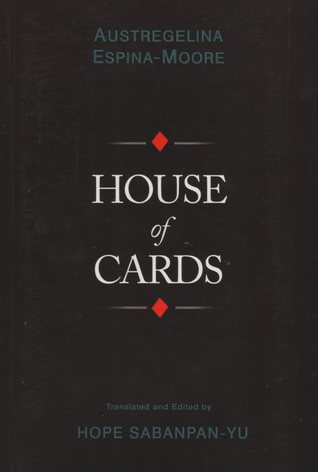
5. House of Cards, tr. Hope Sabanpan-Yu (National Commission for Culture and the Arts, 2013).

Austregelina Espina-Moore (aka Lina Espina-Moore) wrote several novels in Cebuano and three novels in English: House of the Lotus; A Lion in the House; The Honey, the Locusts. I have already read the three translations above and will probably post about them in this blog. They are all available from the Cebuano Studies Center.

Rosario de Guzman Lingat (1924-1997)


2529321820498352


6. The Death of Summer, tr. Soledad S. Reyes (De La Salle University Publishing House, 2013)

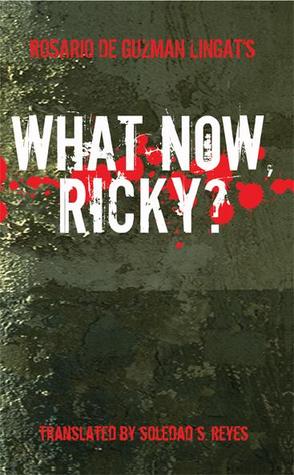
7. What Now, Ricky?, tr. Soledad S. Reyes (Anvil Publishing, 2013) 
20659135

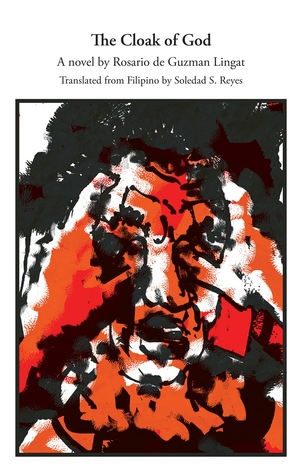
8. The Cloak of God, tr. Soledad S. Reyes. (De La Salle University Publishing House, 2013)

Lingat's novelistic voice was one of the most profound during the Marcos dictatorship. What Now, Ricky? [review] recently won for its translator Soledad S. Reyes the triennial award A.L. Becker Southeast Asian Literature in Translation Prize (yes, there's such an award). Reyes also wrote a biography of the writer, Rosario de Guzman Lingat, 1924–1997: The Burden of Self and History. An article by Reyes about Lingat's fiction can be read here (pdf).

Of the three translated novels, the best is probably The Cloak of God [review], which I also read in its original Tagalog.

Luna Sicat Cleto (1967-    )   

30174783

9. Typewriter Altar, tr. Marne L. Kilates (University of the Philippines Press, 2016)

Luna Sicat Cleto is the only contemporary Filipina novelist translated to date. The original work, Makinilyang Altar, appeared back in 2002. She also produced a second novel, Mga Prodigal (The Prodigals). Translator Marne L. Kilates is a poet and a seasoned translator of poems, notably the multiple poetry collections of Rio Alma.


I started reading it though I'm not sure if I can finish it within the month, let alone post something about it. Based on the first chapter alone, I believe this is worth translating and reading.


Women in Translation Month is initiated by Biblibio.


ANNEX. PHILIPPINE NOVELS IN ENGLISH TRANSLATION (AS OF 21 AUGUST 2016). 
NOTE: THE UPDATED LIST WILL BE UPLOADED HERE (EXCEL FILE).

No. Title Author Gender Translator Gender of Latest Primary Translator Original Language Pub. Year of Original Pub. Year of Latest English Translation
1 The Golden Dagger  Antonio G. Sempio Male Soledad S. Reyes Female Tagalog 1933 2016
2 La Oveja de Nathán (Nathan's Sheep)  Antonio M. Abad  Male Lourdes Castrillo Brillantes Female Spanish 1928 2013
3 Ang Inahan ni Mila (Mila's Mother) Austregelina Espina-Moore FemaleHope Sabanpan-YuFemaleCebuano1969-19702008
4 Diin May Punoan sa Arbol (Where a Fire Tree Grows) Austregelina Espina-Moore  Female Hope Sabanpan-Yu Female Cebuano 1960 2010
5 House of Cards Austregelina Espina-Moore  Female Hope Sabanpan-Yu Female Cebuano 1973 2013
6 Fort: A Novel Buenaventura S. Medina Male Buenaventura S. Medina Male Tagalog 1991 2006
7 Eight Muses of the Fall  Edgar Calabia Samar  Male Mikael de Lara Co & Sasha Martinez Male Tagalog (Filipino) 2008 2013
8 El Folk-Lore Filipino [vol. 1 of 2] Isabelo de los Reyes  Male Salud C. Dizon & Maria Elinora Peralta-Imson Female Spanish 1889 [vol. 1];
1890 [vol. 2]
1994
9 Ang Diablo sa Filipinas ayon sa nasasabi sa mga casulatan luma sa Kastila  Isabelo de los Reyes  Male Benedict Anderson, Carlos Sardiña Galache, & Ramon Guillermo Male Spanish 1886 2014
10 Noli Me Tangere  José Rizal Male various Male Spanish 1887 2006
11 El Filibusterismo José Rizal Male various Male Spanish 1891 2011
12 Orosa-Nakpil, Malate Louie Mar A. Gangcuangco  Male Carla Mae Sioson & Louie Mar Gangcuangco Female Tagalog (Filipino) 2006 2009
13 Typewriter Altar  Luna Sicat Cleto  Female Marne L. Kilates Male Tagalog (Filipino) 2002 2016
14 The Gold in Makiling  Macario Pineda Male Soledad S. Reyes Female Tagalog 1947 2012
15 The Lady in the Market  Magdalena G. Jalandoni  Female Edward D. Defensor Male Hiligaynon 1935 1976
16 Juanita Cruz  Magdalena Gonzaga Jalandoni  Female Ofelia Ledesma Jalandoni Female Hiligaynon 1966 2006
17 Nínay Pedro Alejandro Paterno  Male E. F. du Fresne Male Spanish 1885 1907
18 Margosatubig: The Story of Salagunting  Ramon L. Muzones  Male Edward D. Defensor [1979]; Ma. Cecilia Locsin-Nava [2012]
Female Hiligaynon 1946 2012
19 Shri-Bishaya Ramon Muzones Male Maria Cecilia Locsin-Nava Female Hiligaynon 1969 2016
20 What Now, Ricky?  Rosario de Guzman Lingat  Female Soledad S. Reyes Female Tagalog 1971 2013
21 The Cloak of God  Rosario de Guzman Lingat  Female Soledad S. Reyes Female Tagalog 1975 2013
22 The Death of Summer Rosario de Guzman Lingat  Female Soledad S. Reyes Female Tagalog 1969 2013
23 Driftwood on Dry Land   T. S. Sungkit Jr.  Male T. S. Sungkit Jr.  Male Cebuano unpub. 2013


31 July 2016

Unforeseen shadows: Nínay by Pedro Paterno


"Nínay" by Pedro A. Paterno, tr. E. F. du Fresne, in The Pact of Biyak-na-Bato and Ninay (National Historical Commission of the Philippines, 2012)


In 18_ the cholera waged havoc in Manila. Corpses were hurled in heaps into the fosses. The road to the cemetery, formerly so solitary and lone, was now the way most frequented. In spite of friendly counselings and official restrictions, relatives and friends accompanied the remains of their dear ones to their last resting place.

One afternoon, just as I had left a home which had been invaded by this Asiatics malady, I saw, on the road to the cemetery, a feeble old man able scarcely to creep along, bent by his years than by the intense grief that weighed upon him.

Written in 1885, Nínay by Pedro Paterno was considered the first Philippine novel and the first Asian novel in Spanish*. Other long prose works in Spanish and Tagalog that came before it and were published in the Philippines were classified as "proto-novel." This latter type of novel—e.g., Doctrina Christiana (1593), Pagsusulatan nang Dalauang Binibini na si Urbana at ni Feliza (1864), Si Tandang Basio Macunat (1885)—were written by clerics and dealt with overt religious exercises or political tract.

What Nínay shared with its narrative precursors was the didactic tradition of novel writing in the Philippines which carried over well into the 20th century in novels written in both English and Tagalog (or Filipino). The novela tagala was subtitled "costumbres filipinas." Indeed, it described Philippine customs and the culture of the Tagalog people. The English version was published in Manila in 1907, and it was dedicated to Mrs. William H. Taft. By that time, our chameleon-like novelist was sucking it up to the new colonial masters.

The novel's didactic tendencies of preaching the native customs were combined with the modern, romantic and—surprisingly in one telling chapter—magical realist tradition. It was a cultural guidebook or tourist brochure.

It is timely here to explain to the reader about the ancient Philippine custom called the Pasiám.

Whenever a person dies, his family receives donations to defray the expenses for the interment. There is no relative or friend who forgets this obligation; he who is unable to meet it with money gives his personal services. The house of the deceased is never closed during the first nine days in order that all the friends and relatives may come; those who live close at hand, in the city, and those from the Provinces.

Without doubt grief returns with greater intensity during the shadows of the night, thus at the close of the day the friends gather at the afflicted home to divert the grief of the family, accompanying them in their prayers and afterwards, gathering in circles to recall the laudible [sic] deeds of the departed one; to recount the history of our sunny isles, their stories and their legends, and the thousand poetical thoughts that console the spirit. At midnight all is ended with the accustomed supper and shortly thereafter those who live in the vicinity repair to their homes, and those from afar retire to rooms in the home of the deceased or, if the size of the house does not permit, they are lodged at the homes of some friends.

The deceased was our heroine Nínay, full name: Antonina Milo y Buisan. During the course of the nine-day vigil of Pasiám (or Pasiyam; siyam is the Tagalog word for nine), the life and love of Nínay was recounted by a young man named Taric to the unnamed narrator, a self-confessed "lover of our [Philippine] customs" who was most likely an ilustrado, an educated Filipino who came back to his home country after a period of study abroad. There are narratorial intrusions into Taric's narrative which I am not sure if made by Taric himself or our anonymous narrator. The perspective adopted was that of a tour guide explaining local culture to outsiders: "Keeping in mind that there were present several persons who recently arrived in Manila and were entirely ignorant of the details of our country and our customs, he proceeded in detail as far as possible, as if he were relating the story to the Europeans only."

Sure enough, in every turn of scene in the story, every nugget of wisdom about the customs and traditions of the Philippine islands was related to the hapless Westerners.

After the prayer, as is customary in the Philippines, all those belonging to the household saluted Don Evaristo as head of the family and Doña Carmen took advantage of this occasion to deliver to her hosts the pasalubong, or presents, which the visitors always bring to their old friends.

"How but in custom and in ceremony / Are innocence and beauty born?" asked Yeats rhetorically in "A Prayer for My Daughter," a line that Nick Joaquín used as epigraph in his famous play. Joaquín shared with Paterno, his precursor, a deep-seated Philippine Hispanism. In this novel, culture was a blend of Tagalog and Spanish mores, within the matrix of the Filipino and the Indio.** In the novel too could be seen the forerunners of José Rizal's characters in Noli Me Tangere (1887): Nínay (Maria Clara), Don Carlos (Juan Crisostomo Ibarra), and Berto (Elias).

Over the course of nine nights of the novena (the nine chapters of the novel that follow) the story heard by the narrator and the European listeners was that of a fiery love affair between Nínay and Don Carlos Mabagsic, a very wealthy heir and landlord. It was love in the time of cholera, with two rivals and two jealousies strategically deployed to make the journey of the young lovers more dramatic and melodramatic. The story was in Paterno's patently rich and ornate prose, full of native color (costumbres).

In the middle of this spacious hexagon was a fountain which filled the air on all sides with the sweet murmurs of its cool waters. All was joyful. The dreamy ideas, the angelical fancies of Ninay had communicated an enchantment to all these objects. The very atmosphere exhaled poetry. It was not strange then that the little birds, attracted hither by the enchantment as well as by the solitude of the spot during the remainder of the day in which the young girl was at Santa Cruz, selected this site for the building of their nests and the singing of their loves. Here Ninay searched for the secret for the involuntary emotions and thought to find it in the atmosphere impregnated with the perfumes of an eternal spring-time. Here, full of kindness and of puerility she dreamed of happiness and embroidered the veil of her future with one continual festival. Here, in short, the two amorous lovers found their paradise. Is it necessary to describe the delight of Carlos in this grateful solitude by the side of his beloved, listening to the murmur of the fountain, and the song of the birds; hearing each branch converted into a throbbing heart by the wind; each flower turned into an incensory of sweet aromas; each plant into a spray of flowers?

The sigh was almost audible in that passage. Consider another.

It is impossible to bid farewell to the city of one's birth without suffering a bitter sorrow. It is impossible to say adieu to the dear fatherland without the falling of a tear, and if in the city is an adored and saintly being; if in the fatherland are sincere and loyal friends, then in truth shall the hot bitter tears of the wanderer mingle with the bitter waves that bear him away from all that is dear to him.

That was the introductory passage of Taric's narrative in the penultimate chapter, during the eighth day of the Pasiám), the chapter elevated the novel from mere romanticism and costumbrismo. Certainly topping the previous poetical murmurings of the love story between Nínay and Carlos and the evil machinations of their rivals in love to keep them apart, here in this chapter we have the most revealing, surprising, and action-filled chapter in the story. Marooned in an island after being given up for dead in the raging storm at sea, Carlos was separated from Nínay. He survived and found himself rescuing a woman fleeing a band of fierce savages.

A woman with unloosened hair, followed by a group of ferocious savages broke from the midst of the conflict. Terror lent speed to her feet and rapidly she approached the spot where Carlos was standing. He, moved by a generous impulse, took up the defense of the helpless, pursued woman and arming himself with two rocks of granite, with an unerring blow hurled down the foremost of her pursuers. He tore the saber and spear from the prostate man and, with these, defended himself, finally putting the savages to flight as a whirlwind scatters a heap of dead sere leaves.

The saber was a venerated one; it had counted a thousand victims and now, for the first time, had met defeat and disgrace. It was analogous to those used by the Bertas, a nomadic people of the upper Nile. Schweinfurth has represented it in the hand of the famous Mounza, king of the Mombouttons. The spear is decorated with the pointed teeth of the shark. The fallen man was the king of the invading tribe and his death had caused his followers to flee terror stricken.

The woman, Tik, turned out to be the queen of the island. Carlos was implicated in a fast-paced adventure story involving a queen and her tribe in an island loaded with treasures from various lands and many savage enemies coming and circling it to conquer the queen. With Carlos gaining the approval of the tribe by saving their queen, his ascension as king and defender of the island was as if foretold by the oracle Pythia.

Given what came before, we now came to the turning point of the story, the problematic chapter that defined what it was that was utterly modern in a novel and what it was that transports a reader of fiction to a magical place. From a love story during colonial times to a love story that was almost a parody of the noble savage. From customs and ceremonies of the civilized, the reader was thrust into the rituals and rites of fighting warriors in an isolated island. The switch in the setting and genre of the story was a tone shift too off-kilter to take for granted. The absurd trinkets and ornaments cribbed from all over the world—the general absurdity in fact of this island sojourn—were opening the text to many-worlds interpretation.***

They presented him, as trophies of victory, pieces of human flesh, a shield made from the skin of the elephant and which resembled the Roman scutum, a Moorish poniard and a khouttar with its scabbard of serpent skin; and with mysterious phrases the queen bestowed upon him the graceful plumes of the ostrich to wear upon his head as a recognition of valor. They were nude, except for the girdles of leaves which they wore and their hats which were of the richest variety. Some fashioned from the skins of the monkey, the antelope and the tiger and some woven from the leaves of the palm, while still others were of tails and beautiful feathers. In their hands the warriors bore arrows and bows, spears, sabers, and battle axes some of which were similar to those seen in the hands of certain Thevian warriors in the paintings of Bet Oually.

If in his memoirs on the pact of Biyak-na-Bato, Paterno came across as a hungry political animal, in Nínay he was a transporting novelist of magical absurdism. The winds of fortune changed so fast that the bittersweet reunion of the two lovers after Carlos's bloody island wars was almost anticlimactic though no less full of pathos.

The thread of our existence is woven, in part by chance, in part by design and plan. This obeys our will that dominates and commands us; the one seeks the light that lies in our path; the other drags us into unforeseen shadows. Happy are the hearts that are tempered to receive the blows of Fortune.


*An extensive reading of Nínay can be found in the award-winning The Magellan Fallacy: Globalization and the Emergence of Asian and African Literature in Spanish by Adam Lifshey (University of Michigan Press, 2012). According to Lifshey, Nínay was heavily footnoted in the original Spanish. The footnotes were eliminated in the English (this) and Tagalog translations. See also "The Spirit of Nínay: Pedro Paterno and the First Philippine Novel" by Eugenio Matibag, in Humanities Diliman.

**The novel constantly referred to "Indian" peoples (e.g., "some of the most aristocratic Indian families", "merry groups of young Indian maidens", etc.). This could be a mistranslation as it is a literal rendition of Indio, a racial (often derogatory) Spanish term describing persons native to the Philippines during the Spanish occupation.

**"Many-worlds interpretation implies that all possible alternate histories and futures are real, each representing an actual "world" (or "universe")." As applied to this work of fiction, this could mean the building of an alternate universe within a universe. "The hypothesis states there is a very large—perhaps infinite—number of universes, and everything that could possibly have happened in our past, but did not, has occurred in the past of some other universe or universes."


For Spanish Literature Month, organized by Stu and Richard.


29 July 2016

The horrible noise of struggles: Two works of fiction by Pedro Paterno


The Pact of Biyak-na-Bato and Ninay by Pedro A. Paterno, translated from Spanish by National Historical Institute and E. F. du Fresne (National Historical Commission of the Philippines, 2012)


My situation is most lamentable. I am dragged by my love for my own country and my love for Spain. I am anxious to see them united in divine abundance of love, in the sweetest kiss of alliance and peace. One, for making me a poet when it swing my cradle to the cooing sounds of the rivers, the winds, and the moon. Its flowers intoxicated me with the aroma of honey and its volcanoes gave my soul the fire of patriotism. The other one, for being the mother, the second mother, who stretched out her arms to subdue my soul against her soul and gave me the most beautiful flower from among its most beautiful gardens, no other than the woman whom I adore, the woman that has loved me. The unforgettable woman that now sleeps under some sampaguita flowers—my wife and my soul!

Here was a running joke made by Filipino historian Ambeth Ocampo in his preface to the omnibus edition of two novels by Pedro A. Paterno (1857-1911). The first, The Pact of Biyak-na-Bato (1910), hardly qualified as a novel, let alone a literary work. It was a historical document; but in terms of imaginative retelling, it was a historical hoax, in the same league as the Code of Kalantiaw. Paterno was infamous as a turncoat, what was locally referred to as a balimbing, a native starfruit (Averrhoa carambola) famous for having many sides and edges. A person called balimbing had no principles, no scruples, no convictions. He was a political butterfly, able to change sides and loyalties depending on which master he answers to. In the case of Paterno, he epitomized the colonized imagination, so blinded by power and ambition that he became the pawn of the Spanish government.

I was disposed to sacrifice my well-being, the comforts of my home, and even my own life for my adorable country which I idolized and venerated since childhood.

Self-aggrandizement and self-congratulation characterize his narrative of how he negotiated for the Philippines and Spain to come down to an agreement (pact). His one-sided account—of how he persuaded the revolutionary government of the Philippines (led by Emilio Aguinaldo, the alleged first president of Philippine Republic) to lay down its arms and to arrive at a compromise with the Spanish authorities—is full of color and embroidery. Flowery, ornate, highfalutin, grand garnishing of history—Paterno's novel of the pact had hardly no room for fact. Its descriptions came down to the quantified excess of self-congratulation, to the thousandfold thousand and the hundredfold hundred.

Finally, we arrived in the province of Bulacan after a thousand hardships; the woody Bulacan, so rich and beautiful called the Garden of the Philippines.
...
Anyway, the cargadores who transported me are the same sandatahan [army] who have been so heroic in the thousand episodes of their lives and are related sotto voce in this war for the independence of the motherland.

I lost my thought in a hundred varying ideas and my heart was agitated by a thousand encountered sentiments.
...
The General who have heard my name mentioned a thousand times by his brother, Jose, spoke to me lovingly and with respect.
...
"... confiscating our lands from us and hurling a thousand horrors on our faces?"
...
"A thousand times, no! Sr. Paterno, you must not tire yourself."
...
I took all the necessary precautions even if I smiled before these false alarms ... manifesting the favors to persons who gave me a thousand assistance in those days, except revealing the most intimate secrets which I swore to keep.
...
In all these provinces, I encountered a thousand obstacles ...

These thousand instances: I am not sure if this was a common expression in those times but this was like a thousand betrayals of usage.

The aspiration for peace at the cost of independence was at the center of all armed struggles, the perpetual conflict between the pen and the sword. As the emissary of the Spanish government, Paterno sought for a peaceful resolution by dissuading the Filipino revolutionaries from continuing their struggle and their demand for reforms and independence purportedly because "it would be impossible to uproot in one day what has taken roots for more than three centuries."

Speaking in a eulogy for a fallen rebel, Paterno's speech was still on point.

"All the revolutions of the world are, and have been, ill-fated. We ask for independence because we need it, like the air we breathe in a legitimate manner. Intellectuals and wealth abound in our country that we may be able to aspire for our own form of government. We should throw away our guns far, far away. Fire devastates, desolates. What we need is order and unity.

"Unity and order so that tears would not gush out with force from the eyes as on this occasion when we are just starting to taste the gall of its error. ... Because this one does not give anything but bitter disappointments. Because this is a tree bearing distasteful fruits, for there is more power, a thousand more powers in the valor of an idea than in the idea of force."

He was a brilliant devil's advocate and speaker, it had be admitted. In any case, Don Pedro's undisguised humility and crafty sincerity could be brilliant or disgusting, depending on how one looks at it.

What painful lesson the present people of the Philippines can take away from this memoirs of a diplomat—together with all the pacts, treatises, agreements, protocols, and suchlike incorporated word for word within this document—was that the price of anything, including revolution, was ultimately determined by the currency of money. When the topic was money to buy everlasting peace and order, one could hear thirteen pieces of silver exchanging hands. Although the novelist thought that he embodied a different character.

I think more of my present sad situation [as] that of being caught in the middle, at the mercy of two cross fires and I ask myself if I should be one of those saviours who would come out crucified.

This, for a turncoat, was the greatest sugarcoating. He manipulated every aspect of his image. And he even had his funerary rites planned out.

In return, I do not ask or expect anything but [a] handful of sampaguita flowers for my tomb, a smile from my dear country, and may a cover to my coffin with the banner kissed by my own lips three times. Even in the high peaks of Biyak-na-Bato or in its plains, the sound of the crackling winds along with the horrible noise of struggles could be heard.

How much indemnity does one receive to become a sellout and a turncoat? A banner? A smile in a grave? Our historical novelist was enacting a farce that he honestly believed in.

He would like to be judged by posterity, and posterity will judge Señor Paterno's role as intermediary and negotiator for Spain. At a time when the Spanish government's hold on the Philippine islands is beginning to slip away by the end of the 19th century, it was hard to discern whether Paterno's role in Philippine history was essential or unnecessary. A product of two contending cultures, he certainly brought out the best and the worst in a nationalist. He had a role to play, right before the arrival of a new country to negotiate with, new masters with the same grand colonial design, the Americans taking up the White Man's burden. The arrival of USA to replace the old, refined conquerors actually made the pact all water under the bridge.

Paterno's second work of fiction, Ninay (1885), was an actual and proper novel, in fact the first novel by a Filipino. I should maybe write about this equally astonishing work.


For the Spanish Literature Month—extended until Agosto—by Stu and Richard.


24 July 2016

La memoria de Shakespeare


"Shakespeare's Memory" (1983) in Collected Fictions by Jorge Luis Borges, tr. Andrew Hurley


What if you are to be gifted with the memory of Shakespeare, the bard, the playwright, the inventor of the human? Wrong question, maybe. What if you are to be cursed with the memory of Shakespeare, the poet, sonnet writer, inventor of postmodern consciousness? The possibility alone is disorienting. The sudden rush of literature sickness or vertigo must be enough to tempt the reader.

The story can be told very briefly. It begins in the East, in a field hospital, at dawn. The exact date is not important. An enlisted man named Adam Clay, who had been shot twice, offered me the precious memory almost literally with his last breath. Pain and fever, as you know, make us creative; I accept his offer without crediting it—and besides, after a battle, nothing seems very strange. He barely had time to explain the singular conditions of the gift: The one who possesses it must offer it aloud, and the one who is to receive it must accept it the same way. The man who gives it loses it forever.

The narrator accepted the memory and, like anyone who entered into a Faustian contract, paid the consequences. It is analog memory after all, full of subjective fantasies and objective myths. Professor Emeritus Herman Sörgel, former soldier and now a librarian, is writing the story in 1924. No external hard drives or Universal Serial Bus for memory storage yet. The human brain as giddy receptacle or canister for encyclopedic knowledge, for metaphors and puns, word plays and play words, is just as unreliable as the psyche of Hamlet or of the King of Scotland.

No one may capture in a single instant the fullness of his entire past. The gift was never granted even to Shakespeare, so far as I know, much less to me, who was but his partial heir. A man's memory is not a summation; it is a chaos of vague possibilities. St. Augustine speaks, if I am not mistaken, of the palaces and the caverns of memory. That second metaphor is the more fitting one. It was into those caverns that I descended.

Memory—pale representation of reality—is indefinite. It can betray, as it often does, even the most ardent seeker of knowledge. It cannot strive for comprehensiveness or clarity. It glosses over things. It elides the specific and offers platitudes. The story is full of them: "The exact date is not important"; "such specifics are in fact vaguenesses"; "an undistinguished place that might have been any pub in London." The whole premise is open to interpretation, just like the gift received.

By being Shakespeare, the professor cheats by looking ahead at the solution to the crossword puzzle instead of wrestling with the tragedies and comedies themselves. Where is the challenge in that? The unattainable is suddenly within reach. Or so he thought.

I realized that the three faculties of the human soul—memory, understanding, and will—are not some mere Scholastic fiction. Shakespeare's memory was able to reveal to me only the circumstances of the man Shakespeare. Clearly, these circumstances do not constitute the uniqueness of the poet; what matters is the literature the poet produced with that frail material.

Stranded in a cave, human memory gets shaky. Mental adventures cannot cope with the rush of words in a literary minefield. The dual personality in him, Shakespeare and his own, clashes. In Shakespeare's biographical cave he is lost, unable to find his literary bearings. The professor was overwhelmed by the material of the poet's life and times, but he "[does] not know how to tell a story. I do not know how to tell my own story, which is a great deal more extraordinary than Shakespeare's."


MEMORY CAVE, PALAWAN ISLAND (LA VENTA, 2007)

How often a reader was disappointed with the creator of stories. The stories themselves are brilliant fictional narratives that often provoke or provide a good enough dose of distraction. But the writer or the writer's life was inconsequential, not even necessary to the fictions. The writer was extraneous and needed to be edited out of the narrative.

***

There's nothing like Spanish Literature Month in full swing to break one's vacation from blogging. Stu and Richard again host this exciting fixture in the blog world.

"Shakespeare's Memory" is a titular story from the final collection of ficciones by Borges that includes three more stories. The translation by Andrew Hurley appears in Collected Fictions (Penguin, 1998). The original can be found in Obras completas, 1975-1985 (Emece Editores, 1989).

I cannot vouch for the merits of Hurley's translations. Tim Parks, in his review of a Korean novel, offers a right-hand rule when evaluating translations from a language one does not speak.

Unable to compare translation and original or even to check single English words against the corresponding Korean, since I cannot distinguish one Korean character from another, I have but one resource. I must consider the relationship between content and style in the English translation. In a literary text a certain content manifests itself in a certain style. There is no separating the two. The difficulty with translation is always to reconstruct that relationship. The danger is that one winds up with a voice that may be fluent, but that sits uneasily with the content.

I have read only about a dozen or so stories of Borges in Hurley's translation. I suppose the blind writer's tropes are as recognizable in his version as in those by others. If both content and style—as well as their relationship—are merely reconstructed in a translation, then what is translation criticism but a bold enterprise of second-guessing. Content is recognizable, style is harder to detect, their relationship more so. The difficulty with translation criticism (if one has not read the original or does not speak the original or is unable to compare the original from its by-product), is always to reconstruct the reconstructed relationship between style and content.

But I find it's not only these two poles—style and content—that need to be weighed. One would have to have the memory of the blind writer to perfectly capture his vision of the world. As Bolaño has mentioned about Don Quixote, Cervantes may be badly translated or incompletely translated, certain pages ripped apart or missing, but his vision will still come across in a flawed translation. He is still intact and whole in those pages. In the combination of style and content that reveals a certain perspective or worldview.

What if you are gifted with the memory of Borges? Would you be a constant interpreter of a writer's dreams, of mirrors and shadows? Beset by doubles and knife fights, mazes and forked paths? The universe of possibilities contained in a portable kernel or seed. Earn the Argentine verse and the English imagination both at the same time. Why be Shakespeare if you can be Borges?


06 March 2016

84, Charing Cross Road


84, Charing Cross Road (1970) by Helene Hanff (Penguin Books, 1990)


The movie adaptation of 84, Charing Cross Road, which starred Anne Bancroft and Anthony Hopkins, came out in 1987. Writing in 2002/2003, in a mini-essay collected in Between Parentheses (translated by Natasha Wimmer), Roberto Bolaño recounted his partial viewing of the movie "not many years ago". According to him, "its main virtue ... was its open-endedness, a sketch-like quality that encouraged the viewer to fill in the blanks with two or three or ten imaginary movies that had nothing (seemingly nothing) to do with what was happening on screen." He was fortunate to have encountered the book in 2002, published by Anagrama. He did not know then that it was based on real life.

The book was epistolary. It contained an exchange of letters mainly between a bookish lady who will become a writer and a dealer of rare books. (I can picture the feisty letter-writer of Anne Bancroft going head to head with the properly English and "butler-like" reserve of an Anthony Hopkins.)

This was the only book, in my recollection of his writings, that Bolaño came close to admitting he shed tears on. Telling about the exchange not only of book merchandise between the reader and the book dealer but also of generous in-kind gifts of meat and eggs from Ms Helene Hanff (1918-1997) to Mr Frank Doel and his bookshop co-workers who suffered from food shortage and food rationing during the postwar British economic hardship, Bolaño confessed that "by this point, the reader, so as not to be left out, starts to cry, and if one wants to waste time examining one's own tears, which isn't advisable, one may discover a mysterious mechanism that also drives certain works by Dickens: the best tears are those that make us better and at the same time come closest to laughter."

The book was remarkable for giving many a glimpse of the good practices employed by MARKS & CO., Booksellers, the now-defunct and now legendary shop (on account of this book) at Charing Cross Road. The written reports of successes of Mr Doel the book dealer in finding the requested items by Ms Hanff from private English library collections were always a delight for readers looking for happy endings in the rarefied field of book dealing that was far from the "fingertip book-buying culture" of bookfinder.com, The Book Depository, Abe Books, Kindle, and the Amazonia. Here was a guilt-free celebration of the physicality of books, books gilded with gold along its edges, handsomely bound hard covers, first editions, and books with marginalia and names of previous owners on the first pages. The book had given the reader the succinct flavor and whiff of the trade in used, rare books.

Perhaps the intimate form of the letter gave this correspondence the authenticity that book lovers derive from the riches of literature. The letter exchange lasted for two decades during which time the readers were privileged to gain some knowledge not only of the personal things recounted in the letters but "the blanks to be filled", as Bolaño would have it. What was not mentioned in the compressed letters could not only be inferred as happening in the background; the reader lived them too. There was a dynamic of life (and history) there that was beating and ticking. There was Ms Hanff's unquenchable and constant curiosity for books and her evolving taste in writers. On the other side of the Atlantic, the domestic life and difficulties faced by the employees in the London bookshop. For both, intimations of change in status and career, and intimations of mortality as time passes.

By the end of the book the reader was enriched by something related to the human spirit as reflected in the urgent, energetic, and friendly voice of the correspondents. Their letters were alive with a generous dose of wit, humor, and affability; their gestures, full of kindness, sympathy, and sincerity. The heartrending Dickensian moment came for me near the end, with the accumulation of life events and experiences. Like Ms Hanff who said she owe 84 Charing Cross Road "so much", perhaps for a life (or a lifetime) of reading, readers owe themselves an invaluable treat (books about books!) every now and then.


See seraillon's take on this book here.