Showing posts with label Roberto Bolaño. Show all posts

19 August 2018

The Superstitious Ethics of the Reader


“The Superstitious Ethics of the Reader” (1931) by Jorge Luis Borges, translated by Suzanne Jill Levine, in Selected Non-Fictions, edited by Eliot Weinberger (Penguin Books, 1999)


I am not sure which is the most erudite writer: Borges the storyteller, Borges the poet, or Borges the critic. Perhaps the question is moot when it comes to the literary tradition which Borges helped build: the intellectual tradition, a poetic and metaphysical-philosophical bent, the striving for excellence at every imaginative turn of the pen. With Selected Non-Fictions, with its doors and windows opened wide to inquiring minds, Borges is a critical tradition unto himself. The fount of his critical production derives from all the resources available to a librarian. Borges the reader is the most erudite writer.

The superstition in the essay “The Superstitious Ethics of the Reader” referred to the “superstition about style”. This was a general tendency of readers to look for or characterize a writer’s style (mannerisms) in order to appreciate a literary text. Borges rejected this form of readerly “affectation.” This led him to state that "strictly speaking, there are no more readers left". There are only potential literary critics. He meant this in a most ironical sense.

For our librarian, greatness in a work could exist beyond stylistic flourishes. There could even be an “absence of style” if it comes to that. Don Quixote was sloppy in parts, but it was still great, owing perhaps to its idiosyncratic absence of style. Borges did not consider Cervantes to be a stylist (“in the current acoustical or decorative sense of the word”). Don Q was great not because of its style but because of its other novelistic attributes. A perfect page, our librarian critic suggested, was an “everlasting fallacy” (For this phrase, our critic gave a nudge to Sir Thomas Browne’s Urn Burial, but I did not get the reference.). A perfect page to Borges was not immutable:

On the contrary, the page that becomes immortal can traverse the fire of typographical errors, approximate translations, and inattentive or erroneous readings without losing its soul in the process. One cannot with impunity alter any line fabricated by Góngora (according to those who restore his texts), but Don Quixote wins posthumous battles against his translators and survives each and every careless version. Heine, who never heard it read in Spanish, acclaimed it for eternity. The German, Scandinavian, or Hindu ghost of the Quixote is more alive than the stylist’s anxious verbal artifices.

This passage I quote in full because I just realized Roberto Bolaño plagiarized (borrowed/paraphrased) the idea in an interview where he said: A work like Don Quixote can resist even the worst translator. As a matter of fact, it can resist mutilation, the loss of numerous pages and even a shit storm. Thus, with everything against it – bad translation, incomplete and ruined – any version of Quixote would still have very much to say to a Chinese or an African reader. And that is literature.

Are they (our librarian and his fanboy) saying that one test of a masterpiece is its resistance to translation? Are Helen Lowe-Porter’s supposedly unfaithful translations of Thomas Mann tomes not a hindrance to the perception of the latter as a great novelist?

* * *

The taste of Borges is not always beyond reproach. He does have his personal preferences, but his magisterial coverage of traditions and his wide reading (the reading of a reader’s reader) makes one pay attention.

He is allergic to all-knowing readers. Readers who get ecstatic about style. The superstitious etiquette of readers is to be drawn to the absolute and superlative. This is one of the most interesting books I’ve ever encountered. This is such a weird novel, such a very strange novel. Such a unique reading experience. The best book of the summer.

Ah, to needlessly elevate a book:

Overstating something is as inept as not saying it at all … [R]eaders sense the impoverishment caused by careless generalizations and amplifications.

I admit I am sometimes guilty of this superstition, this affectation for style, this appeal to a definitive assessment and judgement, this Blurbing Syndrome. One has to recognize the beauty of straightforward and imperfect narratives.

The exhortation of our librarian is simple. Book bloggers have to be, first and foremost, readers. Otherwise they become literary critics.


Posted for Stu and Richard's Spanish and Portuguese Lit Months 2018.

06 March 2016

84, Charing Cross Road


84, Charing Cross Road (1970) by Helene Hanff (Penguin Books, 1990)


The movie adaptation of 84, Charing Cross Road, which starred Anne Bancroft and Anthony Hopkins, came out in 1987. Writing in 2002/2003, in a mini-essay collected in Between Parentheses (translated by Natasha Wimmer), Roberto Bolaño recounted his partial viewing of the movie "not many years ago". According to him, "its main virtue ... was its open-endedness, a sketch-like quality that encouraged the viewer to fill in the blanks with two or three or ten imaginary movies that had nothing (seemingly nothing) to do with what was happening on screen." He was fortunate to have encountered the book in 2002, published by Anagrama. He did not know then that it was based on real life.

The book was epistolary. It contained an exchange of letters mainly between a bookish lady who will become a writer and a dealer of rare books. (I can picture the feisty letter-writer of Anne Bancroft going head to head with the properly English and "butler-like" reserve of an Anthony Hopkins.)

This was the only book, in my recollection of his writings, that Bolaño came close to admitting he shed tears on. Telling about the exchange not only of book merchandise between the reader and the book dealer but also of generous in-kind gifts of meat and eggs from Ms Helene Hanff (1918-1997) to Mr Frank Doel and his bookshop co-workers who suffered from food shortage and food rationing during the postwar British economic hardship, Bolaño confessed that "by this point, the reader, so as not to be left out, starts to cry, and if one wants to waste time examining one's own tears, which isn't advisable, one may discover a mysterious mechanism that also drives certain works by Dickens: the best tears are those that make us better and at the same time come closest to laughter."

The book was remarkable for giving many a glimpse of the good practices employed by MARKS & CO., Booksellers, the now-defunct and now legendary shop (on account of this book) at Charing Cross Road. The written reports of successes of Mr Doel the book dealer in finding the requested items by Ms Hanff from private English library collections were always a delight for readers looking for happy endings in the rarefied field of book dealing that was far from the "fingertip book-buying culture" of bookfinder.com, The Book Depository, Abe Books, Kindle, and the Amazonia. Here was a guilt-free celebration of the physicality of books, books gilded with gold along its edges, handsomely bound hard covers, first editions, and books with marginalia and names of previous owners on the first pages. The book had given the reader the succinct flavor and whiff of the trade in used, rare books.

Perhaps the intimate form of the letter gave this correspondence the authenticity that book lovers derive from the riches of literature. The letter exchange lasted for two decades during which time the readers were privileged to gain some knowledge not only of the personal things recounted in the letters but "the blanks to be filled", as Bolaño would have it. What was not mentioned in the compressed letters could not only be inferred as happening in the background; the reader lived them too. There was a dynamic of life (and history) there that was beating and ticking. There was Ms Hanff's unquenchable and constant curiosity for books and her evolving taste in writers. On the other side of the Atlantic, the domestic life and difficulties faced by the employees in the London bookshop. For both, intimations of change in status and career, and intimations of mortality as time passes.

By the end of the book the reader was enriched by something related to the human spirit as reflected in the urgent, energetic, and friendly voice of the correspondents. Their letters were alive with a generous dose of wit, humor, and affability; their gestures, full of kindness, sympathy, and sincerity. The heartrending Dickensian moment came for me near the end, with the accumulation of life events and experiences. Like Ms Hanff who said she owe 84 Charing Cross Road "so much", perhaps for a life (or a lifetime) of reading, readers owe themselves an invaluable treat (books about books!) every now and then.


See seraillon's take on this book here.


17 June 2014

Transcritic


Many modern novelists, at one time or another, have felt that storytelling is a tedious obligation, a regrettable concession to popular taste. Writing to Louise Colet in 1852, Flaubert reflected wistfully, What seems beautiful to me, what I should like to write, is a book about nothing, a book dependent on nothing external, which would be held together by the internal strength of its style. In the first of his Clark lectures, given in 1927, E. M. Forster imagined three voices answering the question, "What does a novel do?" The third voice, his own, says regretfully, "Yes, oh dear yes, the novel tells a story." He adds: "I wish that it was not so, that it could be something different—melody, or perception of the truth, not this low atavistic form" (34). In 1963, Alain Robbe-Grillet combatively declared that plot was an obsolete notion; not only was storytelling no longer necessary, it had become "strictly impossible." Ten years later, in the introduction to Aren't You Rather Young to Be Writing Your Memoirs?, B. S. Johnson lamented the prevailing backwardness of fiction writers and readers: "surely it must be a confession of failure on the part of any novelist to rely on that primitive, vulgar and idle curiosity of the reader to know 'what happens next.' ... Why ... do so many novelists still write as though the revolution that was Ulysses had never happened, still rely on the crutch of storytelling?"

Chris Andrews opens the third chapter of his expansive book of literary criticism Roberto Bolaño's Fiction: An Expanding Universe (Columbia University Press, 2014) with a display of erudition. The chapter is called "Something Is Going to Happen: Narrative Tension", and it offers a reading of Bolaño's fiction in terms of the deployment of narrative suspense. According to him, Bolaño handles narrative tension by "cultivat[ing] suspense more than curiosity, and surpris[ing] the reader by confounding expectations rather than by revealing withheld information." Then he offers specific sample passages of this suspenseful tendency in Distant Star, making me want to reread the novel and closely observe the technique for myself.

Another tendency he observes in the writer is to favor a particular blend of uncertainty and secrecy in stories. He builds on two types of suspense explored each by Ricardo Piglia and Guillermo Martínez. The former explains how the classic short story and modern short story distinctly use and combine the "visible story" and the "secret story" in their plots. The latter explains suspense in terms of how the "logic of fiction" and "logic of common sense" initially coincide before coming apart, with the logic of fiction starting to displace common sense. To illustrate these two modes of narrative tension, Andrews chooses to analyze three short stories by Bolaño.

With this study, Andrews proves himself to be not only a consummate translator of Bolaño's outputs but a wonderful guide to them as well. His careful translations, in fact, are what must be the ballast that allowed for authoritative commentaries on his writer. Like his subject, he shows a natural, effortless erudition and mastery of prose/narrative structure. If writer B is capable of using compelling structures to tell his tension-filled narratives, then translator A is capable of teasing out ideas using a carefully worked structure of long form criticism.

Andrews develops his approaches to Bolaño's "fiction-making" system in intricate fashion. The book does not claim to be comprehensive and exhaustive yet it somehow provides a synthesis of a writer's seemingly inexhaustive and prodigious works. His fluent eye for details and literary perspectives must have enabled him to translate and think through fiction with creative facility. The translator's openness to ideas is evident in the way he modified passages from his own published translations quoted in the book. The translator is a bonafide critic too.


Read in anticipation of Stu and Richard's July Spanish Lit Month. My book copy is from NetGalley.


28 January 2012

The Savage Detectives


Mexico, 1975. We are reading the diary entries of one Juan García Madero, 17 years old, law student, budding poet, and frequent attendee to poetry workshops. García Madero's narrative is conversational, self-conscious, sympathetic, almost unreliable, and frequently courting the cliché.
 
What happened next is hazy (although I have a good memory): I remember Álamo laughing along with the four or five other members of the workshop. I think they may have been making fun of me.

...

What happened next was a blur, but at the risk of sounding corny, I'd say there was something miraculous about it. Two visceral realist poets walked in and Álamo reluctantly introduced them, although he only knew one of them personally; the other one he knew by reputation, or maybe he just knew his name or had heard someone mention him, but he introduced us to him anyway.
 
The voice is honest, sincere, even if full of assumptions and self-confessed forgetfulness ("what happened next is hazy", "what happened next was a blur", "If I'm remembering right (though I wouldn't stake my life on it)", "Maybe she mentioned it, although I may have just made it up."). In fact, it was not only García Madero who could not be relied on 100% in his reminiscences here. The characters in the novel constantly alluded to their sketchy recollections of the past, their half-remembrances and hazy memories.

Translated by Natasha Wimmer, these diary notes began and closed The Savage Detectives by Roberto Bolaño, which appeared in translation in 2007. In 1998, five years before his death and six years before the posthumous publication of his other masterpiece 2666, Bolaño published Los detectives salvajes to great critical acclaim from Spanish readers. It earned for him the coveted Premio Herralde de Novela and Premio Rómulo Gallegos. The novel was a hit due to its totalizing scope and brave narrative techniques. Its themes were deeply personal and yet communal—life on the run, the passage of time, the reliance on memory, the faultiness of memory, poetry as a way of life, the search for meaning, the lack of meaning, madness, boredom, the uses of boredom, the uses (and misuses) of art, friendship, literature and books, the politics of existence, death.

     We talked about poetry. No one has read any of my poems, and yet they all treat me like one of them. The camaraderie is immediate and incredible. 

The two poets who crashed Álamo's poetry workshop, Arturo Belano and Ulises Lima, were patterned after the author Bolaño and his best friend Mario Santiago. They herded a group of young poets in Mexico City and formed a poetry movement called visceral realism, which was also based on Bolaño and Santiago's founded poetry movement called the Movimiento Infrarrealista de Poesia. Their group "wreaked havoc" in the '70s by crashing and disrupting poetry readings of established writers like Octavio Paz, exporting fear in the literary elite. They were, of course, not taken seriously by the establishment.

Arturo Belano and Ulises Lima took it upon themselves to track a female poet named Cesárea Tinajero, a predecessor of a similar poetry movement in the 1920s. Somehow, in the middle of the first part of the novel, García Madero and Lima and Belano became involved with Lupe, a young prostitute under the charge of a nasty gangster-pimp. As a result they had to escape the pimp and Mexico City in a white Ford Impala.

There's an inner seduction to the whole ride, the reader made privy to adventure, naiveté, nonsense, emptiness, senselessness, or a combination of these. The memorable events before and after the holiday celebrations of '75-76 acquired a surreal quality. Hysteria and humor mingled together; the high seriousness of the novel punctuated by the low. As begun and imagined by García Madero, neophyte poet and sex initiate, and as extended into various splinters of voices that populate the midsection of the book, the parade of stories resembled a long drawn out joke and yet the feelings engendered were authentic, deployed in spontaneous bouts of drunken speeches.

"The Savage Detectives", the second chapter, interrupted the first part to give way to the testimonies of a horde of writers, poets, and drifters—representatives from Bolaño's "lost" generation of literati and lowlifes. The interviewees were members, ex-members, non-members of visceral realism, speaking to mostly unknown interlocutor or interlocutors. Their stories tried to shed light on Lima and Belano's pathetic and peripatetic lives before and after their escape from Mexico City. Listening to these different streams of voices was like listening to jazz, raw and improvised. What emerged, partly, was a satire of the literary and intellectual life of poets and writers in Mexico, in the tumultuous and earth-shaking decades from 70s to mid-90s.

*

The structure of the novel invites detective work. The Rashomon-style confessions in the second chapter will strike some as an unsettling and infuriating technique. After the first chapter ended in a sort of cliffhanger of a chase, it was as if a precipice suddenly opened up in front of the reader. An abyss that, by the looks of it, would take a fair amount of time to cross. It was an explosion of voices that took control from and unsettled the calmness and controlled edge of the linear narrative and that dumped the reader into a desert with tiny oasis. These voices are singing nonstop, describing the social, political, public, and private aspects of living in the margins of literature and society.

One of longest digressions devised in fiction, this section would take some time of getting used to. A receptive reader will have to submit and open himself to the artifice of structure that the author has adopted. What happened in between the multiplicities of singing was unclear. But somehow, at the risk of sounding melodramatic, the multitude of voices converged into a modern jazz opera. In the course of their telling, the characters ceased to be individuated voices and became one sustained song, a song singing across times and places, singing of their generation, their dreams, and lost causes.

 *

This being my second reading of the novel, I appreciated the novel's literary abandon that first endeared me to it four years ago. I varied my reading this time, skipping the second chapter and jumping ahead to the third chapter, the continuation of poet García Madero's diary. The intervening years of reading had added to my appreciation of the book, having acquainted myself to the works of Bolaño in translation. In the interim I've also read a couple of books by classic and contemporary writers (Borges, Jarry, Cervantes, Kafka, Rulfo, Marías, etc.) that Bolaño admitted as his influences, the writers he placed in his personal canon. Encountering them in his essays and interviews, several of the writers that were name-dropped like flies in the novel no longer sounded like Greek philosophers to me. Still, references to reclusive writers, like the "French" novelist J.M.G. Arcimboldi, could bring a certain amused reaction. Rereading the novel as a precursor to 2666 and his other books also brought into sharp relief the themes that Bolaño was mining in his writings. In a testimony by one Abel Romero in Café L’Alsatien, Paris, September 1989, Romero recounted a conversation  he had with Belano on September 11, 1983 (the dates in the book tell an interesting story):

Belano, I [Romero] said, the heart of the matter is knowing whether evil (or sin or crime or whatever you want to call it) is random or purposeful. If it's purposeful, we can fight it, it's hard to defeat, but we have a chance, like two boxers in the same weight class, more or less. If it's random, on the other hand, we're fucked, and we'll just have to hope that God, if He exists, has mercy on us.

The echoes and cross-currents with Bolaño's other fiction and nonfiction are worth a look. The Savage Detectives rewards avid readers of his other books with hints of meaningful correspondences. There were mention of the lines, for example, from a French poet that said "the flesh was sad" and that the poet had read all the books and slept with all the women. A female bodybuilder asked Belano what the poet meant by that. An answer was given in the novel but a closer reading of the lines by Mallarmé was found in Bolaño's essay "Literature + Illness = Illness".

Part of the enjoyment of reading The Savage Detectives was derived from its satire and comedy. It skewered the inflated egos of Spanish writers and intellectuals in the academia or otherwise. It also paid homage to actual personalities. The character of Iñaki Echevarne, the critic Belano had a duel with, was a nod to Ignacio Echeverría who was Bolaño's friend and editor and whom he designated as his literary executor. The novel was not above a practical joke. Like Kafka's unfinished novels, it was a joke ("The poem is a joke, they said, it's easy to see, Amadeo, look"). It was also like an elaborate game.

He explained that there were similarities between his last book [The Skating Rink? The Third Reich?] and his new book [The Savage Detectives?] that fell into the realm of games that were impossible to decipher [Antwerp?].... All I could ask was: what kind of similarities? Games, Guillem, he said. Games. The fucking Nude Descending a Staircase, your fucking fake Picabias, games. 

In "About The Savage Detectives", one of the essays in Between Parentheses, also translated by Wimmer, Bolaño wrote that "there are as many ways to read my novel as there are voices in it. It can be read as a deathbed lament. It can also be read as a game." Whether as a joke, as a game, as a deathbed lament (like By Night in Chile), or as a cubist painting, the novel was determined to compose a tilting portrait of moments across the temporal axis. The chosen artistic medium would take care of the message. In an interview, Bolaño expressed his aesthetics of the supremacy of form and structure over the story.

[Plot is] not so important—the form, the structure, always belong to you, and without form or structure there’s no book, or at least in most cases that’s what happens. Let’s say the story and the plot arise by chance, that they belong to the realm of chance, that is, chaos, disorder, or to a realm that’s in constant turmoil (some call it apocalyptic). Form, on the other hand, is a choice made through intelligence, cunning and silence, all the weapons used by Ulysses in his battle against death. Form seeks an artifice; the story seeks a precipice. Or to use a metaphor from the Chilean countryside (a bad one, as you’ll see): It’s not that I don’t like precipices, but I prefer to see them from a bridge.

"A realm that's in constant turmoil". "Battle against death". "Precipice". These are the tropes that defined his creativity, his mad lit, his pellucid ravings, his literature of the abyss. But despite this apparent quarrel with plot, the novel was convulsed with the edge and energy of its prose.

     In a brief moment of lucidity, I was sure that we'd all gone crazy. But then that moment of lucidity was displaced by a supersecond of superlucidity (if I can put it that way), in which I realized that this scene was the logical outcome of our ridiculous lives. It wasn't a punishment but a new wrinkle. It gave us a glimpse of ourselves in our common humanity. It wasn't proof of our idle guilt but a sign of our miraculous and pointless innocence. But that's not it. That's not it. We were still and they were in motion and the sand on the beach was moving, not because of the wind but because of what they were doing and what we were doing, which was nothing, which was watching, and all of that together was the wrinkle, the moment of lucidity. Then, nothing. My memory has always been mediocre ...

This passage is awkward, parenthetical, tentative, roughly hewn. And in a matter-of-fact gloss, memory was deemed mediocre; once again the story cheated with its acknowledged unreliability. And yet, despite the wrinkle, the passage is beautiful. It is propelled by a certain mystery, a certain kind of truth, poetry.

As the declamations of voices neared completion, the duration of their singing became longer and longer. The old familiar voices of the members, sponsors of the visceral realists, and other participants slowly gave way to new voices. The old ones were being muted, their owners dying or dead or forgotten. All except for the Amadeo Salvatierra's tenacious tipsy voice was constantly there to remind us of the mission of the visceral realists to find Cesárea Tinajero, constantly calling out from one of the earliest days of 1976.

The flash fiction pieces that bounce against each other in the beginning were now crowded out. The first long dramatic voice given early in the second part, the one by Auxilio Lacouture, the mother of Mexican poetry (probably the most powerful witness in the book), prefigured the cluster of lengthier testimonies. The immediate voices were still refracting each other, folding the novel's space-time continuum, and rounding up this anthology of dreams. Behind the scenes where the voices of the poets languished, a silent murderous protagonist (time) has also given her own deposition.

Les beaux livres sont écrits dans une sorte de langue étrangère, said Proust. Beautiful books are written in a kind of foreign language. In translation The Savage Detectives is a work of foreign beauty as its natural rhythms and its defiant otherness were quite distinctive in Wimmer's transposition of it into English. The colloquial, conversational, formal, visceral, and other high-strung and low-strung registers of English that the book exhibited may not totally correspond to the intractable types of Spanish inhabited by the original. But despite the obvious loss of the Spanish idioms and accents, that loss was turned into a beautiful noise. Into the music of a brave and beautiful despair.


With thanks to Richard for inviting me to co-host The Savage Detectives Group Read and to Jenny Volvovski for use of her book design as group read badge.


Detectives-Readers

18 January 2012

Blood and sound

José Carlos Somoza's The Athenian Murders is turning out to be a detective novel of wit. A whodunit forged in pale fire. Caustic humor in the same mold as Borges and the Eternal Orang-utans by Luis Fernando Verissimo.

I picked it up yesterday after finishing The Savage Detectives, that book of monologues of hyper poets in a mock-up detective novel. I knew for some time that Bolaño has read and praised the work of Somoza. I'm a third into the book and it's becoming clear to me why this recommendation is a good one.

Somoza, born in 1959 in Cuba, is a writer from Spain. He is a psychiatrist by profession before becoming a full-time writer. The Athenian Murders, translated from Spanish by Sonia Soto, is his first novel to come out in English. The book was originally published as La caverna de las ideas (Alfaguara, 2000). The title should translate as "The Cave of Ideas", which, considering the milieu of the novel, is an apt title. The novel is set in ancient Greece, in the time of Plato and his school, the Academy. Plato's allegory of the cave is a philosophical sound that issues from it, bouncing and reverberating in its pages.

It's quite possible the English publisher wanted to market Somoza as a crime writer. (His second translated novel, The Art of Murder, was originally called Clara y la penumbra!) Nothing wrong with that except that it murders, in a manner of speaking, the self-referential elements of the story whenever the title itself was mentioned in the text, via footnotes. Yes, there are footnotes, it's that kind of book. The notes are provided by the fictional translator of the actual text (his supposed translation) that we are reading. As given by an extract from one of his more than a page long footnotes:

   The Athenian Murders, the novel I had just begun translating, was an eidetic text. She stared at me for a moment, holding one of the cherries on the nearby plate by its stalk.
   'A what?' she asked.
   'Eidesis,' I explained, 'is a literary technique invented by the Ancient Greeks to transmit secret messages or keys in their works. It consists in repeating, in any text, metaphors or words that, when identified by a perceptive reader, make up an idea or image that's independent of the original text. Arginisus of Corinth, for example, used eidesis to hide a detailed description of a young woman he loved in a long poem apparently about wild flowers....
   'How interesting,' smiled Helena, bored. 'And would you care to tell me what's hidden in your anonymous The Athenian Murders? [14]

Substitute The Cave of Ideas to the title in the above and one realizes it's more faithful to this 'eidetic' novel of ideas. Here is a striking passage from the "translated" text itself:

   There was a scream. Then another. For a moment, absurdly, Heracles thought they came from Itys' mouth, which was shut; as if she had roared internally, and her thin body were shuddering and resonating with this sound produced in her throat.
   But then the scream, deafening, entered the room; clad in black, it pushed the slaves away; crawled from one side of the room to the other, then collapsed in a corner, writhing, as if seized by a holy madness. At last it dissolved into an endless lamentation. [10-11]

I marked this up because I remember a similar passage of a sound's motion in The Savage Detectives.

He whispered that he loved me, that he would never be able to forget me. Then he got up (twenty seconds after he'd spoken, at most) and slapped my face. The sound echoed through the house. We were on the first floor, but I heard the sound of his hand (when his palm left my cheek) rise up the stairs and enter each of the rooms on the second floor, dropping down through the climbing vines and rolling like glass marbles in the yard. When I could react, I made a fist with my right hand and hit him in the face. He hardly moved. [194]

I was wondering about the resemblance between them. And then I came upon this passage from García Márquez's One Hundred Years of Solitude:

A trickle of blood came out under the door, crossed the living room, went out into the street, continued on in a straight line across the uneven terraces, went down steps and climbed over curbs, passed along the Street of the Turks, turned a corner to the right and another to the left, made a right angle at the Buendía house, went in under the closed door, crossed through the parlor, hugging the walls so as not to stain the rugs, went on to the other living room, made a wide curve to avoid the dining-room table, went along the porch with the begonias, and passed without being seen under Amaranta’s chair as she gave an arithmetic lesson to Aureliano José, and went through the pantry and came out in the kitchen, where Úrsula was getting ready to crack thirty-six eggs to make bread.

Blood and scream, the sound of slap. What to make of their trajectories?

21 October 2011

The Savage Detectives Group Read


Just leave a comment to join.


Every book in the world is out there waiting to be read by me, says one Juan García Madero. A book is the best pillow there is, says Roberto Bolaño.

Richard of Caravana de recuerdos and I think one of these notable pillow books could be Bolaño's cult object Los detectives salvajes (The Savage Detectives, translated by Natasha Wimmer). We are hosting a group read of this novel in January 2012.

All are cordially invited – rebels, poets, bloggers, slackers. It's not poetry reading but it could have the same effect.

Savagery or previous experience as detective isn't required to participate. Nor is one expected to be a member of an avant-garde group like the visceral realists.

All one needs to do is sleep on the book and maybe join in on the discussion. Readers become "salvajes" in their own right.

Bloggers may post reviews and impressions anytime in January but "official" discussion starts on the last weekend of the month (Jan. 27-29). We'll link to your reviews.

About the book. At around 600 pages, it's a hefty pillow. We can't promise a wild poet chase, but wildness and unwieldiness shouldn't be in short supply. (Here's an excerpt.)

This early announcement should give readers plenty of headway. It's probably best to start early with the detective work. Or you can wait till All Souls Day, when our narrator began to write his adventures. Or the new year. It may turn out to be a firecracking yearstarter.

You can read this as part of the Bolaño Reading Challenge. It's supposed to end this year, but we'll count this toward your future Godzilla status.


"Detectives-Readers"

Amateur Reader (Tom), Wuthering Expectations
Scott, seraillon
Frances, Nonsuch Book

(Image design by Jenny Volvovski) 

28 March 2011

Fourth epilogue for variations: "Phone Calls" (Roberto Bolaño)


Roberto Bolaño's fame as a major novelist in the Spanish language shot up in 1998 after the publication of The Savage Detectives and after his winning back-to-back major awards in Latin America: the Premio Rómulo Gallegos and the Premio Herralde de Novela. His fame in the English-speaking world will begin gradually, and then suddenly, beginning with the publication of his first translated book (By Night in Chile, tr. Chris Andrews) in 2003.

His first English-translated short story, however, appeared early on. It was probably "Phone Calls," from Llamadas telefónicas, that was to also appear (in a new translation) in Last Evenings on Earth. Translated by Mark Schafer, "Phone Calls" was published in 1999 in Issue 67 ("Fire") of the now-defunct magazine Grand Street. It was later to be reprinted in the magazine's Issue 72 ("Detours"). Mark Schafer is a visual artist and translator of poetry and fiction, most recently of Belén Gopegui's novel, The Scale of Maps (2011). Belén Gopegui was one of the writers admired by Bolaño.

"Phone Calls" starts as a love story of B and X. Then it suddenly metamorphosed into a murder story. The sudden plot shifts in the story create an atmosphere of vertigo. It condenses the novelist's universe in miniature.

Here's an excerpt from "Phone Calls" in Schafer's version.

At night X invites him to share her bed. Deep down, B has no desire to sleep with X, but he accepts. When he wakes in the morning, B is again in love. But is he in love with X or is he in love with the idea of being in love? The relationship is problematic and intense: X borders on suicide from day to day, is in psychiatric treatment — pills, lots of pills, which nevertheless do nothing to help her. She cries often and without any apparent reason. So B takes care of X. He cares for her tenderly, diligently, but also awkwardly. His ministerings imitate those of a person truly in love. B realizes this right away. He tries to lift her out of her depression but only succeeds in leading X down a dead-end street or one X judges to be a dead end.

Here's the same excerpt in Andrews's version.

That night X invites him to share her bed. B doesn't really want to sleep with X, but he accepts. When he wakes up in the morning, he is in love again. But is he in love with X or with the idea of being in love? The relationship is difficult and intense: X is on the brink of suicide every day; she is having psychiatric treatment (pills, lots of pills, but they don't seem to be helping at all), she often bursts into tears for no apparent reason. So B looks after X. His attentions are loving and diligent but clumsy too. They mimic the attentions of a man who is truly in love, as B soon comes to realize.

The stories can be read in full at the following links:

http://www.grandstreet.com/gsissues/gs72/gs72a.html 

http://www.ndpublishing.com/books/bolanolast.html


Related posts:

"The Slaughter of the Ponies" (João Guimarães Rosa)

Stairway to hell: Two translations of "Rashōmon"


16 March 2011

Kafka and the end of the world


31. I dreamt that Earth was finished. And the only human being to contemplate the end was Franz Kafka. In heaven, the Titans were fighting to the death. From a wrought-iron seat in Central Park, Kafka was watching the world burn.
- Tres, Roberto Bolaño


Tres, translated by Laura Healy, is coming in September from New Directions.

For a limited period, excerpts from Bolaño's "A Stroll Through Literature," the final section of Tres, can be accessed online at BOMB Magazine, Issue 115/Spring 2011.

More here. Via: Work in Progress.


Cross-posted from The 2011 Roberto Bolaño Reading Challenge.

10 December 2010

Conversation about a cathedral, 2

We play at believing ourselves immortal. We delude ourselves in the appraisal of our own works and in our perpetual misappraisal of the works of others. See you at the Nobel, writers say, as one might say: see you in hell.
- 2666


In his last interview for the Mexican Playboy, Roberto Bolaño was asked of his opinion of those who think he will win the Nobel Prize. “I am sure, dear Maristain, that I will not win it, as I am sure that some lazy person from my generation will win it and not even in passing mention me during his or her Stockholm speech.”

I’m not sure what Bolaño meant by a lazy person. Is that the same as a lazy writer? The present laureate, Mario Vargas Llosa, is not of the same generation as Bolaño. Nor did he mention Bolaño in his Nobel lecture, though the Peruvian did harbor certain opinions of the Chilean.

It’s interesting nonetheless that two young writers from Peru, in talking about Vargas Llosa’s win, couldn’t help but speak of Bolaño in the same breath.

Bolaño is not of the same generation as Vargas Llosa’s. Bolaño is what came after. We would have to wait until 2020 – at least that’s the year Carlos Fuentes predicted, in his novel, that César Aira will win the Nobel – when a Latin American writer of the same generation as Bolaño will stand on a Swedish podium.

The last interview took place shortly before Bolaño’s death, and one can surmise that Bolaño was sure that he will not win it because “death is certain”, as he wrote between his teeth in Last Evenings on Earth. His first book to be translated in English, Shit Storms By Night in Chile, will not appear until the end of that year (2003). But for the life of him, posthumous fame will certainly not qualify him for any well-meaning award.

Not unless it was decided in Comala.

Bolaño could not have predicted Vargas Llosa’s win. Or maybe he just did. In the last piece in The Insufferable Gaucho (trans. Chris Andrews), in an essay called “The Myths of Cthulhu” (a fascinating essay wherein Bolaño gave a diagnosis of Latin American literature, but really a meandering, perhaps unfinished, yet very snobbish essay, snobbish in a bookish-snobbish way, an essay of the most wicked negative psychology), he differentiated the virtues (vices) of the bestselling writers (Pérez Reverte, Muñoz Molina, et al.) from those no one reads anymore (Puig, Arlt, et al.). In the same essay, he discussed how critics cling to old masters and what this implies for Latin American letters. And how much literature loves power too...

Today I read an interview with a famous and shrewd Latin American author. They ask him to name three people he admires. He replies: Nelson Mandela, Gabriel García Márquez, and Mario Vargas Llosa. With that answer as a starting point, you could write a whole thesis about the current state of Latin American literature. The casual reader might wonder what links those three figures. There is something that links two of them: the Nobel Prize. And there is something more that links all three: years ago they were all left wing…. All three have made way for deplorable heirs: the clear and entertaining epigones of García Márquez and Vargas Llosa, and, in the case of Mandela, the indescribable Thabo Mbeki, the current president of South Africa, who denies the existence of AIDS. How could anyone name those three, without batting an eyelid, as the figures he most admires? Why not Bush, Putin and Castro? Why not Mullah Omar, Haider and Berlusconi? Why not Sánchez Dragó, Sánchez Dragó and Sánchez Dragó, disguised as the Holy Trinity?

And from there Roberto's own eyelids hit for low batting average.

02 December 2010

Bolaño’s “powerful endorsement” of Andrés Neuman


An online-only excerpt from Roberto Bolaño's essay “Neuman, Touched by Grace” in Between Parentheses (2011, tr. Natasha Wimmer).

http://www.granta.com/Online-Only/A-Powerful-Endorsement

Andrés Neuman, from Argentina, is one of “The Best of Young Spanish-Language Novelists” – the theme of the latest issue of Granta magazine.

http://www.granta.com/Magazine/113
http://www.andresneuman.com/index.html

The magazine is posting a profile of each of these “twenty-two literary stars of the future.”
 
http://www.granta.com/Online-Only/Best-of-Young-Spanish-Language-Novelists

All these writers are also profiled in Three Percent.

http://www.rochester.edu/College/translation/threepercent/?s=tag&t=young-spanish-novelists

The excerpt is now added to our list of online works of Bolaño.

http://booktrek.blogspot.com/2010/09/guide-to-online-writings-of-roberto.html

28 November 2010

"Ernesto Cardenal and I" (Roberto Bolaño)


I've added the link to the poem "Ernesto Cardenal and I" to "A guide to online writings of Roberto Bolaño." I somehow missed including this poem whose translation first appeared in Poetry magazine in 2008. The translator is Laura Healy, though she wasn't credited in the Poetry Foundation site. It's also in the collection The Romantic Dogs.

Ernesto Cardenal (b. 1925) was a Catholic priest and poet from Nicaragua. Bolaño also wrote about Cardenal in a flash essay in Between Parentheses (forthcoming in translation from New Directions). He considered him "one of Latin America's greatest poets."

08 October 2010

Conversation about a cathedral: Or, what would Roberto think?

Of course, the well-read and opinionated Bolaño has certain opinions of Vargas Llosa. When asked about what comes to his mind when he hears the name of García Márquez, he replied: "A man who's enchanted by the fact that he's known so many presidents and archbishops." And Vargas Llosa: "The same, but more polished."

Among the celebrated Boom writers (García Márquez, Vargas Llosa, Fuentes, and Cortázar), Cortázar is apparently the one he most admired. As for Carlos Fuentes, he also had some things to say. He thought that Octavio Paz is "more universal" than Fuentes, that Paz is a "more interesting" writer of prose (in his essays) than Fuentes, and if he had to sit between them, he'd rather "sit closer to Octavio Paz than to Fuentes."

Bolaño's writing is seen as a break from the magical realist mode of the Boom writers and their imitators. His fiction is a sort of reaction to the previous generation's realism. However, it doesn't mean that he entirely objected to the literary outputs of the rest of the Boom writers. Possibly, he didn't like their politics or he just didn't like them as persons. But still he was an avid reader of their books. In a 1999 interview with two writers of a Chilean magazine (one of his published interviews in English), he shared his positive assessment of the (now) two Nobel winners.


Soto & Bravo: Perhaps the emblematic figures of the [Boom] movement were too adored, an injustice for quieter figures like Monterroso and Onetti, who are vindicated more and more. They’ve stayed relevant with the passage of time.

Bolaño: I don’t believe so. The literature of Vargas Llosa or García Márquez is gigantic.

Soto & Bravo: A cathedral.

Bolaño: More than a cathedral. I do not think time will harm them. The work of Vargas Llosa, for example, is immense. It has thousands of entry points and thousands of exit points. So does the literature of García Márquez. They’re both public figures. They’re not just literary figures. Vargas Llosa was a candidate for president. García Márquez is a political heavyweight and very influential in Latin America. This distorts things a bit, but it shouldn’t make us lose sight of the position they have in the hierarchy. They are superiors, superior to the people who came after and, to be sure, to the writers of my generation….


I suppose, though I’m not entirely sure, he didn’t answer in an ironic tone.

13 September 2010

A guide to online writings of Roberto Bolaño

(Updated Aug. 2013)

This is a compilation of the links to Roberto Bolaño’s writing that were made available online. The works are limited only to translations in English.


STORIES

from Last Evenings on Earth, trans. Chris Andrews

"Sensini", The Barcelona Review

"A Literary Adventure" [audio], Miette’s Bedtime Story Podcast

"Phone Calls", New Directions website
Also translated by Mark Schafer for Grand Street (reproduced here)

"Last Evenings on Earth", The New Yorker

"Gómez Palacio", The New Yorker
"Gómez Palacio" (audio), read by Daniel Alarcón, The New Yorker fiction podcast 

"Dance Card", PEN American Center

from The Return, trans. Chris Andrews

"William Burns", The New Yorker
Audio reading/podcast can be downloaded here or here.

"Clara", The New Yorker
"Clara" (audio), read by Francisco Goldman, The New Yorker fiction podcast 

"Prefiguration of Lalo Cura", The New Yorker

"Meeting with Enrique Lihn", The New Yorker

from The Insufferable Gaucho, trans. Chris Andrews

"The Insufferable Gaucho", The New Yorker

"Álvaro Rousselot’s Journey", The New Yorker

from Between Parentheses

"Beach", trans. Riley Hanick

from The Secret of Evil, trans. Chris Andrews

"Scholars of Sodom", NYRblog
"Labyrinth", The New Yorker
"I Can't Read", Harper's
"The Tour", trans. Guillermo Parra

from Nazi Literature in the Americas, trans. Chris Andrews

"The Mendiluce Clan", The Virginia Quarterly Review

"The Many Masks of Max Mirebalais", Words Without Borders

"The Fabulous Schiaffino Boys", Bookforum

POEMS

from The Romantic Dogs

"Self Portrait at Twenty Years", trans. Laura Healy, The Threepenny Review

"Resurrection", trans. Laura Healy (reproduced here)

"Ernesto Cardenal and I", trans. Laura Healy, Poetry Foundation site

"The Worm", trans. Laura Healy, New Directions website

"The Front Line", "The Detectives", "The Lost Detectives", "The Frozen Detectives", trans. Laura Healy (reproduced here)

"Visit to the Convalescent", trans. Laura Healy, The Review of Arts, Literature, Philosophy and the Humanities

"Godzilla in Mexico", trans. Laura Healy (reproduced in Periódico de Poesía and in The Guardian); also trans. B. H. Boston, Poetry International

"My Life in the Tubes of Survival", trans. Laura Healy, Boston Review

from Antwerp, trans. Natasha Wimmer

"Praise to the highways", Harper's

Excerpt, Scribd

from The Unknown University

"Roberto Bolaño’s Devotion", trans. Laura Healy, NYRBlog

"A Fly Inside a Fly a Thought Inside a Thought and Mario Santiago Inside Mario Santiago", trans. Laura Healy, Boston Review

"Mexican Manifesto", trans. Laura Healy, The New Yorker

"When Lisa Told Me", trans. Laura Healy, The Paris Review

"Victory", trans. Guillermo Parra

"Now your body is shaken by...", trans. Guillermo Parra

"Gypsies", trans. Guillermo Parra

"Post Scriptum", trans. Guillermo Parra

"I’ll give you an abyss, she said...", trans. Guillermo Parra

"A Sonnet", trans. Guillermo Parra

"The Lost Detectives", trans. Guillermo Parra

"Applause", trans. Tim Pilcher

"All the Wind", trans. Tim Pilcher

from Tres, trans. Laura Healy

"Tales of the Autumn in Gerona" [excerpt], trans. Erica Mena, Words Without Borders

"16 poems" [excerpt, limited-time preview], BOMB
Also linked here

"Excerpts from A Stroll Through Literature", Aldus

"Table Talk", The Threepenny Review

"Laura Healy reads for U35 at the Mass Poetry Festival" (video), YouTube

LETTERS

"I Never Went to Blanes" by Diego Trelles Paz, trans. Carolina De Robertis, n+1

" 'Dear Ruffinelli': My Private Correspondence (Just One Letter) with Roberto Bolaño (The Secret Life of a Uruguayan Poet)" by Jorge Ruffinelli, excerpted and translated by Max McClure and Alice Nam, The Claw Magazine

"One Classic, One Modern: The Brief Correspondence of Roberto Bolaño and Enrique Lihn" by Annette Leddy, East of Borneo

ESSAYS

"First Infrarealist Manifesto" (trans. Tim Pilcher ; trans. altarpiece)

"The Corridor with No Apparent Exit" [excerpt], trans. unidentified, The Virginia Quarterly Review

from The Insufferable Gaucho

"Literature + Sickness = Sickness" [excerpt], trans. unidentified, News from the Republic of Letters

from Between Parentheses, trans. Natasha Wimmer

"Fragments of a return to a native land" [audio, excerpt, the essay starts at 27:40]

"The Caracas Speech", trans. David Noriega, Triple Canopy

"Advice on the Art of Writing Short Stories", trans. David Draper Clark, Molossus in partnership with World Literature Today

"A Powerful Endorsement", Granta [excerpt from the essay "Neuman, Touched by Grace"]

"Eight Seconds with Nicanor Parra", trans. Guillermo Parra

"Ernesto Cardenal", trans. Guillermo Parra

"Translation Is An Anvil", trans. Guillermo Parra

"An Afternoon with Huidobro and Parra", trans. Guillermo Parra

"Exile and Literature", The Nation

"Who Would Dare?", NYRblog

"Exiles", NYRBlog

"The City: Geneva and Madrid", Newsweek

INTERVIEWS

"Posthumous Nostalgia for Roberto Bolaño" by Alfonso Carvajal, El Nacional, trans. Guillermo Parra

from Roberto Bolaño: The Last Interview

"The Last Interview," interview by Mónica Maristain [excerpt], trans. Sybil Perez, Paper Cuts

"Roberto Bolaño," interview by Mónica Maristain [pdf, excerpt], trans. Sybil Perez, Five Dials

"Roberto Bolaño" by Carmen Boullosa, trans. Margaret Carson, Bomb


06 September 2010

Visiones de Marías


Bad Nature, or With Elvis in Mexico is the latest book I've read and I'm still constructing my thoughts about it. It's a bad bad book, and I mean that in the wild wild west sense. I read it ahead of the other books I bought in my recent book-hunting in Manila, a rare opportunity to stock my shelf with goodies. I decided to read it for its sheer brevity in length, a mere 57 pages of Marías-concentrate, in one of the beautifully spare designs of New Directions Pearls. I also bought The Literary Conference by César Aira, a writer I've only started reading this year, an instant favorite with his surreal Ghosts and the lighted landscapes of An Episode in the Life of a Landscape Painter. My other purchases are Clandestine in Chile by Gabriel García Márquez, Six Records of a Floating Life by Shen Fu, Pedro Páramo by Juan Rulfo. I was also very fortunate to come across a used copy of "AN ADVANCED READING COPY FROM UNCORRECTED PROOFS" of The Seventh Samurai by Helen DeWitt. Its final published title would be The Last Samurai (no, not the). The reference is to Akira Kurosawa's celebrated movie. I've started reading a few pages of DeWitt and ... BIG WOW. This is the Fall book selection of Conversational Reading. Oh and I also got the bad bad (I really meant this in a bad way) The Body Artist by Don DeLillo. I only picked it up to go with the DeWitt book for the buy-one-take-one promo in the used book store.

I'm still thinking a lot about the ending of Bad Nature. It is tearing me apart. And the frequent references to "dark back" (as in, Dark Back of Time) had me in stitches. The book is about a translator/interpreter who worked for Elvis Presley in a movie set in Acapulco, Mexico. In one of their bar hops, one of the guys in Elvis's contingent offended a Mexican gangster. Inevitably, Elvis and his companions became embroiled in an argument with the gangster's group. The translator is the only person who could communicate the insults shuttling back and forth between the two factions. As is usual with Marias, the currents of terror are at first gliding innocently on the surface of the story and then breaks to the surface to take over the story. As I understand it from this story: the bad nature resides in all of us. The gangsters and also Elvis can be bad, as in evil, anytime. The key to world peace is tolerating "the other" but this is impossible because there is always a barrier of communication. Language and the significations of language can get the better of people. If we can not get past our own linguistic (i.e., cultural) prejudices then we are at a permanent state of conflict. Even gestures, like language, can be fatal. (The key scene in Bad Nature reminds me of a disturbing story, told as a joke, in Roberto Bolaño's 2666 where a simple handshake between a French scientist and an indigenous tribesman in Borneo, a pat on the shoulder, and an intent look in the eyes were all misconstrued by the native as an act of violence or rape or the eating of soul.)

At the back of the book With Elvis in Mexico (why not use the alternate title alone? Sometimes I'd like to refer to McCarthy's meridional bloodbath as The Evening Redness in the West. In some ways, the Elvis and the Redness books share a theme, but I'm not stretching it.), at the back of this short story (really too short to be called a novella) is a sketch (shown below) by Marías. They have one for each of the authors in the Pearls edition. Below the sketch is the blurb "Admired by Bolaño, Ashbery, Sebald, Pamuk, and Coetzee." In a paperback copy of the earlier published Fever and Spear, the back cover blurb only mentions "Pahmuk [sic], Coetzee, and Sebald." Bolaño is a late addition to the roster of Marías admirers but he was really an avid reader of the Spanish writer from early on.


JAVIER MARÍAS

Javier Marías is already internationally renowned as many of his books were translated in several languages and were awarded prestigious literary prizes (in original and translations). His books also sold already in the millions. Born in 1951, Marías is one of the leading contemporary writers in Spain. He is a novelist, short story writer, essayist, newspaper columnist, and translator. He published his first novel at age 19, finished his degree of Philosophy and Letters at Universidad Complutense de Madrid, and taught in Spain, UK (Oxford University) and the United States. Among the writers he translated into Spanish are Conrad, Hardy, Faulkner, Nabokov, Thomas Browne, Sterne, Shakespeare, Yeats, Auden, and Wallace Stevens. At present he reigns as the King of Redonda, an island in the Caribbean.


TRANSLATED BOOKS

Marías is a prolific writer. He has over 30 titles to his name. About a dozen of his books were available in English so far. Everything was translated by Margaret Jull Costa save for Dark Back of Time and Bad Nature (both translated by Esther Allen) and Voyage Along the Horizon (by Kristina Cordero). Some of his nonfiction pieces appeared in The New Republic, Granta, The New York Times, The Believer, and The Threepenny Review.


NOVELS

Voyage Along the Horizon
The Man of Feeling
All Souls
A Heart So White
Tomorrow in the Battle Think on Me
Your Face Tomorrow [in 3 volumes - Fever and Spear; Dance and Dream; Poison, Shadow and Farewell]


FALSE NOVEL

Dark Back of Time [a "false" sequel to All Souls]


SHORT STORIES

When I Was Mortal [one story "Fewer Scruples" is online at The Barcelona Review]
While the Women Are Sleeping [forthcoming this year, the title story is at the New Yorker]


NONFICTION

Written Lives


SINGLE-STORY BOOKS

Bad Nature, or With Elvis in Mexico
Gualta [this story of fantasy can be read online, only if your eyes permit it]
While the Women Are Sleeping


MARÍAS & BOLAÑO

It's not hard to see why the writer is admired by great contemporary writers such as Bolaño and Sebald. He is a great one himself. Bolaño was impressed by Marías's early books, books that have yet to appear in English. He praised Los dominios de lobo (1971) ("The Dominions of the Wolf"), the very first novel Marías wrote at age 18 and published a year later. For Bolaño, this book (along with La asesina ilustrada by Vila-Matas) "marked a point of departure for our generation." In his essay "Advice on the Art of Writing Short Stories" Bolaño listed a handful of "highly recommended books and authors", among them Marías’s story collection Mientras ellas duermen (Editorial Anagrama, Barcelona, 1990). The English translation of this book, While the Women Are Sleeping, is forthcoming from New Directions in November. Bolaño admitted to having been influenced by Marías. He once spoke to the journalist Sergio González Rodríguez whom he consulted in the writing of his final unfinished novel. The critic Marcela Valdes wrote about it in her review in The New Republic: "Listen, Bolaño joked, I'm going to make you [Sergio González Rodríguez] a character in my novel [2666]. I'm going to plagiarize the idea from Javier Marías, who made you a character in La negra espalda del tiempo [sic] [Dark Back of Time]." The plagiarizing of a great writer by another great one is not surprising. The "secret" connectivity in the body of work of Marías is comparable to the expanding universe of the Bolaño oeuvre.

I’m not sure how Marías himself view the Chilean writer’s works. But there's no question that Bolaño belongs to the fandom of Marías. In a 1999 interview for Capital (collected in Roberto Bolaño: The Last Interview), Héctor Soto and Matías Bravo asked the writer: "Between Latin America and Spanish writers, where is your literary brotherhood?" Bolaño replied at length, the perfect blurb really:

Basically among the Latin Americans—but also among the Spaniards. I don't believe in the separation of Latin American and Spanish writers. We all inhabit the same language. At least I think I cross those frontiers. And in my generation there is a mixed nucleus of writers, Spaniards and Latin Americans, the same way they were mixed in another era of Modernism, possibly the most revolutionary movement in Spanish literature of this century. Because of his strength, I think someone like Javier Marías is forced to influence Latin American literature, and he does. He is a great writer. By the same token, young Spanish writers should be influenced by someone like Rodrigo Rey Rosa or Juan Villoro, two enormous writers. I am extraordinarily blessed by a photograph of all of us together, from this and that side of the Atlantic. Rey Rosa, Villoro, Marías, Vila-Matas, Belén Gopegui, Victoria de Stefano.

Now where is that photograph?


MARÍAS & SEBALD

Max Sebald was known to personally admire the books of Marías. As king of the Island of Redonda, Marías instituted a prize where artists (authors, filmmakers, etc.) were given a title in his kingdom. The winners are selected by current reigning dukes and duchesses. Sebald was given the title "Duke of Vertigo." The other "royal appointments" include, among many others, Francis Ford Coppola (Duke of Megalopolis), Pedro Almodóvar (Duke of Trémula), A. S. Byatt (Duchess of Morpho Eugenia), William Boyd (Duke of Brazzaville), and Guillermo Cabrera Infante (Duke of Tigres). In his own work in the posthumous Unrecounted, Max also used a picture of Marías's eyes, one of the several pictures of "visions" in his books. He was also known to indorse the works of the Marías. The themes and prose styles of the writers are comparable to some extent. They are two writers whose whose writing projects are conceived with a view to the totality of their works. Their emblematic images persist in their books which often cross-reference each other. Like Sebald, Marías produced "picture books" where the subtexts of images seem to speak to the reader as much as the text itself. The picture books of Marías are essentially the unofficial "Deza trilogy": All Souls, a roman à clef semi-autobiographical novel and a comedy of the High Table; Dark Back of Time, a "false novel" which dissects the previous one; and Your Face Tomorrow, a novel about espionage and betrayal. (See also the Vertigo blog.)

The nonfiction Written Lives, a collection of biographic entries on literary writers, also contains portraits of writers. In this book, Marías literally became a "writer’s writer." Here he sketched some famous and obscure literary lives, in snippets or vignettes, not really in objective fashion, highlighting certain aspects of the writers' personalities, shattering some myths about them, perpetuating others. I think that the vignette form afforded Marías a perfect exercise in the selection of details. Out of so many facets of a writer's life, he has chosen the details that freeze the writer into a striking relief. This high selectivity of details is also comparable to the "nonfictional" novels of Sebald (as in the quartets of eccentric-melancholic personages in The Emigrants and Vertigo and in the moon-like fragments of The Rings of Saturn). It is also interesting to compare Bolaño's "political" creations of unorthodox writers in Nazi Literature in the Americas with Marías's mini-bios of real "political" writers in Written Lives.

22 August 2010

Third epilogue for variations: "Literature + Illness = Illness" (Roberto Bolaño)


The August issue of Harper's contains an excerpt from Roberto Bolaño's "Literature + Illness = Illness," an essay collected from The Insufferable Gaucho (El gaucho insufrible, 2003) which comes out this month from New Directions. The book contains 2 essays and 5 stories - two of which, the title story and "Álvaro Rousselot’s Journey," already appeared in The New Yorker. It's translated by Chris Andrews. You need to subscribe to view it online. The same essay, translated as "Literature + Sickness = Sickness" by an unnamed translator, was published in News from the Republic of Letters in 2005.

Sections of the essay have titles like “Illness and freedom”, “Illness and French poetry”, “Illness and travel”, and “Illness and Kafka.” The two versions are quite different in approach that one wonders if two patients were made out of one sick person. But no, it's obvious that both essayists are terminally ill. Here's a bit of comparison:


SICKNESS AND LITERATURE
(from News from the Republic of Letters)

No wonder the lecturer beats about the bush. Take the following case. The speaker is going to talk about sickness. There are all of ten people in the theater. Each of them waits there with a dignified expectation worthy of a better subject. The lecture is scheduled for seven or eight in the evening. Nobody’s eaten a thing. So when seven o’clock comes round (or eight, or nine) everyone is sitting there with their cell-phones turned off. It’s a pleasure to speak to people with such good manners. Nevertheless, the lecturer doesn’t show up, and finally one of the organizers of the event announces that he can’t come: at the very last moment he’s fallen grievously ill.


ILLNESS AND PUBLIC SPEAKING
(from The Insufferable Gaucho, translated by Chris Andrews)

No one should be surprised if the speaker loses his thread. Let us imagine the following scenario. The speaker is going to speak about illness. Ten people spread themselves around the auditorium. The buzz of anticipation in the air is worthy of a better reward. The talk is scheduled to begin at seven in the evening or eight at night. No one in the audience has had dinner. By seven (or eight, or nine), they are all present and seated, with their cell phones switched off. It’s a pleasure to speak to such a well-mannered group of people. But the speaker fails to appear, and finally one of the organizers of the event announces that he will not be coming because, at the last minute, he has fallen gravely ill.


[Note: This post edited Nov. 27, 2010. The passage translated by Chris Andrews above was taken from the book, not from the Harper's excerpt.]

02 August 2010

Corridor is Chile


It’s strange returning to Chile, the corridor country, but if you think about it twice or even three times, returning anywhere is strange. Provided, of course, you’re actually returning and not dreaming you’re returning. I returned after twenty-five years. The streets, actually, looked like they always had. So did the faces of the Chileans. That can lead to the most fatal sort of boredom or to insanity. So this time I kept calm for a change and made up my mind to wait for things to happen while seated in a chair, which is the best place to avoid being surprised by a corridor.

That's the start of Bolaño's essay on torture and the Chilean literary establishment, "The Corridor with No Apparent Exit," first published in Barcelona in May 1999. The English translation of the essay appeared in The Virginia Quarterly Review in 2008.

The first half of the essay (no translator was credited) is viewable online. Paying subscribers can view it in full.

In the same journal issue, a profile on Bolaño by the perceptive critic Marcela Valdes discusses the political-literary context of this essay and Bolaño's books, here.


27 June 2010

Portraits of B

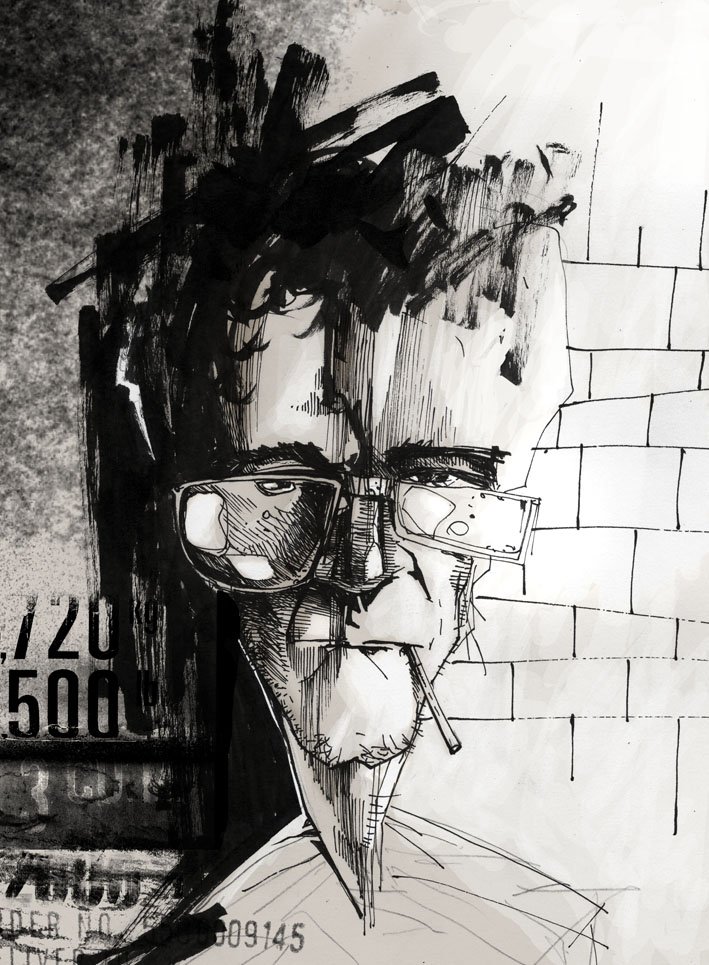
Short-cropped curly hair. Elongated, triangular face. Bushy brows. Eyeglasses. A cigarette. Near the lips. About to blow. Telltale signs that I'm looking for in a cartoon or caricature. It was hard to select one to use for an online reading group avatar. A lot of good drawings of B were uploaded in the web.


1. This illustration by Phillip Fivel Nessen for The Stranger is one of my favorites. Notice the fingers. And the background tells a story.


2. I love this illustration by Carlos Cardona. The exaggerated broad forehead, the background wash of colors, the prominent vein in the hand. Beautiful. The yellow eyes and the ashen skin color make him look like a zombie. This is in my top 3. In fact this is the avatar I've chosen, for now.


3. Noir look. It makes me smile. The nose, the smoke, the open fingers. It's from Marci, also in deviantart.


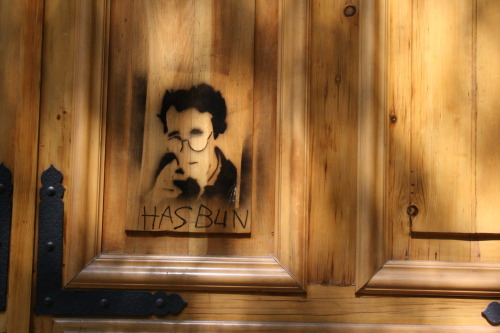
4. A photograph of a street art, posted in flickr (by gsz, via Global Graphica).


5. This is fun, too. The Chilean looks like a sulking teen. Art by Tomas Leal Elgueda.


6. This appeared in The New York Times review of 2666. Art by Christoph Niemann.


7. From The New Yorker review of The Savage Detectives. The ilustrado look. The novelist looks more like a doctor or a lawyer here. Art by Riccardo Vecchio.


8. Accompanying an essay translated from Entre paréntesis. Published in Molossus.


9. Two-face. I've written about it previously. Art by Renzo Podestá. The ciggie is placed like a thermometer.


10. "Malogrado esténcil de Roberto Bolaño." Photography taken in Barrio República, Santiago de Chile. Published by Gabriel Muelle / Mr. Fiasco.


11. From a review of 2666 in The Fanzine. Illustration by Danny Jock.


12-13. Two pencil sketches by


14. From a review of Nazi Literature in the Americas in The New York Times. Art by Kim Demarco


Consejo Nacional de la Cultura y las Artes


Paula Cabeçadas inSuite de ideias


Suite de ideias


THE FLUX I SHARE. Mixed media-like chaos.


I'm sure I left out some great drawings and illustrations. Send me the link through a comment here or email if you've spotted anything else. The images here are copyrighted by their respective illustrators, photographers, bloggers, or magazines, publications, and blogs that published them.

UPDATE (July 6): I found more portraits here.