04 January 2010
Favorite reads of 2009
And in our own reading lives, every day, we come across that blue river of truth, curling somewhere; we encounter scenes and moments and perfectly placed words in fiction and poetry, ... which strike us with their truth, which move and sustain us, which shake habit’s house to its foundations ...
– James Wood, How Fiction Works
It’s time I assess the books I flipped the whole year of MMIX.
Take a quick look at my (virtual) shelf and see which books I put a heart on, which pages I enjoyed, and which I abhorred. Which ones bored me and made me suffer and yet, upon reflection, I still called a good read in the end. Which are unforgettable and which are mediocre. Which are comfort reads, fillers, and time-killers.
I know most people classify a book as “not for everyone” or call it “an acquired taste.” I know a lot of people have said “2666 is a great book but it’s not for everyone, because it is difficult and unfinished, so I wouldn’t actually recommend it.” But be done with it. These not-for-everyone books are the ones I look out for.
Here’s a shortlist of my favorite books in 2009, in the order I read them and categorized into fiction and nonfiction. (Perhaps I can make a top ten later.) I highly recommend them as well worth spending your time on. They are for me the books that shook mannerisms to its foundations. My notes on some books are contained elsewhere on this blog.
Fiction
1. 2666 by Roberto Bolaño
2. The Island of the Day Before by Umberto Eco
3. Nazi Literature in the Americas by Roberto Bolaño
4. Rashōmon and Other Stories by Akutagawa Ryūnosuke
5. The Shadow of the Wind by Carlos Ruiz Zafón
6. Perfume by Patrick Süskind
7. You Lovely People by Bienvenido N. Santos
8. Everyman by Philip Roth
9. Trese: Mass Murders by Budjette Tan & Kajo Baldisimo (graphic)
10. The Rings of Saturn by W. G. Sebald
11. Noli Me Tangere by José Rizal (translated by Ma. Soledad Lacson-Locsin)
It’s one of the best years of reading fiction for me as I liked a lot of the books I read. The reason for this is that I intentionally went for my kind of books and avoided the ones I know I will have bad things to say about.
I recognize that my “best books” are not necessarily my “favorite books.” My favorite books are the great books whose flaws I can tolerate at any time. Books I cherish even if the flaws are evident. The closest thing I can describe my best books is that they are elusive books whose very perfection lies in the apparent flaws in them. That is to say, they are great precisely because their flaws make them so. I recognize this to be a paradox. Perhaps I can better point out my selectivity through my future reviews.
This is the year when I get to read all of the remaining books in English of Roberto Bolaño that I haven’t read – all seven of them. The hype around Bolaño I find really too tame to give justice to his accomplishments. My most favorite book this year, 2666, exhibits all of Bolaño’s idiosyncratic styles. It’s a highly and consciously artistic book, the one where Bolaño pulls all the energy of his brute force method of writing to leave an enduring legacy in literature, that is to say, in life.
Another favorite of mine by Bolaño is the highly inventive Nazi Literature in the Americas. It’s one of the best literary science fiction I have read. More than that, Nazi Literature in the Americas is a novel for monsters, yet another compendium of literary lives, of the fictional sort. At the heart of each of its “mini-wiki” entries is a deceptive question: What makes for a Nazi writer, the written work or the life led? The alternative answer is probably worthy of a new theory.
The Island of the Day Before by Umberto Eco makes me yawn, but this does not prevent me from acknowledging its ambitions. It has moments and passages that come alive like jewels. In some ways a tropic novel of sunlight, not the dreary old-fashioned novel bathed in darkness, although it is old-fashioned.
Akutagawa Ryūnosuke is a Japanese master of the form. In his hands, a short story is a short story. That is to say, it is quick. His words are efficient, without sacrificing the complexity of a plot. His tales are suffused with nuance and concrete details. His themes are large themes. His main concerns are basic. He is interested in the ambiguities of human choice, the uncontrollable passions suddenly flaring, the travails of the outcast, and the futility of moral justifications. There can be no doubt that the six pieces – six master pieces – in the book are among Akutagawa's finest. Any collection that contains the first two in this book, “In a Grove” and “Rashōmon,” is a book to be treasured. The book is a small sampler of Akutagawa’s literary output.
Perfume by Patrick Süskind is one of those twisted fairy tales that only a devious writer smiling inside himself can tell. For Jean-Baptiste Grenouille, its protagonist, the fragrant end rationalizes the evil means. Süskind is presenting a parable of the cult of artistry and genius through a tale of one of the most anomalous characters in fiction. The narrator of the novel does not make excuses for Grenouille’s acts, and he doesn’t criticize it either. He doesn’t make any value judgment or attempt to psychoanalyze its main character. The objective presentation is just superb. Its readers squirm in the fragrant spell of its grotesquerie.
More on the other books later.
Nonfiction
1. Freakonomics by Steven D. Levitt & Stephen J. Dubner
2. Written Lives by Javier Marías
3. A Sand County Almanac by Aldo Leopold
4. Fermat's Last Theorem by Simon Singh
5. How Fiction Works by James Wood
6. Why We Are Poor & Why We Are Hungry by F. Sionil José
7. The Mystery Guest by Grégoire Bouillier
A book of the most perfect despair, The Mystery Guest by Grégoire Bouillier is something rare in the confessional memoir. There's a laugh in every page. The jester's voice is polite and honest and heightened by a pathological sense of "turtleneck paranoia."
For a book about maths, Fermat's Last Theorem by Simon Singh is a very moving accomplishment. Granted, my proof of this (somewhere on this blog) is too lame. I kind of love the subject of mathematics. This book is a self-questioning journey of one man toward the completion of his proof. It is also a journey of several mathematicians through the centuries of doubts and human failings.
James Wood’s How Fiction Works is the best nonfiction explaining fiction. The book’s register is that of a self-knowing critical reader: probably the reason why other critics get irritated by Wood's polarizing opinions. The sweeping assertions and poetic explorations are sometimes dizzying in their clarity. This manual of fiction is a product of deep reflection on the art of novel writing. It is a way of fictive thinking in itself, a synthesis of creative imaginations that informed the choice(s) of writers in the book.
Freakonomics by Steven D. Levitt & Stephen J. Dubner. Abortion lowers crime rate, and other controversial ‘freaky’ ideas from a pair of journalist and economist. They concocted amusing premises, did some un-fuzzy maths and quantitative analyses, and reached some unlikely conclusions that convince nevertheless.
Written Lives by Javier Marías. Smartass Marías literally becomes a “writer’s writer.” Here he sketches some famous and obscure literary lives, in small doses or vignettes, not really in objective fashion, highlighting certain aspects of the writers’ personalities, shattering some myths about them, perpetuating others. The book closes with a chapter on something like “portraits of the artists as portraits.” Marías considers this the most enjoyable book he ever wrote. The sense of joy is with the reader too.
A Sand County Almanac by Aldo Leopold. A classic foundational text on environmental and conservation ethics. It is a well constructed prose poem/philosophical tract that enters and alters the frame of mind and speaks to the soul, to clear the debris of nonsense. It is a powerful and silent plea to conserve all wilderness areas. More trees should be felled to reprint copies of this book.


01 January 2010
What Rise read in 2009
A happy new year to all!
The first decade of the present century has zoomed by and today marks again the new beginning of our lives - reading, writing, traveling, playing, working, and (I'm now officially adding) blogging.
My year in blogging was marked by a lot of highlights, focusing mostly on book reviews and book-related matters. I have started actively writing on April 2009 with my first post In lieu of a field guide. The old entries in 2006 and 2007 were just imported from a now-defunct blog. This blog then is technically eight-and-a-half months old, and I'm glad that I was able to sustain it. I will perhaps make April 14 my "blogaversary" - I hope I spelled that (blogalese / Internetese) correctly.
I've been late in coming up with a summary of my reading. My Christmas holiday reading was just spent on two books - the last two books in the list below. I was much too distracted by Christmas eat and play.
Report on reading challenges. I planned to read 36 books (preferably 18 fiction and 18 non-fiction) - my Quantity Challenge. I've read a total of 48 books, an average of four books a month, and I'm counting 16 non-fiction here, so overall it's not bad at all. I basically passed the challenge with reading colors. However, I was not able to progress with my Challenge Read, the thicky-thicky War and Peace.
As for the Diversity Challenge, I was able to read all of the 24 books from diverse categories, except for the common title. I kind of half-finished the common book as I was able to finish Rizal's Noli Me Tangere as translated by Ma. Soledad Lacson-Locsin. I guess I will continue with the sequel El Filibusterismo this year, even if I've previously read these books in the translations done by Leon Ma. Guerrero. The Noli and Fili are always worth re-reading.
My other challenge, "Lost in Translation," is easily surpassed as most of what I read are books in translation anyway. I count 19 translated books from the list, way more than the required 6 books.
My 2009 reading log:
JANUARY
1. Freakonomics by Steven D. Levitt & Stephen J. Dubner
2. The Romantic Dogs by Roberto Bolaño (re-read in June)
FEBRUARY
3. Love Story by Erich Segal
4. 2666 by Roberto Bolaño
5. The Lives of Animals by J. M. Coetzee
6. The Road by Cormac McCarthy
MARCH
7. Written Lives by Javier Marías
8. Kokoro by Sōseki Natsume
9. A Sand County Almanac by Aldo Leopold
10. Tugmaang Matatabil by Axel Pinpin
APRIL
11. Einstein's Monsters by Martin Amis
12. Beyond Words by John Humphrys
13. Interpreter of Maladies by Jhumpa Lahiri
MAY
14. The Island of the Day Before by Umberto Eco
15. Nazi Literature in the Americas by Roberto Bolaño
16. Distant Star by Roberto Bolaño
17. Amulet by Roberto Bolaño
18. By Night in Chile by Roberto Bolaño
19. Fermat's Last Theorem by Simon Singh
JUNE
20. How Fiction Works by James Wood
21. Netherland by Joseph O'Neill
22. A Superior Death by Nevada Barr
JULY
23. Ecology and the End of Postmodernity by George Myerson
24. Rashōmon and Other Stories by Akutagawa Ryūnosuke
25. Five Moral Pieces by Umberto Eco
26. Six Easy Pieces by Richard P. Feynman
27. Gerilya by Norman Wilwayco
28. The Shadow of the Wind by Carlos Ruiz Zafón
AUGUST
29. Chronicle of a Death Foretold by Gabriel García Márquez (re-read)
30. Three Challenges to Ethics: Environmentalism, Feminism, and Multiculturalism by James P. Sterba
31. Perfume by Patrick Süskind
32. Why We Are Poor by F. Sionil José
33. The Blue Day Book by Bradley Trevor Greive
SEPTEMBER
34. Learning to Think Environmentally: While There is Still Time by Lester W. Milbrath
35. Quantum Theory: A Very Short Introduction by John Polkinghorne
OCTOBER
36. You Lovely People by Bienvenido N. Santos
37. Trese: Murder on Balete Drive by Budjette Tan & Kajo Baldisimo
38. Trese: Unreported Murders by Budjette Tan & Kajo Baldisimo
39. Everyman by Philip Roth
40. Why We Are Hungry by F. Sionil José
NOVEMBER
41. The Sandman: The Dream Hunters by Neil Gaiman & Yoshitaka Amano
42. The Mystery Guest by Grégoire Bouillier
43. Letters to a Young Contrarian by Christopher Hitchens
44. Trese: Mass Murders by Budjette Tan & Kajo Baldisimo
45. Hear the Wind Sing by Murakami Haruki
DECEMBER
46. The Skating Rink by Roberto Bolaño
47. The Rings of Saturn by W. G. Sebald
48. Noli Me Tangere by José Rizal, translated by Ma. Soledad Lacson-Locsin
I have made some "field notes" on most of these books but I wasn't able to write my full review. I will perhaps carry over to this year some of my takes on the books I read in 2009. Blogging is fun, and reading bliss.
23 December 2009
Karakol Fluvial Festival, Puerto Princesa City, 7 December 2009
The Karakol Festival is a fluvial parade held yearly in the City of Puerto Princesa on the eve of its patron saint’s day, the Feast of the Immaculada Concepcion. It begins with a mass held in the virgin’s honor, after which her statue is paraded the short length from the place of the holy mass (within the premises of the pier) to the docks. From inside the port the statue is carried in a procession into a waiting boat decorated with banderitas – flaglets that express the cheer of expectation and celebration of the virgin’s triumphant arrival. A sizeable number of devotees follow her in procession and ride on the boats parked in the quay. More than a dozen boats and small bancas participate in the parade. The boating parties, led by the virgin’s boat, will then circle the entire cove of Puerto Princesa Bay. Throughout the procession on land and sea, a marching band strikes their vibrant music. The entire parade takes about an hour at sea. Devotees believe that joining the festival ceremonies will bring good luck to them in the coming New Year. It is a beautiful spectacle to behold and I am happy that I was able to join this year’s festivities. The following photographs are some of the ones I took in this year’s celebration.
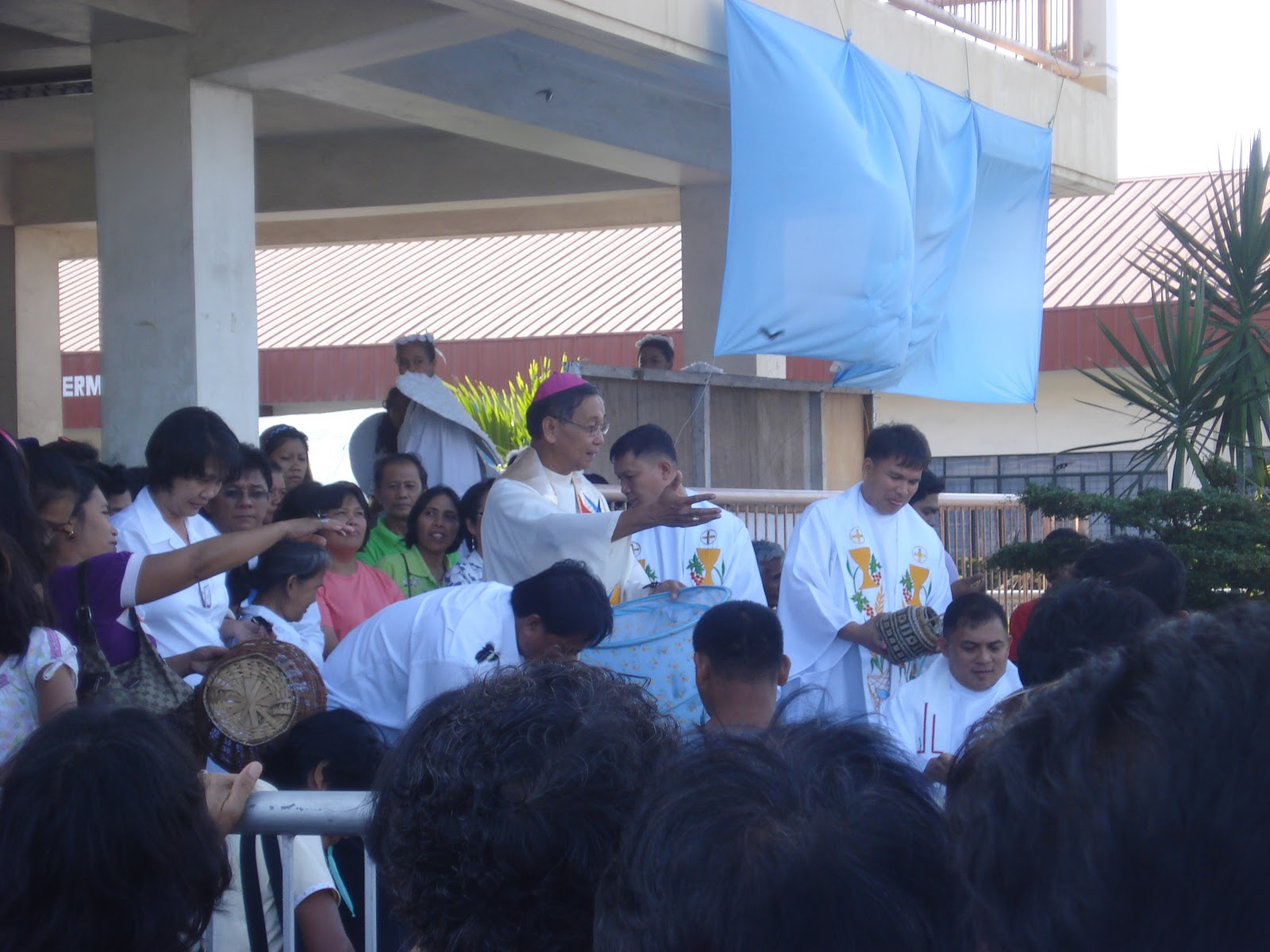
Before the parade the priests who led the holy mass open the baskets containing butterflies to release them in the air.


The march begins.

The procession to the docks draws a large crowd.

The statue is loaded aboard the banca.

Followers ride on the boat.

The band plays on.

The boating parties.

Coast guards standing by for rescue.

Aboard.

Small boats join in the sea parade.

A plane passes by.

The giant city Christmas tree in the baybay or park by the coast.

Passing a Chinese fishing vessel parked offshore.


Along the baybay.

Nearing the end of the sea journey.

The full military band.

Reaching the end.

Coming to a stop.


Disembarking.

The sacristans wait for the statue of the virgin.

The statue carried aloft from the boat.


Exit procession.
17 December 2009
The best of Bolaño is yet to come
Or at least the one-half of it. If Bolaño himself (crafty mythmaker) is to be believed. Forrest Gander mentioned in his not-fully-available-online essay, “Un Lio Bestial,” in The Nation, that ‘Bolaño considered Tres (Three), a book of poems published in 2000, to be "one of my two best books."’ The other best book being ... I don’t know.
Such straight pronouncements are characteristic of Bolaño, whose essays are often riddled by Parra-like (Parrian?) puzzles. These puzzles of Bolaño appear like Freudian slips that are both conscious and unconscious, thrown to the wind and catching them at the same time.
Bolaño has interpreted a poem by the anti-poet Nicanor Parra, a poem that plays on numbers: “The four great poets of Chile / Are three: / Alonso de Ercilla and Rubén Dario.” Bolaño’s close reading of this poem was recounted in an essay by Marcela Valdes, also in The Nation. This anti-poem inspired a joke which I’m sure Bolaño will appreciate: “So the two best works of Bolano/ Are one/ Three.”
And then there is this last advice of Bolaño to an aspiring short story writer: “Read Anton Chekhov and Raymond Carver, for one of the two of them is the best writer of the twentieth century.” He does not say which one. I’m inclined to vote for the Russian but then the “seriousness” of the joke is bound to be broken once I made the wager.
Tres, by the way, is a compilation of three poems. Another collection of Bolaño poems is Los perros románticos (The Romantic Dogs) which collects the poems of Bolaño starting from 1980. Both poetry collections were published in 2000; I’m not sure which came first. But so far I loved The Romantic Dogs. Intentional or not, a sort of “Parrian subtraction” is actually embedded in the book. At the back of the book it says that it is “a bilingual collection of forty-four poems,” but strangely I (dizzy) counted only 43 in the table of contents. I'm counting again later to make sure. And also at the back page, there’s a blurb by Forrest Gander about a poem describing some "fist-fucking" and "feet-fucking" and mentioning “Pascal, Nazi generals, Shining Path bonfires, and a teenage hooker.” Well, pray tell me which poem is this in the book, because I haven’t found it. Maybe I did not read close enough. This could be the 44th poem so it has to be somewhere in there.
A few months back I came across Garabatos, a journal blog by Laura Healy, the translator of The Romantic Dogs. It was started sometime in June, I think. I cannot open it directly now; you need to subscribe. But I have my RSS feed. There were only two journal entries to date.
In the first entry, “Introduction,” we get to have a glimpse of Healy's background: “The Part About the Translator of Poetry.”
I started this blog to help me study for my general exams as I start my first year of work toward a PhD in Romance Languages and Literatures at Harvard. My specialty is 20th-century Latin American literature. I’ve always known I should start a reading journal, but I’ve just never had the discipline, so hopefully this blog will be a way for me to record my initial reactions to different texts, without having to adhere to any particular format. That’s the hope. We’ll see how it goes.
And then she provided her reading list in Spanish lit for the course she's taking, 154 books in all!
Poetry has always been sidetracked in favor of prose. B was aware of it and so he “shifted” to fiction to better fend for his family. The quantity of his novels far outweighs that of his poetry, but readers do not complain.
Even in translation, focus has always been given to B’s novels and stories rather than his poems. Of course, his poems are the batteries energizing the flashlights of his fiction.
Here's the beginning of the second journal entry by Healy ("A Bolaño Fanatic"):
I’m not quite sure where to start here, since Bolaño has been such an incredibly important figure for me. I first found out about him from Zach and Jonah in 2005. Jonah had heard about him from some friends in Chile and Zach had been reading Chris Andrews’ translations of Distant Star (1996) and By Night in Chile (2000), both published by New Directions. Distant Star is a beautiful, flawless little novella, though I found myself more engrossed by the voice of Father Urrutia in By Night in Chile. I could say much much more (obviously) but I’ll leave it at that for now and go into more detail in future posts.
Anyway, around the same time that I read those novellas (in English), I decided to take some time off from school and travel around Europe with Zach. After bopping around for a while, we rented a room in an apartment in Barcelona and stayed there for a few months. Zach’s Spanish wasn’t very good at the time and he was on a poetry kick, so he bought me a copy of Los perros románticos, a collection of Bolaño’s poems, and asked me to translate it for him. I already had my eyes peeled for a translation project because I would need to complete one in order to graduate, so I gave it a shot.
Translating a book of poems is no small potatoes, so I figured I might as well milk it for all I could. I contacted Bolaño’s literary agent, was put in touch with New Directions in New York and somehow managed to get permission to translate the collection and submit my translations for publication. By the time I returned to school, I had completed most of the collection and Forrest Gander (a great poet/translator and also my advisor) helped me to edit them and polish a final draft. He also advised me through a translation of another collection of Bolaño’s poems, Tres, which will hopefully be published eventually (the opening series of prose poems “Prosa de otoño en Girona” is one of my all-time favorite pieces of writing).
...
Great story on how the translator first discovered the work of her author and the circumstances leading to the publication of her translation.
Healy’s acclaim regarding the opening prose poems “Prosa de otoño en Girona” of Tres corresponds to that by another translator of the same cycle of prose poems. Chad W. Post of Three Percent interviewed Erica Mena, a translator who will publish her version of “Tales from the Autumn in Gerona” in the March issue of Words Without Borders. I can’t wait to read it. Erica Mena chose this project as her best translation to date, adding that B’s prose poetry is “much, much better” than his other poems. Bolañophiles alert!
I also wonder, like Chad W. Post, who will finally translate the entire book for publication.
What I’d like to happen is for the two translators, Healy and Mena, to complete their separate versions, and then we will have side by side two interpretations of what could really be one of B’s two best books.
To venture an opinion: I’m not surprised that B will excel in the form of prose poetry, a necessary hybrid that interleaves the savage spirit of his poetry within the sturdy clothing of prose.
But still, the question begs itself: Is Bolaño’s (other) best book yet to come in English language? Is it this much-vaunted, much-awaited (by me at least) Tres? The knight’s answer may or may not be the same as the knave’s. If we don’t trust Roberto, then I guess we should always trust his translators. After all, when Roberto asked the essential question: “How do we recognize a work of art?” he himself answered it without reservation:
That’s easy. We must translate it. That the translator not be a genius. We must rip out pages randomly. We have to leave it strewn in an attic. And if after all this a young person appears and reads it, and after reading it makes it his own, and is faithful to it (or unfaithful, it makes no difference) and reinterprets it and accompanies it on its journey to the edges and both are enriched and the young person adds a grain of value to its natural value, we are in the presence of something, a machine or a book, capable of speaking to all human beings: not a tilled field but a mountain, not the image of the dark forest but the dark forest itself, not a flock of birds but the Nightingale.
That rambling prose poem is your answer.
I can be led to believe that Tres is one of the two best books of Bolaño, the other being the rest of his oeuvre.
12 December 2009
“The Dinosaur” (Augusto Monterroso)

Note to the reader: The following review may contain spoilers. Please read no further if you have not read the story yet.
Sleeping giant: review of “The Dinosaur,” a short story by Guatemalan writer Augusto Monterroso
Yesterday I read (for the second time) in one sitting Augusto Monterroso’s story called “The Dinosaur.” I re-read it many times, fourteen times maybe, I lost count. I tried to analyze the story in terms of prehistoric literary theories: stunted evolution, creationist realism, posthumous savagery. It was a radical novel. Anyway, after I wrote a first draft of my review, I checked my email, and then I slept afterward. It was not a peaceful sleep. I was trashing left and right on my bed. I dreamt of a Uranusaurus rex just like the one in Stephen Szpilman Bergman’s movie Triassic Park, based on a TV show created by Michael Flintstonnes (pronounced flight-stuns).
When I woke up, I read again my review. I worked on it some more, polishing the paleontological arguments. After some not-so-extensive revisions, I saved the file. I looked behind me and jumped. The U. rex was still there.
Subscribe to:
Posts (Atom)