31 October 2016

The Golden Dagger


The Golden Dagger by Antonio G. Sempio, translated from Tagalog by Soledad S. Reyes (De La Salle University Publishing House, 2016)


In her Bibliography of Filipino Novels: 1901-2000 (2010), Patricia May B. Jurilla noted that the most prolific novelist in Tagalog was Antonio G. Sempio (1891-1943) for having the most number of published novels in book form. Most novels in Tagalog/Filipino were first serialized in magazines or newspapers before being published in book form.

Between 1917 and 1942, Sempio produced 19 novels, including a translation. According to Jurilla, it was likely that most of these novels were self-published owing to the fact that Sempio was known for peddling his books as he traveled from town to town.

One such novel—Ang Punyal na Ginto (Nobelang Tagalog) (1933)—recently appeared in English translation by Soledad S. Reyes as The Golden Dagger. This novel was notable for being the basis of the first ever "talking" film in the country. In a way, this was the story which finally broke the "silence" of the silver screen.

According to Jessie B. Garcia in A Movie Album Quizbook (2005), cited by Video 48 blog (link), the exhibition of Punyal na Ginto the movie at the Lyric Theater on the Escolta "was made possible with the importation of American technicians and sound camera equipment by two American businessmen and promoters, George F. Harris and Stewart “Eddie” Tait of the Tait Shows carnival fame."


(IMAGE SOURCE: IMDb)


The plot of The Golden Dagger was a melodramatic and rather tragic treatment of the love between the poor girl Dalisay and the filthy rich boy Dante, with the boy's father, the despotic Don Sergio, doing everything in his power to thwart the affair. In the translator's introduction, Reyes cautioned the reader to look at the novel "against a specific sociopolitical context and an evolving literary tradition", for the reader to "retrieve the novel's original meaning on its own terms". Without the context to situate the novel in the American colonial period fraught with inequalities between the landed rich and the working poor, the novel would be easily dismissed as poverty porn.

The names of the characters were rich in meaning. Dalisay is the Tagalog word for pure and untarnished, and it was her destiny to erase the stain that marked her ill-fated association with Don Sergio and his son. Dante Villa Centeno was the only major character given a full name in the story. It was as if only the rich were the only ones entitled to a full name. Elias, Dalisay's cousin and the third corner of the love triangle, seemed to echo the noble character of Elias in Rizal's Noli Me Tangere. By the end of the book, Elias became like Simoun the jeweler in El Filibusterismo by being rich himself, and like Isagani by derailing Dalisay's plan of revenge. Elias then had the nobility of his namesake, the wealth of Simoun, and the righteousness of Isagani.

The tragic conclusion of the story was foretold in the beginning. What was left to ponder in the novel? The sentimental drama and the momentous, heart-stopping twists and turns; the Philippine sociopolitical background that informed such a story; the ingenious use of the reference code; the narrator's frequent intrusions, his ironic commentaries to the story, and his constant taunting of the reader at the end of the chapters; the verbal and psychological battle of wills between the rich boy and his father, and between the poor girl and the rich boy's father; time lapse and transformations of character. Somehow, too, the corrupt stench of patronage politics and partisanship of the 1930s pre-Commonwealth period still assaulted the nose of the present.

—Oh, no! I'm here to pay you a visit. I'd like to find out what you need and what you think. What can I do for you, friends?

Ah, if that's what you want to know, there's a whole list—Mang Bastian replied. —First of all, there is only one artesian well that the democrats built at one end of the village nearest the street where their party mates lived; this is not enough. Secondly, the number of students is growing, but since the only public school is small, the students are forced to stop schooling because the school in the town proper is inaccessible.

—But what are your mayor, representative, and senator doing? Why don't you ask them for help?

Naku! Those officials say they have the people's welfare in mind, that is, when campaigning, but the moment they are elected, they conveniently forget their promises!

—Let me handle this and I'll look into these needs and follow up on them until they reach the office of the Governor-General. We're friends, and I promise to facilitate what your elected officials fail to deliver! [...] But of course they will not dare disappoint me! Do you think the amount of money I donate to their campaigns during election is a pittance? They all entwine themselves around me! Start with Quezon, to the oldest senator, and the representatives, and you may add the secretaries of the various departments. Not one of them can afford to turn me down! They owe me a great deal, and they will not have the nerve to refuse me! Ah! Even the Governor-General has not failed me, not even once!

The proud speaker was Don Sergio, and his certainty of victory spelled the doom not only for the political trajectory of the country but for Dalisay's unwinnable love for Dante.

Don Sergio's "golden dagger" (a transparent metaphor for the unlimited power and resources available to the rich) was poised and ready to fight against Dalisay and her love for Dante. The golden dagger was designed for the systematic terrorizing and breaking down of poor folk who dare cross the path of the ruthless rich.

How would he make the young woman [Dalisay] withdraw her promise? How, ah, how? What if he offered untold riches? He was willing to pay her off since Dante's money was the sole motive driving both mother and daughter [Dalisay and her mother]. He would offer thousands of pesos, or however much it would take, to free his son's ensnared heart. Once she agreed, then there was no more need to talk. Just allow Dalisay to name her price, and he would pay her with alacrity, with a smug smile on his face. But if Dalisay remained firm despite her gentle pleading, he would unleash the terror—he would berate her, threaten her, and put the fear of the Lord in her. If she did not succumb to his entreaties, then he would resort to violence. Nobody who defied him was spared his deadly revenge. This scheme, this one plot was the only alternative that would probably lead to satisfactory results!

The rich were results-oriented, once they put into motion their best-laid plans. Using Plans A to C and other cruel contingencies, their quarry would not be able to escape.

After another round of furious exchange, the police van finally arrived. How could they afford to ignore the master's order? The chief of police was a friend of Don Sergio's, and sending a van over with alacrity was the least he could do.

With the whole political establishment at his side—the so-called "duty-bearers": legislators, judges and lawyers, the police force, the Governor-General!—it was no wonder that Don Sergio would not have the least trouble perpetrating his evil design on Dalisay. The "rights-holder"—the poor, the marginalized, the disenfranchised—would be easily robbed of their rights and freedoms. For her part, Dalisay—even before Miss Saigon—would be forced to perform the ultimate sacrifice. And even if it killed her trying, she would have her revenge, one way or another.

The Golden Dagger was one of the last publications of the De La Salle University (DLSU) Publishing House. According to a major online local bookseller I talked to, the press was no longer in operation. This was a tragedy, not least because the DLSU university press was one of a handful of progressive publishers of translated novels in the Philippines. In 2013, the press released, also in translation by Soledad S. Reyes, two remarkable novels by Rosario de Guzman Lingat.

I am not sure if the movie adaptation is still extant. If it is, I hope I will have the chance to watch this first ever Tagalog movie recorded with sound.

Notes on Bibliography of Filipino Novels: 1901-2000


Bibliography of Filipino Novels: 1901-2000 by Patricia May B. Jurilla (The University of the Philippines Press, 2010)


Patricia May B. Jurilla does a great service to readers and students of Philippine novel in her well researched Bibliography of Filipino Novels: 1901-2000, published by the University of the Philippines Press in 2010. She collated a century's worth of Philippine novel writing and production in three separate lists: (i) English language novels, (ii) Tagalog (Filipino) language novels, and (iii) translations of foreign novels into Tagalog (Filipino) language.

She excluded novels written during the Spanish period (pre-20th century novels) and books with less than 49 pages, the UNESCO standard definition of a book. According to her, she omitted "quite a number of early Tagalog novels" because of this page constraint, with these books "looking more like booklets, chapbooks, or pamphlets really—almost resembling novenas." The page constraint was not followed strictly though as I noticed a book with 48 pages included in the list.

The 1910s was considered the Golden Age of the Tagalog novel, the decade that produced a total of 93 Tagalog titles. Her introduction to the bibliography discussed significant trends and factors that contributed to the production of novels in the Philippines.

After the Americans introduced English language in the country in 1900, it took 21 years before a first novel in the language appeared: A Child of Sorrow by Zoilo M. Galang, which he self-published and later translated into Tagalog as Anak ng Dalita (1960). Self-publication was a common practice during the first half of the century.

According to Jurilla, novels in English generally did not cater to popular taste. Compared to Tagalog novel reading, the Philippine novel in English appealed only to a small readership: those in the upper-middle and upper classes who had command of the English language and who had access to education.

The most prolific Filipino novelist in English was F. Sionil José (10 titles during the period covered), followed by Linda Ty-Casper (9 titles). The most common words included in the titles of novels in Filipino and in Filipino translation were: pag-ibig (love), buhay (life), puso (heart), luha (tears), and bulaklak (flower).

Unfortunately, translations of novels from a Philippine language into English were excluded from the list. Based on my limited search, only two titles appeared in English translation in the period covered by the bibliography—(i) The Lady in the Market by Magdalena G. Jalandoni in 1976; and (ii) Margosatubig: The Story of Salagunting by Ramon L. Muzones in 1979. Both titles were translated by Edward D. Defensor from Hiligaynon language, and both were published by University of the Philippines in the Visayas (Iloilo).

The two books of Don Quixote appeared in Tagalog translation by four translators in 1940. However, according to Virgilio S. Almario, in "Sulyap sa Kasaysayan ng Pagsasalin sa Filipinas" (A Glimpse into the History of Translation in Filipinas), one of the essays in Introduksiyon sa Pagsasalin: Mga Panimulang Babásahín Hinggil sa Teorya at Praktika ng Pagsasalin (Introduction to Translation: Introductory Readings on the Theory and Practice of Translation) (2015), these books were translated based on the English translation.

The only book that appeared in bilingual translation was The Birthing of Hannibal Valdez (1984), originally in English by Alfrredo Navarro Salanga, with an accompanying "Pilipino" translation by Romulo A. Sandoval. I read this book—the author calls it a "novella"—earlier this year.

Needless to say, the bibliography needs to be updated to cover new novels published in the new century. It also needs to be expanded to cover novel output from other vernacular languages with novel tradition such as Hiligaynon, Cebuano, Kapampangan, etc. Several Tagalog (Filipino) titles in the list already appeared in English translation only in the last decade. Annotations on reprinted books need to be updated (e.g., Surveyors of the Liguasan Marsh (1991) by Antonio Enriquez was published under a new title, Green Sanctuary, in 2003; Eric Gamalinda's Empire of Memory (1992) recently appeared in a new edition).

Certain lacunae in the entries needed to be filled (e.g., Carlos Bulosan's novel America Is in the Heart: A Personal Journey was undated. Jurilla made a conjecture that this was likely published in the country in the 1970s. According to Bienvenido Lumbera, in a foreword to Bulosan: An Introduction With Selections, edited by E. San Juan Jr., the Philippine edition was published in 1980.) Perhaps an "online edition" of the lists can serve to validate or update the bibliographical entries.

Although the bibliographer did not mention it, war, disasters, and tragedies were not kind to the preservation of Philippine books and manuscripts. The destruction and looting of libraries during the Battle of Manila in 1945 consigned a lot of the collections to the dustbin.

Jurilla's book is quite handy for anybody interested in reading Filipino novels or, for that matter, investigating novel production and output in colonial, post-war, and post-colonial settings, and pre- and post-martial law regime.

From the list, I only read a measly 7 out of the 365 titles in Tagalog (Filipino), none from the titles in Tagalog (Filipino) translation, and 20 out of 177 novels in English.

This bibliography has already given me an idea on which novels to read next.

      A Lion in the House


      I don't like to write in books with ink. Books heavily underlined and annotated scandalize me. The blank pages and margins of books are not meant to be defaced like a temple. Yet I like to mark them myself with occasional notes. For that I use a pencil, which I like to think makes for a lesser violence, a temporary violation an eraser will set right. So I write on books very lightly. I do not stretch out the books and open them fully flat when I read. I open them at an angle so as not to break the spine of the book. I always read acutely, at an angle less than ninety degrees. If it is a new book I bought I would never settle down for more than the right angle. I dare not open books at an obtuse angle. That is an obtuse thing to do. It is depressing to look at books with heavily curved or broken spines. Or any book with physical flaws for that matter.

      I was flipping the pages of A Lion in the House, a novel by Lina Espina-Moore about adultery. Published in 1980, it feels outdated now. Outdated not for being a period novel set in 1980 but for its heavy use of colloquial language of Manila of its time. It has its moments, like the scene of the wife rushing to get his husband from the apartment of his mistress, an apartment the husband was renting out. This section of the novel was recently included in Querida: An Anthology (2013). But overall the novel sounds false to me in 2016. The dialogues do not crackle. It relies too much on the slang, colloquialisms, and high society details of its period. Novels must be felt as if it is new. Its language must sound fresh for all time.

      When I started the book I already flipped through its pages and saw the last page and I was vexed at an offending drawing, in ink. I never minded the musty smell and the browning, crispy pages of the old book. I never minded that the book was apparently read by someone else before it was sent to me. But that someone had the luxury of time to make doodles and lettering of a character's name. I was mad at the publisher (I ordered the book from the publisher, from their old stocks) for allowing this to happen and for sending me this vandalized book. I was mad at the vandal-reader for the indiscretion. However ambivalent I felt about the book, I did not like that it was tampered.


      But I would not let this affect my reading. I continued reading and soldiered on to the last pages. The final, epistolary chapter was titled "Q.E.D." I finished the book. Then I discovered the "flaw" was not a flaw at all but part of the "text." But of course. This literary device was not new. I was amused.

      Then everything fell into place. The philandering husband, Mr. Alberto de Leon, the "lion in the house", wrote in doodles. Of course. The stoic character whose thoughts were not always accessible in the book. A paper with nonsensical writing in it, from his "desk" illuminated something about his character. A thought balloon appeared, a thought bubble burst. The drawing expressed it all. His inflated ego, his narcissism, his vanity. Therein lay all his psychological complexity. Or his utter simplicity. Flawed as a person, as a lion, as a character. The book and its flaws. Quod erat demonstrandum.

      12 September 2016

      Shri-Bishaya


      Shri-Bishaya by Ramon Muzones, translated from Hiligaynon by Ma. Cecilia Locsin-Nava (New Day Publishers, 2016)


      File:Visayans 4.png
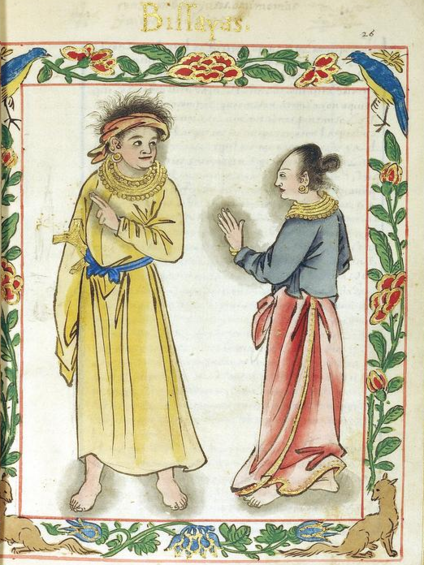
      VISAYAN KADATUAN (ROYAL) COUPLE, FROM BOXER CODEX


      Shri-Bishaya by Ramon Muzones was first published as a serial novel in Hiligaynon magazine from 1969 to 1970, two years before the imposition of martial law. It borrowed its title from the ancient kingdom of Southeast Asia, the Srivijaya. It was a fictional adaptation and imaginative fusion of two famous epics from Panay Island in the Visayan region, central Philippines: the Maragtas and Hinilawod. The former was an embellished history of the origin of Visayan people who migrated from Borneo. Shri-Bishaya used the Maragtas as narrative framework of the novel, recounting how ten datus from Borneo fled to Panay Island to escape the despotic ruler Sultan Makatunaw. It described how the datus bought the island from Aetas and the challenges encountered by these new settlers to institute a free, independent government with a new set of laws and system of leadership.

      Sultan Makatunaw was a transparent evil character, a composite of familiar rulers of today. He was mercurial, prone to sudden fits of violent temper. Makatunaw's rapacious greed and lust and blatant disregard for human rights reflected (and anticipated) the government under Ferdinand Marcos from late 1960s and onward until his toppling by a popular uprising and revolutionary government in 1986. In "The Maragtas Mystique", the novel's well-researched preface, translator Ma. Cecilia Locsin-Nava provided ample background in which to view this dictator novel as a form of resistance literature and postcolonial literature, notwithstanding the contested fictional nature of Maragtas as based on a "racist migration theory", according to historian William Henry Scott.

      As a dictator novel, it described the injustices of Sultan Makatunaw in suspending due process for individuals who "live in fear and terror, because there is no telling who will be seized next from his home and will never see his family again." Just like in the time of Marcos, the sultan also forbade people from holding peaceful assemblies that might lead to the rise of resistance movements and a revolution to bring him down from power. Under Makatunaw's rule a new edict was issued wherein, based on reports by informers identifying the enemies of the state, "sans prior investigation, a person could be thrown into a river full of man-eating crocodiles, pilloried and fed to the ants, hanged on the lunok tree, buried neck-deep in hot sands, cut, quartered, and fed to wild beasts, and subjected to other forms of gruesome tortures."

      Elsewhere, the sultan ordered the kidnapping of people suspected of going against him. "Many residents had been seized unawares in the middle of the night, torn from the embrace of their families, and banished without any trace of their whereabouts." This clearly anticipated the desaparecidos during the time of Marcos, and even up to the present.

      As a maritime novel, a rare one in Philippine literature, the novel gave a glimpse of seafaring life at sea, albeit sometimes in magical realist fashion. Maritime wars fought at sea, encounters with cruel pirates, and fantastical sea creatures gave a mythical and adventurous flavor to the novel.

      As a costumbrista novel and foundation epic recounting the building of a just and lawful society from a clean slate, it illumined some ancient Visayan character traits, customs, and laws (some already thankfully defunct) to instill disciple among the people.

      "You are the oldest and the wisest among the datus I am leaving behind. In your hands I leave the management of the land and the lives of our people," Datu Puti continued.

      "Do you have suggestions on what needs to be done?"

      "I was thinking of several things. The land we bought is vast, there is a need for you to divide it, and give each datu his share."

      "I intend to do that. I plan to give Datu Paiburong and Bangkaya their individual shares."

      "That's a good start. But, there must be laws to govern the lives of our people. Have you thought about this?"

      "Yes, I have thought up some laws, but there is a need to discuss these with the other datus first."

      "Remember that you are starting afresh in this new land. You need to set strong foundations. What laws have you thought up?"

      "It's true we are starting a new life in completely new surroundings. People have to work really hard so they will prosper. That is why I thought up a law that punishes heavily those who are lazy and do not provide for their daily needs."

      "That's a good idea. What is the punishment for the lazy?"

      "The lazy should be arrested and sold as a slave to an affluent family so he will learn the difficulty and value of domestic and farm work. After he learns his lesson he will be allowed to go back home. The cost of his sale will be returned to the buyer and he will no longer be considered a slave, but a timawa or free man who has been redeemed from indolence and is ready to live by the fruits of his labor. But, if it is discovered later that he has reverted back to his old ways, he will be arrested again, and banished into the jungle. He will not be allowed to mingle with other people lest he set a bad example."

      "That is very good, Sumakwel. What else have you thought up?"

      "Punish heavily the light-fingered. The fingers of a thief should be chopped off."

      Datu Puti nodded his head.

      Sumakwel continued to explain: "Only men who can support a family or families can marry more than one wife, and will be allowed to have children. The poor should not bear more than two children because it is hard to support or rear them. Children who cannot be supported, should be thrown into the river."

      "Isn't it unfair to punish the innocent children for the crime of their parents?"

      "This is a warning to those who would like to start a family but cannot afford to do so. The punishment is harsh, but there is a need for a man to learn at the outset his obligations to society and to the state. If he wants to start a family, he should work hard to support his dependents."

      "Continue."

      "If a man has gotten a woman with child and he abandons her because he has no intention of marrying her, the child should be killed because it is hard for a woman without a husband to support a child. Since the woman has brought shame to her family she cannot inherit anything. The man should be hunted down by the leaders of his district, and when he is caught but continues to refuse to marry the woman he has wronged, he and his child should be buried alive."

      "Are you concerned about the honor of the family?"

      "Yes, because I want the people to live righteous lives."

      "Do you have other laws in mind?"

      "I have, but they will have to wait until we will have held a meeting."

      "I will not meddle with your affairs; I just want to remind you that we left Bornay because of the rapacity and brutality of the sultan. Let us not stain this new land with blood. This is not just a request, it is a bond because I am entrusting everything here to you."

      "I will bear that in mind."

      Datu Sumakwel, the leader and lawmaker entrusted by Datu Puti to lead the people prior to the latter's return to Bornay to assuage the anger of Sultan Makatunaw, was here outlining the rigid laws he would institute as leader. By contemporary standards, the laws were unsound and barbaric. And even the resolve of Datu Sumakwel to strictly implement these laws was ultimately tested when he found his own wife Kapinangan was having an affair with his own servant.

      A terrible curse afflicted the life of Sumakwel, the wise datu whom everybody looked up to as the epitome of righteous living and good governance. Sumakwel could always be depended upon to implement the will of the people no matter what. But this crisis in his life was not a simple case of a wife's betrayal of her husband. It had other implications. If Kapinangan had committed the crime in Bornay, this would be no problem for Sumakwel but the trickery and treachery was committed in this new land, and there has, as yet, been no precedent regarding this.

      The unfaithfulness of Kapinangan was a major plot element that tested the true character of the leader. Can the righteous and just Datu Sumakwel who wanted to set a good example to his people ever forgive the shameful crime committed against him? The novel was a forgiving medium to offer an unusual love story.


      File:Visayans 3.png
      VISAYAN KADATUAN (ROYAL) COUPLE, FROM BOXER CODEX


      As an adventure story, the novel was replete with magical elements and supernatural powers. When Datu Sumakwel and his babaylan Bangotbanwa climbed a mountain believed to be the home of their comet god, Lord Bulolakaw, they encountered amurukpok, an evil spirit dwelling in the jungle and exercising power over other evil spirits.

      Bangotbanwa believed that they had simply disturbed the tranquillity of the denizens of the jungle who sent them the hideous creature. While Sumakwel had the highest regard for the babaylan, in his heart he believed that the world really harbors many evil elements that disturb human relations and hinder prosperity in life. There are malevolent spirits that are out to test man's capacity to take care of his own self.

      The evil creatures they encountered, as well as the ones haunting the sea voyage of Datu Labawdungon and Datu Paibare, two main characters in a parallel story, came in various forms, but often in the form of a bakunawa or giant snake. The snake motif and imagery in the novel was like a premonition or prefiguration of the character of Sultan Makatunaw, who manifested such snake-like rapacity that his elimination became the central conundrum of the novel.

      Sometimes they heard a screeching sound in front of them, sometimes beside them, and sometimes behind them akin to the hoot of a huge, unseen bird. At times, they would stop dead on their tracks because they would hear a pitiful, ear-splitting, sonorous cry as though someone was being tortured. However, they could not trace the origin of the sound. Their attention was also attracted by the boisterous roar of rushing waters but when they rushed to what they believed was its source, it would suddenly stop, and an eerie silence would suddenly descend on the jungle. They would also hear the grisly cackle of the muwa or the terrible roar of the bawa. But Sumakwel and Bangotbanwa were both busalians endowed with unusual physical prowess and superior kinaadman, fortified with the most potent talismans, curative himag, and tigadlom charm. They had penetrated many a jungle and tested their manhood matching wits with embattled kiwigs, and other wily and supernatural and preternatural creatures.

      The charismatic power of the datus, derived from their kinaadman, was the same mythical magic and power possessed by the characters in the earlier translated Muzones novel Margosatubig: The Story of Salagunting. Shri-Bishaya was the next logical novel to be translated after Margosatubig, its companion novel. The two shared the author's thematic elements and predilection for magic, monsters, power plays, game of thrones, nation-building, and full-scale war.

      Makatunaw had developed an expansionist design over many lands, and he harbored deep desire to punish the ten datus who fled from his kingdom. This novel abounds with political insights of the times. One could detect the current spate of untenable extrajudicial killings on this highly prescient novel.

      "Don't believe we are without enemies. Put inside your head that we have secret enemies who are just lying in wait for the right opportunity. Therefore, spread out and disseminate the information that the kingdom is strong and ready to take on any comers. If you catch anybody doing something wrong against the kingdom, I give you the authority to exact the right punishment. You are fully aware that I know how to reward those who are loyal to me," stressed the sultan.

      And ...

      They celebrated their gathering with abundant food and wine. When the datus went back to their respective districts, life changed. They now enjoyed tremendous power, because they were given by the sultan the authority to exact punishment on any enemy of the kingdom. So, they abused their power. They showed everyone who was who inside the kingdom. [emphases supplied]

      The long drawn out final showdown in the novel, between the soldiers of Sultan Makatunaw and the freedom fighters of Datu Labawdungon and Datu Paibare, was meticulous in its plotting. The sultan was fully aware of the brewing war in his kingdom and the people's increasing discontent at his brutality.

      Labawdungon and his cohort Paibare were already set on living in another place, in Madyaas, the land where the Bornean datus escaped to. They came back to Bornay, the sultan's seat of power, ostensibly to unseat the sultan in order to satisfy the wishes of their prospective wives, and yet their connection to their former land was bound by kinship and loyalty to its people.

      It was finally a race between him and the two datus to manufacture a "deadly weapon that can kill wholesale". The seemingly endless volley of stratagems and art of war tactics from both sides demonstrated how difficult it was to resist tyranny such that rebels and revolutionaries must offer everything just to secure an attractive future for their country.

      "I know what you are thinking," said Labawdungon. "We all hold life dear, but more precious is freedom for which we should offer our lives. More important than ourselves is Bornay's future. If we want a peaceful and just rule, we must pay for it, no matter the price."

      This statement was almost a tired template for nationalism – dying for one's country, exactly following Benedict Anderson's definition of a nation in his Imagined Communities (1983): "[A nation] is imagined as a community, because, regardless of the actual inequality and exploitation that may prevail in each, the nation is always conceived as a deep, horizontal comradeship. Ultimately it is this fraternity that makes it possible, over the past two centuries, for so many millions of people, not so much to kill, as willingly to die for such limited imaginings."

      Dying for the country was dying for a loved one. This equation was not inappropriate given that Labawdungon's motivation for declaring war on the Sultan was not only to free the people of Bornay from the sultan's tyrannical rule, but actually to secure the hand of a woman in marriage who only consented to become his wife if he could bring "the skull of Sultan Makatunaw" as bride price.

      This remarkably prescient epico-historical novel did not sacrifice plausibility and authenticity for a diverting narrative of love and war. Dr. Locsin-Nava's translation overall captured the fantastical elements of evil and magic, its dialectical nature, and the aphorisms, hints of sarcasm, irony, and humor of the story. The dialogues often combined proverbs and a mix of idiomatic expressions. Here is a sample pile of idioms from its rich treasury of proverbs.

      "It's impossible that nobody will bite if the bait is tasty," Sultan Makatunaw told his two trusted associates, Datu Hatib and Datu Garol. "I'm quite aware that there are people who even if you feed them with your hand will swallow your elbow," the sultan added. "These people are close to me, they help me, follow my every wish, and praise me to my face – that is, for as long as I have something to feed them and I am in power."

      "Beloved Sultan," Datu Garol became anxious, "that has never entered my mind. Even if you subject me to a test, I will put my life on the line for the good of the kingdom."

      "I'm not referring to the two of you," assured the sultan, "but to those who, while I am in power, praise me to my face but the moment I fall off my perch will devour me. Those people are with us while something is cooking in the pot but not if the food is gone."

      "You are right, Beloved Sultan," Datu Garol agreed. "In this world there are bats and butterflies who will only alight when there is honey to suck. I'm sure you know that when a boat begins to list, rats spill over because they do not want to sink with the vessel."

      "Because of this," the sultan continued, "we must extend and strengthen the reach of the kingdom so that people have something to suck on. For as long as their stomachs are full people will not entertain destructive thoughts. It is when the stomach growls because it is empty that we put ourselves in danger. We must guard our vessel well so that our enemies will not bore holes in our ship of state."

      "It is easy to catch the enemy from the outside but difficult to flush out the enemy from within. It is like squeezing grain from unhulled rice," Datu Hatib added.

      "That is what we need to focus on right now so that termites will not eat up the foundation of our house. People with full stomachs are no threat, what we should guard against are hungry people because a hungry man is an angry man," warned the sultan.

      Would that this relentless, dynamic, and "proverbial" epic novel will have its epic share of readers.


      Related post: http://booktrek.blogspot.com/2016/09/nick-joaquins-small-rowboat.html


      10 September 2016

      Nick Joaquín's small rowboat


      "Society for the Filipino is a small rowboat: the barangay," wrote Nick Joaquín in the beginning of "A Heritage of Smallness," one of the essays in Culture and History (1988). This provocative essay made the argument that the Filipinos' tendency to act on the small scale was detrimental to the development of their society and culture. This includes the Filipino writers' apparent preference for writing short stories. The lack of novels in the country was proof of the Filipino writers fearing the daring and bold enterprise. This habit of "thinking small" was, for Joaquín, a recipe for poverty and pettiness. The Philippine national heritage, according to him, was nothing but "a heritage of smallness."

      However far we go back in our history it's the small we find – the nipa hut, the barangay, the petty kingship, the slight tillage, the tingi [retail] trade. All our artifacts are miniatures, and so is our folk literature, which is mostly proverbs, or dogmas in miniature. About the one big labor we can point to in our remote past is the [Banaue] rice terraces – and even that grandeur shrinks, on scrutiny, into numberless little separate plots, into a series of layers added to previous ones, all this being the accumulation of ages of small routine efforts (like a colony of anthills) rather than one grand labor following one grand design. ... Many little efforts, however perfect each in itself, still cannot equal one single epic creation. ... [Y]ou could stack up all the best short stories you can think of and still not have enough to outweigh a mountain like War and Peace.

      The depressing fact in Philippine history is what seems to be our native aversion to the large venture, the big risk, the bold extensive enterprise. The pattern may have been set by the migrations. We try to equate the odyssey of the migrating barangays with that of the Pilgrim Fathers of America, but a glance at the map suffices to show the difference between the two ventures. One was a voyage across an ocean into an unknown world; the other was a going to and fro among neighboring islands. One was a blind leap into space; the other seems, in comparison, a mere crossing of rivers. The nature of the one required organization, a sustained effort, special skills, special tools, the building of large ships. The nature of the other is revealed by its vehicle, the barangay, which is a small rowboat, not a seafaring vessel designed for long distances or the avenues of the ocean.

      Like his predecessor José Rizal before him who lamented the "indolence of the Filipinos", Joaquín was here lamenting the lack of imagination of his compatriots. The barangays he talked about referred to the smallest political unit in the country, roughly the same as barrios or villages. The word had its origin from balangay which was the sailing vessel the ancient inhabitants of the islands used as transport within the archipelago and neighboring regions.

      Philippine society, as though fearing bigness, ever tends to revert to the condition of the barangay: of the small enclosed society. We don’t grow like a seed, we split like an amoeba. The moment a town grows big it become two towns. The moment a province becomes populous it disintegrates into two or three smaller provinces. The excuse offered for divisions is always the alleged difficulty of administering so huge an entity. ... What we're admitting is that, on the big scale, we can’t be efficient; we are capable only of the small. The decentralization and barrio-autonomy movement expresses our craving to return to the one unit of society we feel adequate to: the barangay, with its 30 to a hundred families. Anything larger intimidates. We would deliberately limit ourselves to the small performance.

      The exhortation of Joaquín was premised on his study of Philippine artifacts that constitute the national cultural heritage. Specifically he observed three things about them: (i) the Filipinos worked best on small things ("tiny figurines, small pots, filigree work in gold or silver, decorative arabesques"); (ii) they worked in soft and easy materials like "clay, molten metal, tree bark and vine pulp, and the softer woods and stones"; and (iii) they tended to rut in his mastered skill ("material, craft or product") and did not move on to a higher level. For these assertions, he offered examples in pottery, agriculture, and wooden sculpture.

      In contrast to this, the writer offered Christian statuary and architecture as indicating a semblance of a "heritage of greatness." He added three critical phases in the Spanish colonial period: the defense of the land against two centuries of attempt of Dutch and British invaders to conquer the islands; the Propaganda Movement; and the 1896 Philippine Revolution against Spain.

      There were a lot of things to quibble about Joaquín's essay. His assessment was too harsh. Yet one could not easily dismiss him as having a "colonized mind" for extolling the Spanish virtues and contribution to Philippine culture. The essay was presented as a challenge for present readers not too "blame our inability to sustain the big effort on" colonialism. This was a sore point, for "colonial mentality" was a legacy that calcified in the country after one colonial regime was replaced by another (by Americans), then further replaced by the Marcos dictatorship, and after a series of "people power" revolutions – the recent ones becoming more and more dubious through time – we have the current specter of postcolonial or neocolonial capitalism.

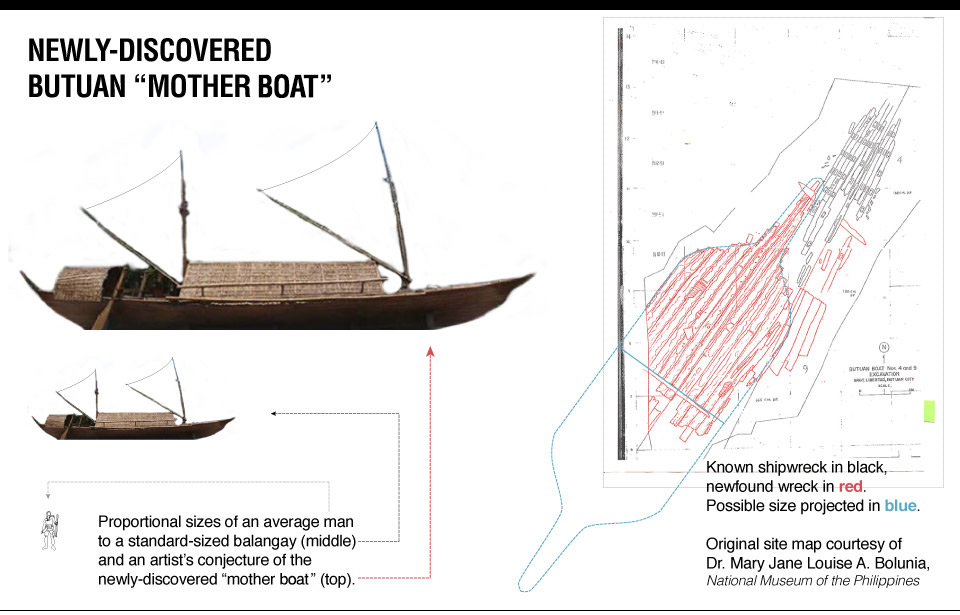
      The archeological and anthropological evidence Joaquín marshalled in writing his 1988 essay was based on the available data set at the time of his writing. The small balangay sailboats he referred to pertained to small excavated remains of boats in 1970s in Butuan, Philippines.

      In 2012, almost a quarter of a century after Joaquín published his essay, a suspected much larger balangay "mother boat" was unearthed that could disprove the things he mentioned about lack of organization, effort, skills, and tools of ancient Filipino seafarers. The discovery of the large balangay – measuring 25 meters in length compared to previously excavated balangays that measured 15 meters – could disprove his argument on the lack of maritime skills, boldness, and daring of the early island people.

      According to [National Museum archeologist Dr. Mary Jane Louise A. Bolunia], this new discovery suggests that these [the eight small vessels previously excavated] may just have been support vessels for a much larger main boat, where trade goods and other supplies were likely to have been held for safekeeping.

      The discovery also suggests that seafaring Filipinos were much more organized and centralized than previously thought. [Source: http://www.gmanetwork.com/news/story/321334/scitech/science/massive-balangay-mother-boat-unearthed-in-butuan]

      The interpretations Joaquín supplied for his thesis were based on artifacts available at the time that might be an incomplete data set in the light of recent discoveries. The latest information could bring in new perspectives that could weaken some of his impassioned opinions. It seemed like, for our essayist and seasoned cultural commentator, the absence of evidence is evidence of absence.

      All of which was but a long prelude to a review post I was planning to write on the novel Shri-Bishaya by Ramon Muzones, which came out this year from New Day Publishers in a translation by Ma. Cecilia Locsin-Nava. This was a maritime novel, in fact Muzones's second to be translated. The first was Margosatubig which like Shri-Bishaya was an "epico-historical" novel partly set in the waters of Sulu and Philippine Seas.

      Somehow the translation and publication of these two novels disproved the assertion of the writer Jose Dalisay, in an article or interview that I can no longer locate in the blogosphere, that there's a lack of novels in this part of the world that deals with the sea, which for an island nation was a bit puzzling. Well, here we have Muzones narrating in dynamic fashion the story of seafaring people gallivanting across seas, from Bornay to Paragwa (Palawan) to Aninipay/Madyaas (Panay) to Bruni (Brunei?).