28 September 2020

Notes on The Childhood of Jesus


A writer deliberately wanted to be inscrutable on the page, and it was the fault of the reader not to see the thicket for the bush. In the beginning were words, and the words were with the novelist, and the words were inscrutable to the reader. 

The title of the book was a devil trick of the novelist. The first few chapters were not indicative of any hallowed subject. The nature of the divine did not knock on the page. It was not simply granted for the atheistic reader. But why invoke the son of God into the discourse if this was not a superhero's tale?

David, the precocious boy in the book, was a Chess whiz. He easily beat an old man in a blitz chess. The man would surrender and say, 'I'll think twice before taking you on again ... You've got a real devil in you.' Can you make it any more obvious, Sir?

There definitely was something different about the boy's disposition. He doesn't like chess even if he is very talented in it. He doesn't flinch when a physical threat of violence was made right in front of him. He doesn't like violence. There was something of a pacifist, if not divine, in his comportment. But the Coetzee school of writing still resisted the equivalence of his childhood with that of sweet Jesus.

* * *

A novel is not a vaccine that could trigger an immune response to the reader. But there are certain writers who have a way with stringing words together that could trigger mass delusion on the part of the thirsty flock. An extreme case, at the end of the spectrum, was the Coelho school of writing. This was a writing characterized by an imposition of hack ideas and quack medicine about finding alignment in the universe for the circumstances to constellate into your own Personal Legend.

Another extreme case, at the other side of the spectrum, was another instance of "placebo effect", a novel variant. This was the Coetzee school of writing. This writing was not sociable, hardly helpful, full of ludic misdirections. It was not the sub-meter accurate GPS device truth-seekers yearn for. 

'What did she mean? Do you really want to push something inside her?'

'It was only a manner of speaking. She meant that I was trying to force my ideas on her. And she was right. One should not try to force ideas upon people.'

It was quite a leap: the forcing of ideas on someone (or in a novel) was satanized as sexual assault. I may be taking the dialogue out of context. In this novel, it was quite impossible to force meaning out of words when it was the meaninglessness of life itself that seemed to emerge like a castle of sand.

On page 42, a running joke on rats to prove a point that we were not reading a gospel.

'It seems to me,' he continues, 'that a growing child needs more variety, more nourishment. One cannot live on bread alone. It is not a universal food. You don't know where I can buy meat, do you ... ?

Álvaro scratches his head. 'Not around here, not around the docklands. There are people who catch rats, I have heard tell. There is no shortage of rats. But for that you will need a trap, and I don't know offhand where you would lay your hands on a good rat trap. You would probably have to make it yourself. You could use wire, with some kind of trip mechanism.'

'Rats?'

'Yes. Haven't you seen them? Whenever there are ships there are rats.'

'But who eats rats? Do you eat rats?'

'No, I wouldn't dream of it. But you asked where you could get meat, and that is all I can suggest.'

He stares long into Álvaro's eyes. He can see no sign that he is joking. Or if it is a joke, it is a very deep joke.'

A trap with a trip mechanism for catching rats? Why belabor the talk of rats when the suggestion was absurd in the first place? And this coming from a vegan author of The Lives of Animals. 

And: "One cannot leave on bread alone". We know what you're trying to do there, Mr Coetzee.

Later on, a villainous character was introduced, a new worker in the docks.

The next day a stranger makes his appearance at the docks. He is small and wiry; his skin is burned a deep walnut shade; his eyes are deep set, his nose hooked like a hawk's beak. He wears faded jeans streaked with machine oil, and scarred leather boots.

The amount of words Coetzee heaped upon the character, Señor Daga, indicated that this guy was up to no good. Here at least was a novelistic trope we could rely on.

Come pay time, all workers lined up to receive their pay. Señor Daga received money from the paymaster.

'What's this?' says Daga.

'Your pay for the days you have worked,' says Álvaro.

Daga picks up the coins and with a quick, contemptuous movement flings them back in the paymaster's face.

'What's that for?' says Álvaro.

'Rat's wage.'

'That's the rate. That's what you earned. That's what we all earn. Do you want to say we are all rats?'

Later there was fight between Señor Daga and Álvaro. Daga wounded the latter with a knife before mounting the paymaster's bicycle and skirting away.

The boy David would ask his guardian: 'Why is he called Señor Daga?'

Simón the guardian would reply: I don't know if Daga is his real name. It doesn't matter. Names don't matter. If he wants to call himself Daga, then let him.'

Throughout this part I was laughing. Names do matter, especially in the Coetzee school of writing. In Tagalog, the word daga, with the accent in the second syllable, actually means a rat. A rat's wage for a rat. Tit for tat.

* * *

So much for the first seven chapters of this first book in the Jesus trilogy. In spite of the flashes of humor, there was no reprieve for the reader. The opaqueness of its presentation, borrowing from the Kafka school of narrative, was jarring. So far, the experience (as perceived by this reader) was antithetical to the communion of reader and writer as perceived by Martin Amis.

The relationship between the writer and the reader is a mysterious one, and rather unexamined in my view. At its simplest, it’s a matter of straightforward transmission: I am telling a story. But it goes much deeper than that, until reader and writer become identical, almost indivisible. One mustn’t, of course, baby the reader, but one must be very considerate of them. The frame of this novel is a direct dialogue with the reader.

Contrary to what were emphasized above, the novelist in question (Coetzee) was very inconsiderate of the reader. To hell with the reader. And isn't it concerning that reader and writer could become one and the same, like one is being possessed by the other? That's a disenchanting thought. It's like forcing ideas on the reader.


12 September 2020

On Arlt's broken threads and mixed metaphors


The streetlamps shone feebly, their shafts of woolly light only penetrating the dark of the pavements for a couple of yards, while the rest of the suburb remained invisible. Filled with an immense sorrow, Erdosain walked on as disconsolate as a leper.

He felt as though his soul had finally become detached for ever from any human emotion. His anguish was that of a man who carries a fearful cage inside him, where prowling, blood-stained tigers yawn among a heap of fish bones, their remorseless eyes poised for their next leap.

The mixed metaphors in that passage of Roberto Arlt's were oddly cinematic. The foreboding was almost its own parody. From the walk of a leper, to the fearful cage inside Erdosain, to blood-stained, yawning tigers on a heap of fish bones, you've got to hand it to the man. The noir and hysterics combined to produce a quirky animation of a forlorn man as he walked toward the dilapidated home of the Espilas, a family of misers. 

The first time he had seen them in their new surroundings had been a great shock. The Espila family had moved into a ramshackle three-story building near Chacarita, divided up by corrugated iron sheets. From the outside the tenement looked like a huge ocean liner, with kids swarming all over it as if it were a religious commune.

The "huge ocean liner" tenement where kids swarm all over as if it was "a religious commune" – the mixed descriptions teased out the absurdity of life in the underbelly of Buenos Aires. The hint of humor, however cruel, was suppressed but it bubbled to the surface like the hiss of chemicals mixed in a beaker.

The fog blocked off the road beyond sad patches of light around the oil streetlamps. Suddenly, Luciana grasped Erdosain's arm and whispered to him:

"I care for you so much, I really do."

Erdosain shot her an ironic glance. All his anguish had turned to cruelty. He said: "I know." She went on: "I love you so much that just to please you I've studied how a blast furnace and a Bessemer converter work. D'you want me to explain what the joists are for, or how the cooling process is carried out?"

Erdosain gritted his teeth. He stumbled along the street thinking only that man's existence is absurd, and an inexplicable anger rose in him again, directed against this sweet girl who was clutching his arm.

Erdosain rejected Luciana's feelings even if she did everything – even studied the alchemy of making a copper rose – for him. He could not simply imagine a fuck up trying to woo a fuck up like himself.

In the absurd, fucked up world of The Seven Madmen, characters were mostly unemployed or down on their luck. They wallowed in the poisonous pit lake of desperation and destitution. They fired off monologues as if saying their piece of mind was enough to atone for their sins. But their unedited speeches condemned them further to a life sentence. 

"Now I've reached the end. My life is a disaster … I have to create the foulest messes for myself … to commit sin. Don't look at me. Perhaps … listen: people have forgotten the meaning of the word sin … sin is not simply a mistake … I've come to realise that sin is an act by which a man breaks the slender thread still linking him to God. It means God is denied him for ever. Even if after committing the sin that man's life were purer than the purest saint's, he could never reach God again. And I'm going to break the slender thread that connected me to divine charity. I know it. As from tomorrow, I'll be a monster on the face of this earth … just picture it, a little creature … a foetus … a foetus that was somehow living outside its mother's womb … unable to grow … covered in hair … tiny … with no fingernails … walking among men without being one itself … its fragility horrifying all those around it … and yet there's no force on earth capable of restoring it to the lost womb. That's what's going to happen to me tomorrow. I'll cut myself off from God for ever. I'll be alone on this earth. My soul and me, just the two of us. With infinity in front of us. Alone for ever. Night and day … under a yellow sun. Can you picture it? Infinity growing all the time … a yellow sun up above, and the soul which cut itself off from divine charity wandering alone and blind under that yellow sun."

Erdosain's anguish before committing murder had made him philosophical and voluble. But his self-picturing of a fetus detached from its mother's womb was the summary statement of the negated status of Arlt's lost wanderers. People lost to the womb, cut off from charity and from the source of its life force. 

In Arlt, possession of life is malum prohibitum. Unlinked from God, his characters were walking dead sinners whose mere existence was itself a crime, or a sin. In the bleak, rank world of Arlt's novel, how does one create beauty from the savagery of existence? Remove the last traces of humor and the paradox is suffocating.


04 September 2020

Stefan Zweig's shame


The quest for spices began it. From the days when the Romans, in their journeys and their wars, first acquired a taste for the hot or aromatic, the pungent or intoxicating dietetic adjuvants of the East, the Western World found it impossible to get on without a supply of Indian spices in cellar and storeroom. Lacking spices, the food of Northern Europe was unspeakably monotonous and insipid, and thus it remained far into the Middle Ages. Centuries were to elapse before the fruits, the tubers, and the other products which now seem commonplaces were to be used or acclimatized in Europe. Potatoes, tomatoes, and corn were unknown. There were no lemons to prepare acid drinks, there was no sugar for sweetening, the cheering tea and coffee were still lacking; even at the tables of the rich and the powerful, there was naught to relieve the sameness of perpetual gluttony – until, wonderful to relate, it was found that a touch of spice from the Orient, a dash of pepper, a minute addition of ground nutmeg, the mingling of a little ginger or cinnamon with the coarsest of dishes, would give an unwonted and wholesome stimulus to the jaded palate. Precious culinary overtones were interspersed between the crude treble and bass of sour and sweet, or sapid and vapid; and the still barbaric medieval gustatory nerves speedily found it impossible to dispense with these exotic flavourings. More and more of them was demanded. A dish was not properly prepared unless it had been pricked up with so gross an excess of pepper that it bit the eater's tongue immoderately. Even beer was strongly seasoned with ginger, and mulled wine was so laden with spices that it tasted like liquid fire.

Stefan Zweig's opening salvo to his biography Magellan: Conqueror of the Seas (translated from the German by Eden and Cedar Paul) set the spicy pretext for his conqueror's travel from Portugal to the Philippines in the 16th century. In search of spice in the Eastern world, a flotilla of five ships started on a circumnavigation of the Earth that ended fatefully. Zweig was in owe of his subject's audacious exploits, extolling the navigator's Conradian suffering and sacrifices at sea. The teller's motivation for writing his tale was explained in the book's introduction.

It would be well for every author to analyse what urge, what desire for personal gratification, has led him to commit his thoughts to paper. For my part I have no doubt as to the internal causes that led me to pen the present work. I did so under stress of a comparatively unusual but very powerful sentiment – that of shame.

How come shame? Apparently, Zweig felt guilt at the modern comforts afforded by his slick travels in calm seas that he could not imagine his present luck compared to the struggles of ancient voyages and sailor battling the harsh elements and dire conditions of the sea. Thus, he felt shame at his enjoyment of the amenities of the modern ship he was on.

Compare your present experiences with those of the valiant navigators who were there first to cross this ocean, and to make the world known to us. Are you not ashamed of yourself when you think of them? Try to picture how they set forth, on ships little larger than fishing-smacks, to explore the unknown, to sail they knew not whither, lost in the infinite, ceaselessly in peril, exposed to all the vicissitudes of storm, to every kind of privation.

I could almost imagine the hapless and pathetic situation of our novelist. So moved was he by the romantic idea of sailors battling the winds and tides and having to endure bad food, cramped quarters, and unbearable loneliness. There was a sigh in these pages that cried for those star-crossed spice boys marooned in their fates, "alone in the unending desert of waters". Clearly, Zweig identified with the romantic notion of danger as men ventured into the unknown "to make the world known to us". This was the very European, very Western perspective of frontier mentality. And what was in store for Zweig's civilized sailors but doom as they entered the lair of the barbarians?

And so Zweig was "thoroughly ashamed of [his] impatience" while recalling the travels of his "nameless" conquistador heroes. So he studied them in libraries to learn more of their destinies, leading him to the one person that epitomized his dream. "Was not this the most glorious Odyssey in the history of mankind, the departure of two hundred and sixty-five resolute men of whom only eighteen got back to Spain on a crumbling vessel, but with the flag of triumph flying at the masthead?" There was something fanatical and obsessive about this perspective of Zweig's. Almost pitifully, shamelessly – in spite of his initial shame – he stanned Magellan.

In recounting this Odyssey as faithfully as I could after the examination of all the documents available, I have been animated throughout by the strange feeling that I must be painting a fanciful picture, must be relating one of the great wish-dreams, one of the hallowed fairy tales of mankind. Yet what can be better than a truth which seems utterly improbable? There is always something inconceivable about man's supreme deeds, for the simple reason that they greatly transcend average human powers; but it is by performing the incredible that man regains faith in his own self.

The downside to all these fanciful picture was Zweig's deliberately Western and colonialist privileging of the white man's burden. Zweig's misplaced shame in 1937 could only be called out by asserting the point of view of the "savage". While European historians and novelists waited for the barbarians, no one really understood the barbarian within.

The historical clash between Magellan's forces and Lapulapu's warriors in 1521 provided the flashpoint in which to understand and misunderstand each other and the 'Other'. In his critical introduction to Lapulapu: The Conqueror of Magellan by Vicente Gullas (a novel translated by Erlinda K. Alburo), the critic Resil B. Mojares called into question the Western colonialist appropriation of modern history and denigration of the pre-colonial subjects.

Magellan biographer F.H.H. Guillemard (1890) saw the battle in anti-heroic terms, "a miserable skirmish with savages." Stefan Zweig (1938) wrote that the great Magellan was "felled by a ludicrous human insect named Silapulapu," who was "one of the most insignificant of the princes," and referred to the Mactanons [people of Mactan] as "a horde of naked islanders." Playing with sarcasm, Zweig write of Lapulapu's refusal to give up Magellan's body:

He valued the trophy he had won, for now the news was spreading through the islands that Silapulapu the Great had destroyed the white lord of thunder and lightning as easily as he would have destroyed a fish or a bird. [Mojares quoted from the 1938 edition of Zweig's novel titled Conqueror of the Seas: The Story of Magellan].

Mojares considered modern historians' one-sided histories, including Zweig's, as embellishments of "the bare bones of fact". The acts of imagination could be blinded or blindsided by one's limited experience or deliberate limitation of feelings. One could not blame Zweig for his spicy narrative and (racist?) narrative. After all, the "ludicrous human insect" that defeated Magellan in battle was not Gregor Samsa's transformed body but an insect beyond the horizon of shame that the novelist saw in his binoculars as he looked back to re-imagine history.

I do not have anything to say about Zweig's fictional version of history – sapid or vapid – for I have not read it except for Introduction and a few pages of the first chapter called "Navigare Necesse Est". Of Vicente Gullas's 1938 novel – to which Mojares provided his lengthy introduction – which apparently mythologizes Lapulapu on the other hand, I have nothing to say either. Mojares's honest assessment of the book was trying to convince me not to read it further.

As a novel, [Lapulapu: The Conqueror of Magellan] has few literary merits. Its plot is loose, repetitive, and episodic (in the manner of popular, serial fiction at the time) and its characters flat and sentimentalized. ... Transposing early twentieth-century realities to sixteenth century Cebu, the novel is filled with anachronisms, incongruities, and contradictions. Freely drawing from history and oral lore, Lapulapu is an excessively fictional invention.

Later Mojares would describe Gullas's novel as peddling "a mendicant form of nationalism that claims that what the West has brought has been ours all along".

Soaring free of the ground of empirical facts, he distorts the historical Lapulapu beyond recognition.

A work of fiction, Gullas' Lapulapu is the most extreme example of the reinvention of the hero.

Was Gullas "re-inventing a hero"? Was his reinvention of Lapulapu a form of "veneration without understanding"? Was the legacy of Lapulapu distorted or misunderstood, tainted enough for him to be included in Nick Joaquín's gallery of flawed heroes in A Question of Heroes.

Two unfinished books, one seemingly racist, one obviously over-fictionalized. These imagined heroisms, these hagiographies. Just what is the limit for (historical) fiction to be excessive?


22 August 2020

The death motif in Peter Weiss


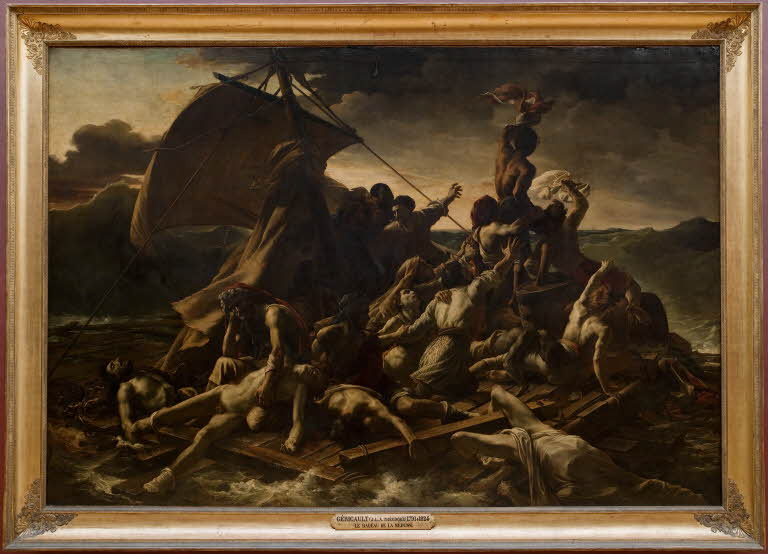
In 1817, the painter Théodore Géricault started his study of a contemporary subject for a painting, an enterprise that he took heavily to heart and that consumed him as he started painting feverishly and convulsively, in a frenetic pace and with an obsession almost akin to madness. His subject was the remains of the shipwreck of the Medusa, a French frigate that sailed with 400 people, including more than 150 soldiers on board. A raft was built for those unable to board the lifeboats. As the days passed, the number of people on the raft dwindled little by little, until only 15 individuals survived after 13 days at open sea, and after battling hunger and sickness and the inevitable descent into anarchy and cannibalism.

Le Radeau de la Méduse was the opening set piece described in the second volume of Peter Weiss's three-part pièce de résistance. The Aesthetics of Resistance was exploring the motivations and creative process behind resistance art and its relation to Marxist thinking. Joel Scott took on the reins of translation after the death of Joachim Neugroschel, who was behind the translation of volume I published fifteen years ago.

In volume I of The Aesthetics of Resistance, we could see how Weiss viewed art as transmutation of real life situations into fixed monuments, with the viewer of art as the arbiter of meanings and radical interpretations.

In transposing an actual event to the range of art, the painters had succeeded in setting up a monument to radical instants. They had shifted experience to their own present, and we, who saw each crystallization, brought it back to life. What was shown was always different than what it had emerged from, a parable was shown, a contemplation on something in the past. Things drifting by had become something lasting, freestanding, and if it possessed any realism, that was because we were suddenly touched by it, moved.

Peter Weiss's novel was a successive series of commentaries on artworks which were reflected and contemplated upon by an inquiring protagonist as he visited museums and read novels and marveled at the personal responses evoked by works such as Kafka's The Castle or Picasso's Guernica.

The discomfort and awkwardness that the painter provoked in the critics of the time who dismissed The Raft of the Medusa was an indication that the painter's resistance was never futile. Like an investigative journalist, the French painter followed his instinct and amassed all available materials he could lay his hands on to understand the essence of his subject. This technique was mirrored by Weiss who also read the same accounts of the shipwreck and provided his own critical and Marxist reading.

But the reader who in November eighteen seventeen delved into the recently published book about the shipwreck of the Medusa could see in it how the epoch in which they lived was unfolding out of narrow-mindedness, selfishness, and avarice; he saw an empire with provincial features rising up, he saw the profiteers, and he saw their victims. The suffering of the castaways on the raft of the stranded ship had left him shaken, as it had many others; the account written by the two survivors, Savigny and Corréard, which I read in the contemporaneous German translation on the night of the twentieth of September nineteen thirty-eight and into the twenty-first, introduced him to a wealth of scenes which, after a year of drafting, would result in the constellation that materialized in his great painting.

Weiss provided political commentary as well on the colonial backdrop of the frigate's sailing. But it was the milieu of tragedy that continued to shape the subject of the painting.

Immediately after rounding Cape Finisterre in good weather with a weak northeasterly, an incident occurred that placed the journey under the sign of calamity. Watching the leaping dolphins from the quarterdeck, a scream could be heard; a cabin boy, they said, had fallen overboard and, after having clung to a dangling rope for a few moments, had been carried away in the rapid movement of the ship. With the feel for precision that the authors [Savigny and Corréard] had already displayed in their listing of the participants of the expedition, and because there was nothing further to report about the victim of the accident, they now described the rescue buoy that had been thrown out. Fastened to a hawser, cobbled together out of pieces of cork, measuring a meter in diameter and bearing a small flagstick, it was able to be sketched by Géricault. 

In describing Géricault's almost madman-like work on the painting, Weiss set out to investigate the hidden motivations of an artist or novelist to give shape to some undeniable and pandemic truth. His long unbroken paragraphs were marked by shifting viewpoints and abrupt transitions from the painter to the novel's protagonist. Between the accounts of Savigny and Corréard and the composition of The Raft of the Medusa, the novelist made a hybrid account of how art imitates life and demonstrated how art breeds art. The unsettling events that led to despair and frustration, to mutiny and cannibalism of the castaways were recounted by Weiss in relation to the emerging composition of the painting. At the same time, he was describing his own vertigo as he walked the streets of Paris contemplating the painting he had just witnessed. His mind was suddenly overtaken by the Medusa. 

The actual venture into the unknown began when I had reached the street overlooking the Seine. I followed the railing to the right, suffering an attack of dizziness and delirium. A pole had been torn out of the base of the raft, erected as a mast and fastened with a tow rope, the clapping of the tatters of the sail could be heard and the torque was palpable, the irreparable twisting of the raft due to an overly long, laterally protruding piece of wood. By the second day the refusal to hand over the firearms to the sailors had already proven its purpose. Inebriated, having smashed and drunk a barrel of wine, the crew went after their superiors with axes and knives in a throng around the mast, where the officers held their ground with their pistols. In this burgeoning mutiny, the painter saw the possibility of a great composition arise.

Art's gestation in the mind, its execution, and its reception were perfected within the parameters of composition beyond the fodder materials of research. After careful or haphazard research, these materials were unlocked and distilled by the death's door, a mysterious alchemy that converted the exact dimensions of a flagstick to its scaled version in a painter's sketch, and that converted the base instincts of men into an inspiration for art. For beauty is nothing but the beginning of terror, Rilke intoned, which we are still just able to endure, / and we are so awed because it serenely disdains to annihilate us.

Weiss's narrator celebrated the company of painters that he encountered in Paris—Delacroix, Courbet, Millet, Géricault. His political activity was reinforced by his desire to visit museums, that "arsenal of images". He longed to serve the Party while luxuriating in the "limitless discoveries" afforded by "painted surfaces", losing himself as he head "into the absolute freedom of the imagination".

And if to the nameless masses, who in the alleys had stacked up the stones into barricades, I added those who had entered into the life of the city with their artworks, then I was immediately thrust into a hot and bubbling mêlée that left me gasping for air. Almost all of the people who had contributed to shaping my thought had resided here; the fact that their gazes had examined the scenes I was now seeing, that they had crossed this street, placed demands upon me for a moment that were scarcely bearable, but then it encouraged me, for none of these people had managed to transcend their beginnings in an instant either, and it was the ones who were most dear to me who had left behind evidence of their efforts and hardships.

Weiss was looking back at his experience as a youth during the period of Nazism. The narrator's affinity with the masters of canvas and paint was an outlet that fueled his political orientation. The artworks he frequented in the galleries were evidence and documentation of history. They spoke to him of the past and their currency was never in doubt. Bearing witness of their turbulent times, the dead artists, not to mention the masses, were the company he was much at home with. These dead artists were once struggling youth like him. They remained steadfast and purposeful because they faced death and did not waver. They lived to produce their art, gradually and not in an instant, courageous in the face of evil, undeterred by the incessant approach of death.

The death motif in Géricault's painting that Weiss dissected in the second volume of Ästhetik de Widerstands was the same abiding concern that W. G. Sebald attributed to Peter Weiss's works on the page and on canvas. [Related post: "The Remorse of the Heart: On Memory and Cruelty in the Work of Peter Weiss" (W. G. Sebald).] However, on reading volume II, especially the opening section on Géricault's painting, one could realize how W. G. Sebald's identification and fascination with Peter Weiss's novel was not only in terms of subject and theme but of style and form as well. Weiss's and Sebald's narrators were silent spectators to an earth-shaking event, a silent catastrophe that consumed the mind and heart. At the same time, Sebald obviously borrowed his method of artistic appropriation from Weiss—just as much from Thomas Bernhard—in annotating works of art from several removes or perspectives.

Weiss, as imitated by Sebald, provided an almost dry recounting of an artwork's provenance, giving objective historical details about its composition and then providing subjective analysis of the work. He was fascinated by the painstaking process of research that a painter like Géricault undertook—reading articles and firsthand accounts about the shipwreck, interviewing survivors, studying cadavers in the morgue to get the skin color of his figures on the palette right—in order to make the full representation of a work of art as he envisioned it in all its violent impact.

He attempted to imagine what it was like, the sinking of teeth into the throat, the leg of a dead human being, and while he drew Ugolino biting into the flesh of his sons, he learned to come to terms with it, as those on the raft had done after letting out a hurried prayer. The naked figures, huddled together on the raft, found themselves in a world deformed by fever and delusion, those still living merged with the dead by consuming them. Drifting about on the plank structure, in cloud-like waters, Géricault felt the penetration of the hand into the slit breast, the grasping of the heart of the person he had hugged goodbye on the previous day. After a week, thirty remained on the raft. The saltwater had driven the skin on their feet and legs to blister and peel, their torsos were covered with contusions and sores. Often they cried and whimpered, at most twenty of them could still hold themselves upright. In the counting and calculating from one day to the next, in the continual withering away of the heap of castaways, in the depictions of the thirst, the running dry of all that was drinkable, the drooling over urine—which bore various aromas, sometimes sweetish, sometimes acrid, of thinner or thicker consistency, cooled in a small tin container—in the description of sucking up the wine ration through a quill, which prolonged the drinking, in the incessant approach of death, the burning of one hour into the next, the painter too heard the seeping of time into infinity, and from this dripping, ticking, and flowing the painting's process of creation was set in motion.

To imagine the unimaginable, to bring to life what was brutal and horrible: is there not a more profound way for an artist to dramatize personal resistance against the brutalities of existence? Is there not a more explicit way for works of art to resist the temptations of death and forgetfulness? And is there not a more drastic way to maneuver death's being superseded by life and remembrance? From the sinking of the ship to the sinking of the teeth on flesh, the novelist's shadowing of the painter's obsession showed that resistance is justified if in the act of resisting the status quo, romantic existence was shattered to give a more panoramic context to apocalyptic events.


Le Radeau de la Méduse by Théodore Géricault (Image from Musée du Louvre)


09 August 2020

Antares

Antares by Mesándel Virtusio Arguelles (Balangay Productions, 2018)


In Antares, the poet Mesándel Virtusio Arguelles took on that very slippery of subjects. Sex. Maybe this post should contain a trigger warning. Puns.

In an almost ekphrastic or exegetic manner of delivering short lines, the poet took inspiration from the titles of arthouse sex films, borrowing them for his own subdued sex poems.
 

All About Anna
(Jessica Nilsson, 2005)
 

ang tao ay may ginagawa
upang makumpleto, na hindi niya
magagawang makumpleto.

ang tao ay pabula.
ang tao ay nakikipagtalik
upang makumpleto. Ang tao ay tamod.

ang tao ang paggawa. ang tao
ang kanyang titi puki.
Maraming hubad na tao. Buong kahubdan. 


All About Anna
(Jessica Nilsson, 2005)
 

a person does
the act, that that person will never
accomplish.

a person is fable.
a person fucks
to accomplish. A person is semen.

a person is the act. a person
is his dick, is her pussy.
So many naked persons. Full monty. 


My near literal translation almost made this a comic parody. I am quite sure Ayer's resident translator, Kristine Ong Muslim, found a more balanced and nuanced equivalent to the idioms. I am also happy to note that Muslim's translation of the entirety of Antares will appear in Three Books, in an illustrated and bilingual tripartite edition from Broken Sleep Books. Triple the fun, for a threesome.

As with Ayer's previous foray into redaction and erasure territory, the inquiry was once again directed toward knowledge of the self, the self in light of the sexual act. However, this time, the method of redaction was almost paradoxical. To censor words and sentences while revealing hidden meanings and desires. To construct an aesthetics of sex through bursts of Freudian slips, deliberate in action, climaxing into an end result known and unknown.

In "Shortbus": "It is true: self is a fabrication. / Self as seen through the lens after / having sex in a variety of positions." (trans. Muslim). In "And They Call It Summer": "Man fornicates with / himself. Everything is / exposed in the bed." (trans. Muslim). In the terminal lines of "Enter the Void", the reflexive tendency was almost simplistic.


Ang pag-ibig ay tao, maraming anyo
ng mga hindi kapani-paniwalang puwersa
ng pag-ibig, na may ganap na kahubdan

ang sex bilang sex.

***

Lovemaking is the person, there are manifold
unbelievable forces
of lovemaking, in full naked glory

of sex as sex.

(my translation)


The single line of "Much Loved" perhaps synthesized the ideas of the collection.


laman ang gumaganap sa isang tao

flesh is performance of self

(trans. Muslim)


In Antares, the act of sex is performative. "I knew many positions, but positions are positions and sex is sex", Roberto Bolaño replied to an interview question about sentimental education, from an interview on page 69 of Roberto Bolaño: The Last Interview. Bolaño admitted his folly in youth wheh he equated sentimental education with sexual education. 

Arguelles poemed the sexual education into the act of sex itself. Or maybe one should say, he sexed the poem because a poem (and its fragile translation) can be vulnerable when describing an act that compromises the sacred value of body and soul. There were many ins and outs to the poems that hovered over then skirted kitsch and camp, like the movies from where their ideas were derived.

In Antares, The poet's unraveling of the intimacy of self and selves in sex, base or soulful, was worth the rewatch of your favorite indie sex film. With ample carnal, I mean kernels, of truth on display, this trove of lustful aphorisms is lit.


Read the translator's notes here and excerpts here and here.