01 December 2014

Sebald's art of restitution


The Emergence of Memory: Conversations With W. G. Sebald, ed. Lynne Sharon Schwartz (Seven Stories Press, 2010)


"So what is literature good for?" asked Sebald in an essay which appeared in his posthumous collection Campo Santo. He quoted Hölderlin at length before giving a direct answer.

Am I, Hölderlin asked himself, to fare like the thousands who in their springtime days lived in both foreboding and love but were seized by the avenging Parcae on a drunken day, secretly and silently betrayed, to do penance in the dark of an all too sober realm where wild confusion prevails in the treacherous light, where they count slow time in frost and drought, and man still praises immortality in sighs alone? The synoptic view across the barrier of death presented by the poet in these lines is both overshadowed and illuminated, however, by the memory of those to whom the greatest injustice was done.

The answer came at the penultimate sentence of the essay. "There are many forms of writing," he noted; "only in literature, however, can there be an attempt at restitution over and above the mere recital of facts, and over and above scholarship."

For Sebald, restitution was a delicate function of literature that must be pursued creatively, actively, and at all costs. The object of such restitution was memory ("the memory of those to whom the greatest injustice was done"). As Ruth Franklin wrote in "Rings of Smoke," the penultimate essay in The Emergence of Memory: Conversations With W. G. Sebald: "Art is the preserver of memory, but it is also the destroyer of memory."

This is the final tug-of-war in Sebald's work and the most fundamental one. As he searches for patterns in the constellation of grief that his books record, he runs the risk that the patterns themselves, by virtue of their very beauty, will extinguish the grief that they seek to contain. Sebald's peculiar alchemy of aestheticism and sorrow unwittingly underscores its own insubstantiality. Even as he investigates the roots of memory, Sebald, like the weavers whom he finds so emblematic, continually unravels his own creations.

Unraveling was the fate of Sebald's narrators in their life and in their work, whether artistic or occupational work. This was the "destructive" working method of the painter Max Ferber in The Emigrants. "When memory is lacking, art will suffice," Franklin observed in the tendency of Sebald's narrators to use artworks (paintings) as surrogate or representation of their anguish. "Sebald aestheticizes history, but he never mistakes history for art."

Franklin's inquiry led her to question Sebald's "shocking" "ahistorical" treatment of air war in his controversial lectures about the carpet bombing of Germany in World War II. Sebald did not give a political or moral context to his taking to task the German writers for failing to write about their experiences in the imaginative sphere of fiction.

Sebald's patterning amounts to an aestheticizing of catastrophe, and thus it annihilates causality. We appreciate the beauty of the image that the writer discerns, but it adds nothing to our understanding of why things happened as they did. And this is the great problem with a "natural history" of the bombings [in his "Air War and Literature" lectures]. The air war over Hitler's Germany was not a natural disaster, like the eclipse of 1502. It was not random in its causes or its effects; and so, morally speaking, it was worse than a natural disaster. The bombings may have the physical impact of an earthquake, but they cannot be understood in the same way, because to do so is to ignore the fact that this catastrophe was man-made, a human action, and thus more complicated and more terrible than another inevitable repetition of nature's rich but meaningless pattern of disaster.

Franklin here assumed that the lack of historical context in Sebald's lectures and narratives about man-made catastrophes "adds nothing" to the comprehension of these tragic events. Sebald's use of the "natural history" framework was problematic, according to her, because of the apparent gloss over the moral (human) transactions that accompany wartime disasters. Franklin's literal interpretation of "natural" in natural history excluded human nature which was still part of the "ecosystem approach" to history.

Sebald's ecological philosophy was in fact more complex than she gave him credit for. Franklin's focus on the agency of decision making in man-made disasters failed to recognize how, throughout history, violence was a natural state of humans. Sebald's depiction of environmental disasters, whether natural or man-made (e.g., the declining population of the herring and the powerful hurricane that leveled millions of trees in The Rings of Saturn), was not much explored in criticism about him.

In Sebaldian poetics, environmental collapse was closely aligned with the collapse or breakdown of morals. As he said in an interview, "We're living exactly on the borderline between the natural world from which we are being driven out, or we're driving ourselves out of it, and that other world which is generated by our brain cells."

Moreover, the metaphoric use of natural disasters for man-made disasters was closely related with how cruelty and violence were hardwired in humans. The mess produced by wars had the same or comparable destructive impact or effect as, say, extreme weather events. (Even our capacity for self-destruction was more and more evident with the way we influence the climate system to give rise to anthropogenic climate change.) Sebald's "natural history" should in fact be read in terms of his "ecopoetics." Critics have yet to give emphasis, let alone explore, the ecological aspect of his writings.

Franklin went on to question Sebald's tendency to equate gap in literature with gaps in memory. "Sebald looks to art to fill gaps in memory, and the air war is his own biggest gap," she noted, and later she went on, "But gaps in memory are experience that is forever lost; and art cannot take its place."

Art surely cannot replace memory but it can build or (re)imagine one. If it is successful in doing so then it can bring something tangible or intangible to its readers. It could offer consolation or engender sympathy. Or it could convey simple understanding or suggest hints of recognition. Sebald's essays and stories were in fact an attempt at restitution through the recreation or preservation of memories. So that the individual stories would not simply vanish in smoke.



Conversations with Sebald


The Emergence of Memory: Conversations With W. G. Sebald, ed. Lynne Sharon Schwartz (Seven Stories Press, 2010)


https://beautyisasleepingcat.wordpress.com/2014/09/25/announcing-german-literature-month-iv-november-2014-2/


I had a good reading plan for German Literature Month—including writing something about one volume from Thomas Bernhard's masterful memoirs, a play by Peter Weiss, a journal issue dedicated to Robert Walser, and a novel by Elfriede Jelinek. But alas, the month was over and I only managed to cover a book of interviews with and essays about W. G. Sebald. It was not even strictly a German book although it offered critical readings of Sebald's works in German or in translation and candid conversations with him about his themes, his influences, and his writing methods.

The pieces in The Emergence of Memory reveal important aspects of Sebald's spectral writings and personality which added to an appreciation of his literary enterprise. That project was centered on elusive, illusory memory and truth and their recovery and representations in art and literature. The greatest essays in this book were those that attempt to describe the nuances of his project, its totality, and its vision. An essay by Tim Parks, for example, tried to define the core of Sebald's vision as "engagement in the present inevitably ... devouring the past." (However, I disagree with Parks's characterization of his prose style as "much lighter" and "more flexible" than Thomas Bernhard's.)

In interviews Sebald made frequent mentions of the "conspiracy of silence" about German war crimes and war experiences in his household, community, and university. This seemed to be the main thing that his writings were trying to respond to. His temperament was often seen as melancholic, his disposition as pessimist. And yet these views were grounded in a playful mental landscape. His powers of association were an instance of a wandering imagination; his solitary walks and constant agitations were not symptoms of a decadent spirit. He was a loner engaged in the natural state of his natural world. Destruction and ruins and madness were the ashes from which he found words of staggering beauty. Nothing could be more paradoxical than Sebald's finding beauty in destruction.

It is a characteristic of our species, in evolutionary terms, that we are a species in despair, for a number of reasons. Because we have created an environment for us which isn't what it should be. And we're out of our depth all the time. We're living exactly on the borderline between the natural world from which we are being driven out, or we're driving ourselves out of it, and that other world which is generated by our brain cells. And so clearly that fault line runs right through our physical and emotional makeup. And probably where these tectonic plates rub against each other is where the sources of pain are. Memory is one of those phenomena. It's what qualifies us as emotional creatures, psychozootica or however one might describe them.

Deadpan as always. The border between comedy and tragedy in Sebald could hardly matter at all. Tragedy could be uplifting? It could offer consolation? It was a matter of perspective.

There is of course a degree of self-deception at work when you're looking at the past, even if you redesign it in terms of tragedy, because tragedy is still a pattern of order and an attempt to give meaning to something, to a life or to a series of lives. It's still, as it were, a positive way of looking at things. Whereas, in fact, it might just have been one damn thing after another with no sense to it at all.

In writing about horrific subjects, the necessity for restraint was not only a literary requirement. Restraint had to be the only way to get to the core of cruelty and violence. A reinforcement, if not a variation, of Adorno's dictum.

I've always felt that it was necessary above all to write about the history of persecution, of vilification of minorities, the attempt, well-nigh achieved, to eradicate a whole people. And I was, in pursuing these ideas, at the same time conscious that it's practically impossible to do this; to write about concentration camps in my view is practically impossible. So you need to find ways of convincing the reader that this is something on your mind but that you do not necessarily roll out, you know, on every other page. The reader needs to be prompted that the narrator has a conscience, that he is and has been perhaps for a long time engaged with these questions. And this is why the main scenes of horror are never directly addressed. I think it is sufficient to remind people, because we've all seen images, but these images militate against our capacity for discursive thinking, for reflecting upon these things. And also paralyze, as it were, our moral capacity. So the only way in which one can approach these things, in my view, is obliquely, tangentially, by reference rather than by direct confrontation.

Two other fascinating essays in the book were contributed by Michael Hofmann and Ruth Franklin. Hofmann was critical of Sebald. His short review essay was puzzled (bitter) at Sebald's success, while Franklin's essay was incisive yet possibly misdirected. I will try to post something on them later.


The November German Lit Month is hosted by Caroline (Beauty is a Sleeping Cat) and Lizzy (Lizzy's Literary Life).


05 November 2014

Antipoems


Antipoems: New and Selected by Nicanor Parra, ed. David Unger, tr. Lawrence Ferlinghetti, Allen Ginsberg, Edith Grossman, et al. (New Directions, 1985)

Antipoems: How to Look Better & Feel Great by Nicanor Parra, antitranslation by Liz Werner (New Directions, 2004)


The antipoet's persona(lity), as relayed in his antipoems, was of one grumpy extraordinaire. He was frank and tactless. He was absolutely cantankerous. He was not sentimental. You wouldn't want to cross paths with him.

I'm Not a Sentimental Old Man

a baby leaves me absolutely cold
I wouldn't take a baby in my arms
even if the world were caving in
every man scratches his own itch
I can't stand family get-togethers
I'd rather be horsewhipped
than play with my nephews
my grandchildren don't move me very much either
what I mean is they set my nerves on edge
the second they see me come back from the coast
they come running at me with open arms
as if I were Santa Claus
little sons of bitches!
who the hell do they think I am

[tr. Miller Williams]

If this is not "antipoetry", then I don't know what is. At 100 years of age, Nicanor Parra is the immortal founder of a decidedly anti-poetry movement. He is the Satan Claus of Chilean/Latin American/world poetry. He was an evil old man. He had a soft spot for chickens.

XXIX
A little friendly advice:
DON'T CLIP THE WINGS OF YOUR CHICKENS
they have as much right to fly as anyone
certain housewives
indulge in this diabolic practice
it is better to lose a chicken
than commit the unpardonable sin
of believing ourselves capable
of improving on the plan of the Creator:

if He in his infinite wisdom
provided them with wings
he must have had a powerfully good reason
even if it seems ridiculous to us.

[tr. Sandra Reyes, from New Sermons and Preachings of the Christ of Elqui (1979)]

This brand of poetry called antipoetry was more a worldview than a movement. On its surface, it was more like personal stuff than philosophical slash political stance. More myth than legend. If there was a guiding principle to it, then perhaps it was the anti-establishment position. A show of bravery and bravado, it knew not serious pretense nor preternatural seriousness. It was a show of freedom more than anything else.

I don't understate nor exalt anything.
I simply tell what I see.

["Nineteen-Thirty", tr. Miller Williams, from Nebula (1950)]

"I call a spade a spade", the antipoet wrote elsewhere, in "Letters from a Poet Who Sleeps in a Chair". Words to live by. How not to take oneself seriously. How not to take the poet himself seriously. Tell, don't show.

Generous reader
                         burn this book
It's not at all what I wanted to say
Though it was written in blood
It's not what I wanted to say.

..................................................

Listen to my last word:
I take back everything I've said.
With the greatest bitterness in the world
I take back everything I've said.

["I Take Back Everything I've Said", tr. Miller Williams]

The disclaimer, most definitive, was the order of the day. Say something with conviction, then take it back with conviction. Bite the dust! The antipoems maximized the use of maxims. And since we were in the realm of self-empowerment, the antipoet was preaching to the choir and atheists both. The genre was as much self-help nonfiction as antipoetry.

V
Young poets
Say whatever you want
Pick your own style
Too much blood has gone under the bridge
To still believe—I believe—
That there's only one way to cross the road:
You can do anything in poetry.

["Letters from a Poet Who Sleeps in a Chair", tr. David Unger, from Emergency Poems (1972)]

The Christ of Elqui, based on the real life Domingo Zárate Vega, was perfect stand-in for the anti-Christ Parra. The "sermons and preachings" mode of antipoetry was custom-made for the mad, apocalyptic ravings of a peripatetic messiah-like figure wandering the streets of Chile in the 1920s. "Even though I come prepared / I really don't know where to begin", the Christ began rather self-contradictorily. The resemblance of his Christian ideas with those of the antipoet's was uncanny.

you have to call a spade a spade
we're a step away from the Apocalypse

["The Christ of Elqui Defends Himself Like a Cornered Cat", tr. David Unger, from Recent Sermons (1983)]

let's cut the crap
when you stand at a wide open grave
it's time to call a spade a spade:
you can drown your sorrows at the wake
we're stuck at the bottom of the pit.

["Rest in Peace", tr. Edith Grossman]

In "Memories of a Coffin" (1975), the spade in the graveyard made way for the personified coffin whose life in the showroom "took a 180˚ turn" when the coffin was purchased by a widow. Then came the "most glorious day of [its] life", when it was paraded and it believed it was receiving solemn respect from "all the pedestrians [it] met along the way". Until it was buried. Six feet under the ground, the coffin was "under a ton of flowers" and now waits for things to happen to it. Tragic.

To end this anti-post, more words of wisdom from the Christ of Elqui.

POETRY POETRY it's all poetry
we make poetry
even when we're going to the bathroom

Christ of Elqui's own words

to piss is to make poetry
as poetic as strumming a lute
or shitting poeticizing farting,
and so we'll just see what poetry is

Prophet of Elqui's own words

["Apropos of Nothing", antitr. Liz Werner]

To piss is to make poetry. How sublime.

Art happens every time we read a poem, said Borges, paraphrasing the American painter Whistler. What happens when one reads an antipoem? In his "Note on the Lessons of Antipoetry", Parra would only acknowledge that: "Poetry happens—so does antipoetry". Artful or not, Parra cuts the bullshit.


The reading of Parra is made with Richard—Caravana de recuerdos—and Tom—Wuthering Expectations. Richard's post is found here while Tom's are here, here, and here.


03 November 2014

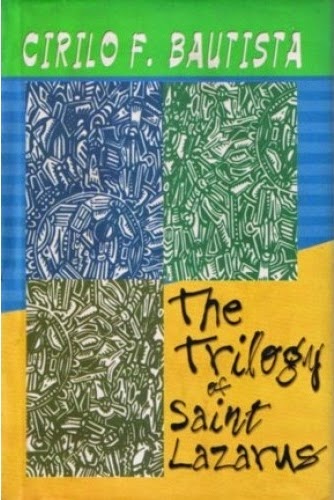
On The Trilogy of Saint Lazarus


The Trilogy of Saint Lazarus by Cirilo F. Bautista (De La Salle University Press, 2012)


http://www.vibebookstore.com/the-trilogy-of-saint-lazarus.html


In his foreword to the three collected volumes of his poetic trilogy, Cirilo F. Bautista, recently elected as National Artist of the Philippines, explained his motivation for his undertaking the writing of an epic poem.

In 1967, I realized that I could not be writing poetry all my life. Not only was it impractical for me to engage in a profession patronized by a negligible sector of society but I also had other interests in mind. But before I ceased writing poetry, I had to finish a project that would justify such a stoppage.... I decided I would write an epic trilogy about the development of the Filipino soul from the very start of Philippine history to the twentieth century. I would call it The Trilogy of Saint Lazarus, Saint Lazarus being the original name the Spanish colonizers gave our country in honor of the worker-saint. For it was on March 16, [1521] the feastday of the saint, that they sighted the Archipelago.

...

The story in the trilogy builds upon the discourses of various [historical] personas—their cogitations, explications, justifications, and interpretations of the significant realities that affected their time and milieu in connection with the nation's struggle for selfhood and freedom. The events and circumstances that connect them are told not in chronological sequence ... but in psychological sequence, the focus being the passionate retrieval of national memories. Each of the voices in the plot relates a story or several stories, and these stories merge and submerge with each other in interrogative and confirmative moods.

1. The Archipelago 

Of Malacca, the Portuguese wine bowl in Ior,
Cramped with cloves and nutmegs kings bent maps for, moving
The sun by Papal error higher and lower
Than the fish, amongst waterlilies and metals,
How shall I sing the blood? Ruyfarelo lost in
His islands which like chesspieces lynched their mover.
Serrano gone. Caño, Loaysa, Saavedra:
Gone. If it is a virtue polishes the sword and
Denies its teeth, I am rock who this dark island
Coveted, and am weeping. The ship we rode, the ship
We cut the whales with when powder and prayer would
Not blind their nose—to know how much my foreparents
Stamped their limbs in the vineyard, crushing the olives
And the light to put as by magic chocolated
Bread on a square of table, to hear the clang of ax
That broke butter, will show how lumber rules the high seas,
How salt is the price of sceptre. Gone. Olive. Onion.

The first part of Cirilo F. Bautista's famous lyrical epic is called The Archipelago. It contains some very good lines of poetry. In terms of scope, theme, and stylistic flourishes, the trilogy is a truly national epic. The entire work is obviously a labor of love, having been constructed over a period of years: over three decades! Bautista clearly wanted to display his talent through the use of different poetic registers (sometimes narrative, sometimes dialectical like dialogues in a play), various line lengths and divisions (long lines, short and clipped lines, lines cut at various indentations), and various points of view. The use of lines of various lengths creates a kind of symphonic diversity and makes for a dynamic rhythm and cadence. Like all the good poems, I think this was meant to be recited. It could certainly be adapted as a musical or play. I would have liked to listen to the varied sounds of this poem and see how it will be interpreted on stage, complete with costumes by Spanish conquistadors and native peoples. Some of the speakers are easily identified and recognizable. The voices are dominated by historical figures like Ferdinand Magellan, Miguel López de Legazpi, Limahon, and Rizal. The quotations from historians Antonio de Morga and Pigafetta, etc., in the epigraphs provide a clue as to which historical sources were consulted in the writing of the poem.

2. Telex Moon

The middle part of the trilogy is a departure from the first part's diverse form. In place of variable lengths of the lines, varied indentations, and varying stanza lengths is a strict sequence of quintains (stanzas of five lines) all throughout this second book.

The multiple voices in the first part give way to the single voice of the national hero. The epic shifts from many perspectives and places to one quiet and intimate sojourn in Dapitan, right before Rizal's death in Luneta. Rizal meditates on religion, on love, on armed revolution versus pacifism, on the "house of memory", on life in the city.

The internal rhymes and alliterations are sustained for long stretches. Brilliant really. But rather than staid, straight lines, the rhythm is often broken by punctuations—e.g., by a series of em dashes, or long passages in "quotations"—and sometimes lines within poetic lines are signified by slashes ("/").

The image of the telex is elaborate and complex, but it is playfully introduced.

The sex of telex brings the grex an ax,
tells exactly the factly lack of lex
though in electric stockrooms it is rex;
its shocky hair that shakes the air mirific

connects the coin machines to the dreamers
in the stars, twenty-one ladders to Mars
with no crossroad in the main, and every brain
pulsing to the monetary tune....

I don't completely understand the image of the telex moon but it is quite curious.

... Slowly—electric nervure—

once embossed in cornfields and banana groves—
chiselled in emblazonry—coaxes now
to bloom the telex moon! The rooty galax—
the rootless galaxy—the telstar legion

all flow magically to coax the telex
moon! And out of the escutcheon jumps
the telex moon! The fecund—the fictive—
the florid! Telex moon! Pollex moon! For

from afar it measures a finger long—
a finger song—from side to side/ It contains
the techniques—the tactics for clarity
and form—but none of the erotica

the City drags its bones by/

Bautista luxuriates in wordplay and fancy word combinations here. Telex is the prototype of mobile phone. It can represent the modern city, its technology and its evils. It can represent modern progress through faster communication. It is an instrument that can bridge the past and present. Sort of like telepathy through time, or time travel. The past and present can coincide through memory. In this section, the story of Rizal still has relevance to the present and still communicates something to us.

The moon's classical meaning is death. And death is constant in the same way that the moon is always out there, a satellite orbiting the earth. Telex moon is the enduring witness to Rizal's despair while in exile in Dapitan and also the same witness to his death in Bagumbayan. Right now, above us is the telex moon, beaming a silent message through light: time is eternal, history is a cycle.

3. Sunlight on Broken Stones

With Sunlight on Broken Stones, it becomes obvious that Bautista is concerned with the political trajectory of Philippine history. This final volume is an ethical poetic sequence describing the challenges faced by the country in instituting good governance. It describes the "broken" condition of the country in the aftermath of colonialism (Spain, America, Japan) and neocolonialism characterized by endemic corruption in government (at all levels!), endless hunger and poverty, oligarchy, and military abuses.

The epic has become a little closer to current events, spanning the period of Martial Law right up to People Power Revolution and the years under Cory. For the Marcos babies, the references to Marcos, Imelda, Cory, and Cardinal Sin are recognizable.

Marcos:

... Why then should I hide
anything when I have nothing to hide? Look
at the medals that fill my chests, and the bright
citations embracing my walls—are they not

the categorical imprimatur on
my legitimacy?

We also hear the first person monologues of national heroes Bonifacio and Rizal and, also from beyond the grave, the dead Marcos despairing over Cory's refusal to allow his corpse to return home from Hawaii.

There's Imelda vs Cory (+ Cardinal Sin); + their dead hubbies:

... "Revenge is mine," says one, and will not
permit homecoming for a corpse. "Must I mourn
till the close of doom?" says the other, and oils
the gearsprings that feed her money. How many
times must memory mock their bright peacock pride?

Tarmac-hero? Christ-like tyrant? Their husbands
are dead weights now though the cardinal with some
crazy name would canonize the first, condemn
the second, as if Virtue resided in
his fingertips.

An interesting passage is one attributed to Tolstoy, from a section which contains one epigraph after another. It perpetuates the cliche (especially among our national writers) about the "collective" imaginings of a race, contained in so-called "national literatures":

However important a political
literature may be, a literature
that reflects society's passing problems, and
however necessary to national

progress, there is however, still another
type of literature that reflects the true
eternal necessities of all mankind,
the dearest and deepest imaginings of
a whole race, one that is accessible to

all and to every age, one without which no
people has been able to grow powerful
and fertile.—L. Tolstoy, 1859.

As to the title, the "sunlight" signifies hope after a long period of shadows and darkness hovering over the "broken" spirit of the Filipino people.

"And what language must rise out of broken stones
that serve as landscapes for a people's desire
to relight the fire of harmony and strength
?
Where are they now, the words Jaena splattered
at Barcelona and Madrid in splendid

"subversiveness? Where are the contracts for death,
or for life, that rich men and poor men inscribed
with the blood of their faith in reckless pursuit
of a common rule?"

In terms of geography, the Philippines is a pile of "broken stones" because of its archipelagic nature. In historical terms, the country is broken by colonization of three imperial powers and later (up to the turn of the twenty-first century) by the rule of the oligarchs and the elite, the often corrupt leaders who, with impunity, plundered the country of its resources. Notwithstanding the reign of these modern-day conquistadors, Bautista's elegy ends with an unqualified hope derived, in part, from embracing the lessons of history.

          Keep the books now
the won patrimony
all letters not fetters
to announce the anthem
           to the four winds

          Keep eternal
account of our shared griefs
and pains   gaiety and goals
gold lost    now recovered
           birthright returned


06 October 2014

Bullfight


Bullfight by Inoue Yasushi, tr. Michael Emmerich (Pushkin Press, 2013)


Prior to the bullfights that culminated this Japanese story, Mr. Tsugami, the bold editor-in-chief of the Osaka New Evening Post who risked to organized the event together with a gambling showman Tashiro, hosted a pre-tournament dinner for the owners of the bulls and his reporters. During the feast, he and his guests "found themselves witnessing a startling scene":

The owner of one of the bulls regarded as an obvious contender for first place, a woman named Mitani Hana, suddenly started shouting hysterically, kicked over her tray, and got up from her seat. She was a plump woman whose clothes revealed a certain flair that was hardly typical of a forty-something housewife from a small farm.

"As if I'd drink from a cup you filled, Mr. Kawasaki—you of all people! I've put my life on the line for this! Right about now my old man and the kids are dumping cold water over themselves back home, purifying themselves and praying that we win!"

Her expression was pleasantly taut, her face slightly flushed from two or three cups of sake; she leaned unsteadily against one of the sliding, paper-paneled walls as she yelled, her gaze roaming over the faces in the room. She was not drunk. The fierce intensity of her desire to see her bull win had stretched her nerves to the limit, pushing her into a state resembling temporary insanity. The Kawasaki bull stood right up there with the Mitani bull as a potential winner, and when that other bull's owner had filled her cup she had been unable to suppress the gush of antagonism that welled up within her, all the stronger because she was a woman and he was a man.

The fierce competitiveness overtly displayed by the Mitani woman was emblematic of the Japanese competitiveness that characterized the country in the years leading to the second world war. (This competitiveness was also present in Kawabata Yasunari's The Master of Go.) The setting of Inoue Yasushi's 1949 Akutagawa Prize-winning story was postwar Osaka where the residue of violence and combat still hangs in the air, albeit in the form of ruins and destruction. An altogether different set of social norms was in place. The former middle class used to luxury items had almost  been decimated; they would now be buying third-tier seat tickets in the bullring. Ringside seats would now be taken over by the “new salaried class.” As one character saw it: “Times had changed utterly since the war ended.” There was not a hint of irony in his statement.

In these postwar days, perhaps this was just the sort of thing the Japanese needed if they were going to keep struggling through their lives. Set up some random event for people to bet on, and everything would take care of itself: they would come and place their bets. Just imagine it—tens of thousands of spectators betting on a bullfight in a stadium hemmed in on every side by the ruined city…. In times like these, bull sumo was as much as people could manage.

Bull sumo or bullfighting. Just imagine it. A distraction for a people still hurting from their defeat in the war. Any story could easily take advantage of the economic realities and psychological downturn of a ruined city. Bullfight was a portrait of a society picking up the remaining pieces of lives scarred by firebombings. The reality of war hovered in every scene, haunting the air like a bad hangover. The city was charred in places. The inhabitants were in low spirit. The war was over. Japan had finally embraced pacifism. It may finally be an opportune time for some hard-earned entertainment.

The better part of Inoue's story described the logistical difficulties and the bureaucratic wranglings as Tashiro, Tsugami, and his assistants tried to hurdle many setbacks in putting up an ambitious, expensive three-day bull sumo event for the people to shell out money for. What seemed at first a straightforward preparation for a straight entertainment for the masses became an enterprise more and more quixotic as everything seemed to conspire against Tsugami and Tashiro's project. Tsugami already had an inkling of the economic risks; his pride and ambitiousness were tested as unforeseen problems cropped up at the last minute. His team had to skillfully negotiate with various stakeholders, including some shady and ruthless characters, to see the bull sumo project through. In requesting permission to hold a fireworks display, for example, postwar circumstances again made the request likely to be denied:

The town authorities were hesitant because this would be the first aerial firework display since the end of the war, and of course rules governing the use of gunpowder were very strict; they would do what they could to help, but they couldn’t say for certain that permission would be granted as a matter of course.

The wartime setting of story and the quick character sketches made for a fascinating combo. The bullfight was launching pad for Inoue's exploration of Japanese attitudes after the war. Tsugami himself was a man of complexity, tinged by an “unsavory side” according to his lover Sakiko with whom he shared an unstable relationship. He had a cold, icy character, reminiscent in some ways of the character of Shimamura in Kawabata Yasunari’s Snow Country. Tsugami's relationship with Sakiko was a reflection of the lead characters in Kawabata's impassioned novel. But where Shimamura was presented as nothing more than a cold aesthete, Tsugami was cold-blooded and calculating. Tsugami and Sakiko's love affair was on the rocks; they could either make or break it, depending on the outcome of their "mental fighting" which could be as decisive as two bulls locking horns together.

The translator Michael Emmerich was able to convey Inoue's crisp descriptions of characters. To stitch together Inoue's efficient prose, he often maximized the power of semicolon, a punctuation that does not waste a stray conjunction.

The creases in his pants were invariably crisp; he was nimble both in his interactions with visitors and in the manner in which he disposed of his work, and sharp to the extent that he sometimes came across as unfeeling…. They said he was loose with money, or smug, or an egoist, or a stylist, or a literature boy, and to an extent the criticisms they leveled at him hit the mark; but these very faults lent him an intellectual air that set him apart from most city news reporters.

Inoue managed to pack a lot of human observations in this elegant novella. The bull sumo was almost a side event in his exploration of the ethical aspect of human transactions; the lead up to main event was almost an excuse to investigate human profiteering and shady deals of businessmen. The novelist shrewdly introduced extreme situations to generate the responses he want from his characters.

“I have an urgent need for three hundred and sixty liters each of rice, barley, and sake.”

The quantities Tsugami named were much larger than was necessary. He was using this request as a way to plumb the depths of Okabe’s personality, his badness or his goodness—to take the measure of this man who, though this was only their second meeting, he had already discovered was peculiarly difficult to figure out. Tsugami was curious to see how Okabe would respond.”

Tsugami's opportunism in this instance was the same as the novelist's. Inoue plumbed the depths of his characters’ personalities, their quirks and weaknesses. He tried to figure out how they would respond considering the possible consequences of their decisions, the risky choices they made. It was what made Bullfight a beautiful, nuanced, often intense observation of human nature.


A selection for the Japanese Literature Challenge 8, hosted by dolce bellezza. My copy of the book courtesy of Lines from the Horizon and Pushkin Press.