10 September 2016

Nick Joaquín's small rowboat


"Society for the Filipino is a small rowboat: the barangay," wrote Nick Joaquín in the beginning of "A Heritage of Smallness," one of the essays in Culture and History (1988). This provocative essay made the argument that the Filipinos' tendency to act on the small scale was detrimental to the development of their society and culture. This includes the Filipino writers' apparent preference for writing short stories. The lack of novels in the country was proof of the Filipino writers fearing the daring and bold enterprise. This habit of "thinking small" was, for Joaquín, a recipe for poverty and pettiness. The Philippine national heritage, according to him, was nothing but "a heritage of smallness."

However far we go back in our history it's the small we find – the nipa hut, the barangay, the petty kingship, the slight tillage, the tingi [retail] trade. All our artifacts are miniatures, and so is our folk literature, which is mostly proverbs, or dogmas in miniature. About the one big labor we can point to in our remote past is the [Banaue] rice terraces – and even that grandeur shrinks, on scrutiny, into numberless little separate plots, into a series of layers added to previous ones, all this being the accumulation of ages of small routine efforts (like a colony of anthills) rather than one grand labor following one grand design. ... Many little efforts, however perfect each in itself, still cannot equal one single epic creation. ... [Y]ou could stack up all the best short stories you can think of and still not have enough to outweigh a mountain like War and Peace.

The depressing fact in Philippine history is what seems to be our native aversion to the large venture, the big risk, the bold extensive enterprise. The pattern may have been set by the migrations. We try to equate the odyssey of the migrating barangays with that of the Pilgrim Fathers of America, but a glance at the map suffices to show the difference between the two ventures. One was a voyage across an ocean into an unknown world; the other was a going to and fro among neighboring islands. One was a blind leap into space; the other seems, in comparison, a mere crossing of rivers. The nature of the one required organization, a sustained effort, special skills, special tools, the building of large ships. The nature of the other is revealed by its vehicle, the barangay, which is a small rowboat, not a seafaring vessel designed for long distances or the avenues of the ocean.

Like his predecessor José Rizal before him who lamented the "indolence of the Filipinos", Joaquín was here lamenting the lack of imagination of his compatriots. The barangays he talked about referred to the smallest political unit in the country, roughly the same as barrios or villages. The word had its origin from balangay which was the sailing vessel the ancient inhabitants of the islands used as transport within the archipelago and neighboring regions.

Philippine society, as though fearing bigness, ever tends to revert to the condition of the barangay: of the small enclosed society. We don’t grow like a seed, we split like an amoeba. The moment a town grows big it become two towns. The moment a province becomes populous it disintegrates into two or three smaller provinces. The excuse offered for divisions is always the alleged difficulty of administering so huge an entity. ... What we're admitting is that, on the big scale, we can’t be efficient; we are capable only of the small. The decentralization and barrio-autonomy movement expresses our craving to return to the one unit of society we feel adequate to: the barangay, with its 30 to a hundred families. Anything larger intimidates. We would deliberately limit ourselves to the small performance.

The exhortation of Joaquín was premised on his study of Philippine artifacts that constitute the national cultural heritage. Specifically he observed three things about them: (i) the Filipinos worked best on small things ("tiny figurines, small pots, filigree work in gold or silver, decorative arabesques"); (ii) they worked in soft and easy materials like "clay, molten metal, tree bark and vine pulp, and the softer woods and stones"; and (iii) they tended to rut in his mastered skill ("material, craft or product") and did not move on to a higher level. For these assertions, he offered examples in pottery, agriculture, and wooden sculpture.

In contrast to this, the writer offered Christian statuary and architecture as indicating a semblance of a "heritage of greatness." He added three critical phases in the Spanish colonial period: the defense of the land against two centuries of attempt of Dutch and British invaders to conquer the islands; the Propaganda Movement; and the 1896 Philippine Revolution against Spain.

There were a lot of things to quibble about Joaquín's essay. His assessment was too harsh. Yet one could not easily dismiss him as having a "colonized mind" for extolling the Spanish virtues and contribution to Philippine culture. The essay was presented as a challenge for present readers not too "blame our inability to sustain the big effort on" colonialism. This was a sore point, for "colonial mentality" was a legacy that calcified in the country after one colonial regime was replaced by another (by Americans), then further replaced by the Marcos dictatorship, and after a series of "people power" revolutions – the recent ones becoming more and more dubious through time – we have the current specter of postcolonial or neocolonial capitalism.

The archeological and anthropological evidence Joaquín marshalled in writing his 1988 essay was based on the available data set at the time of his writing. The small balangay sailboats he referred to pertained to small excavated remains of boats in 1970s in Butuan, Philippines.

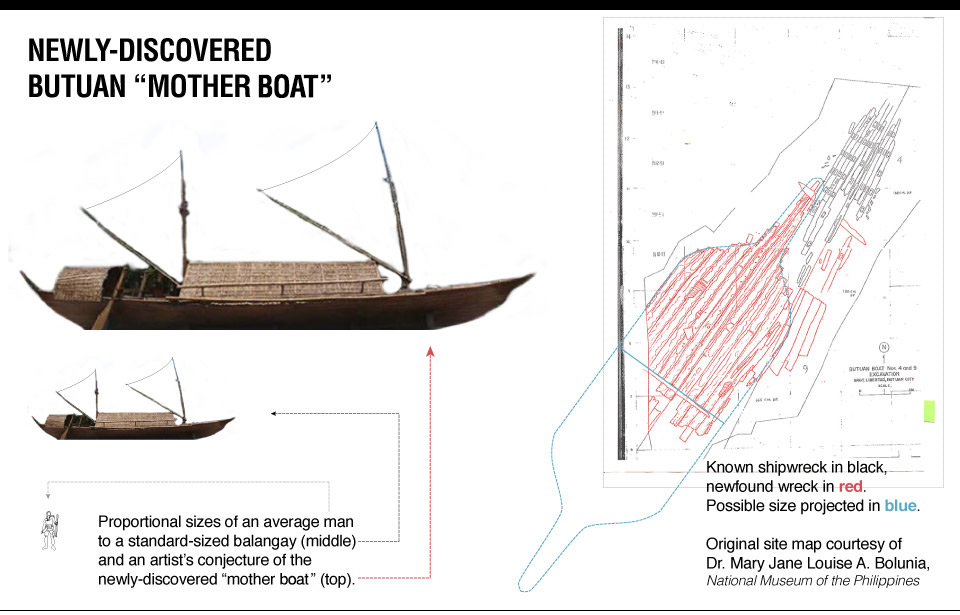
In 2012, almost a quarter of a century after Joaquín published his essay, a suspected much larger balangay "mother boat" was unearthed that could disprove the things he mentioned about lack of organization, effort, skills, and tools of ancient Filipino seafarers. The discovery of the large balangay – measuring 25 meters in length compared to previously excavated balangays that measured 15 meters – could disprove his argument on the lack of maritime skills, boldness, and daring of the early island people.

According to [National Museum archeologist Dr. Mary Jane Louise A. Bolunia], this new discovery suggests that these [the eight small vessels previously excavated] may just have been support vessels for a much larger main boat, where trade goods and other supplies were likely to have been held for safekeeping.

The discovery also suggests that seafaring Filipinos were much more organized and centralized than previously thought. [Source: http://www.gmanetwork.com/news/story/321334/scitech/science/massive-balangay-mother-boat-unearthed-in-butuan]

The interpretations Joaquín supplied for his thesis were based on artifacts available at the time that might be an incomplete data set in the light of recent discoveries. The latest information could bring in new perspectives that could weaken some of his impassioned opinions. It seemed like, for our essayist and seasoned cultural commentator, the absence of evidence is evidence of absence.

All of which was but a long prelude to a review post I was planning to write on the novel Shri-Bishaya by Ramon Muzones, which came out this year from New Day Publishers in a translation by Ma. Cecilia Locsin-Nava. This was a maritime novel, in fact Muzones's second to be translated. The first was Margosatubig which like Shri-Bishaya was an "epico-historical" novel partly set in the waters of Sulu and Philippine Seas.

Somehow the translation and publication of these two novels disproved the assertion of the writer Jose Dalisay, in an article or interview that I can no longer locate in the blogosphere, that there's a lack of novels in this part of the world that deals with the sea, which for an island nation was a bit puzzling. Well, here we have Muzones narrating in dynamic fashion the story of seafaring people gallivanting across seas, from Bornay to Paragwa (Palawan) to Aninipay/Madyaas (Panay) to Bruni (Brunei?).


03 September 2016

Juanita Cruz


Juanita Cruz by Magdalena Gonzaga Jalandoni, tr. Ofelia Ledesma Jalandoni (The University of the Philippines Press, 2006)


With my reading of Juanita Cruz by Magdalena G. Jalandoni (1891-1978), I have completed (save for one other out of print Jalandoni book) my reading list of Filipino women novelists in translation. It was a refreshing experience, particularly since Juanita Cruz was as entertaining as it was rewarding in its old-fashioned milieu and barely melodramatic storytelling.

This was only the second novel translated from Hiligaynon language that I read. From what I gather there were only four of them translated so far, a pair of novels each by Ramon Muzones (1913-1992) and Jalandoni, the two leading novelists in the Hiligaynon language and the two most heavily debated in terms of which writer from Hiligaynon better deserves the title "National Artist for Literature".

The National Artist award is, of course, the highest and most coveted prize given to Filipino artists, including writers, alive or dead, in recognition for their body of work. Like any other literary prize on the face of the earth that was decided by fallible human beings, the National Artist in the Philippines was a political exercise and was not exempted from ugly controversies and abuse of authority. The controversy in 2009 was even elevated to the Supreme Court which found (decision here) that "the former President committed grave abuse of discretion" in choosing several individuals as National Artists.

Jalandoni and Muzones were two hapless Hiligaynon novelists pitted against each other for the National Artist award. No writers writing in languages other than in English and Filipino had been awarded so far.

According to translator Ma. Cecilia Locsin-Nava, in her prefatory essay to Shri-Bishaya, the second novel of Muzones that she translated, Muzones is "the most awarded Hiligaynon Writer of the Century ... and its most likely candidate for National Artist." She considered Muzones a better writer than Jalandoni and the more deserving of literary awards such as the Republic Cultural Heritage Award conferred to Jalandoni in 1969.

Leoncio P. Deriada, in an introduction to Shri-Bishaya, categorically crowned Muzones as "the greatest Hiligaynon writer":

Certainly, there is a good number of detractors – all women – who think it is Magdalena G. Jalandoni who deserves this honor. These detractors have read a lot of Jalandoni, but sadly, I doubt if they have read enough of Muzones.

What makes [for] good literature anyway? Among other things, literature must be enjoyable reading. Reading Jalandoni's prose is a torture. If we are looking for greatness, we will find it in her poetry, not in her prose.

The problem with the Philippine literary landscape was that it was a very small field. Writers rubbed shoulders against each other or rubbed other writers the wrong way. Even dead writers were not exempt from posthumous postmortem.

According to Virgilio S. Almario—himself a National Artist—in a foreword to Locsin-Nava's translation of Margosatubig which appeared in 2012, Locsin-Nava's critique of Jalandoni made her a kontrabida in the eyes of Jalandoni's supporters.

After reading the translation of Margosatubig, I myself have started to wonder why the Jalandonistas would prefer her to Muzones. Because she is a woman writer and he is a male chauvinist? Because she remained detached from hometown politics while he indulged in it and was a politician until his old age? Or more nonchalantly kuno [so to speak], because she is rich and he is poor?

He offered a challenge to the Jalandonistas, his term for the followers of Jalandoni.

I wonder now what literary qualities the Jalandonistas saw in the ga-bundok [mountain-high] output of Jalandoni. Well, this is my challenge to them: Unless they come out with a greater study and translation of their favorite's works, Cecile's [Locsin-Nava's] books have earned my support for Muzones as a National Artist.

Perhaps unbeknown to Almario, there were already two published translations of Jalandoni's novels: Juanita Cruz (translated by her niece Ofelia Ledesma Jalandoni and published in 2006 by The UP Press) and The Lady in the Market (translated in 1976 by Edward D. Defensor who was also the first to translate Margosatubig in 1979). Lucila V. Hosillos, who wrote the foreword and introductory essay to Juanita Cruz, herself wrote a study of the writer in Interactive Vernacular, National Literature: Magdalena G. Jalandoni's Juanita Cruz as Constituent of Filipino National Literature. To my mind, Hosillos made a convincing case for Jalandoni in her essay which highlighted the novelist's aesthetic sensibility and style; her treatment of Philippine life and society as compared to José Rizal, N.V.M. Gonzalez, and Nick Joaquín; and her perception of the writer's singular brand of feminism that is distinct from Western feminism and that is closely integrated to her deep nationalism.

The characteristics that Almario was looking for in literary criticism of regional literatures were present, I think, in Hosillo's appreciation of the novel Juanita Cruz. This was a form of criticism that incorporates cultural and literary context and background to the discussion of the art of the regional novel.

The first big problem, I think, is the need for thorough and knowledgeable literary criticism of our regional literatures. It is true that all Philippine literatures share a common history and thus some mainstream characteristics. But there are particulars—details, deviations, innovations—which are found in one regional literature and not in others. These particulars can only be articulated through a criticism which is intimately familiar with each and every nuance of a regional literature. This kind of criticism will contribute to a delineation of every regional literature's history, and ultimately, to the fashioning of a truly national literary history. What we need is the emergence of good critics who are dedicated to the regional literatures of the country. Such a good critic must be well-informed about the region's culture and the literary traditions available in the region, as well as the national literary situation, and, most importantly has a Taste (as Kant would define it) for the genius of the region.

The "second big problem" for Almario is the lack of translations of regional literature in the country. Only through translations can many readers adjudge for themselves the virtue of one writer over the other. Non-Hiligaynon readers would not be able to confirm or verify the competing claims of the two camps without the aid of competent translators like Ma. Cecilia Locsin-Nava and Ofelia Ledesma Jalandoni. A sense of greatness of the two novelists in question could only be detected once a good selection from their prodigious outputs were 'bridged' in translation. Only then can the literary arbiters of award giving bodies—majority of whom does not speak the regional language in question—would be able to render a wise decision.

As can be seen in the footnotes in the Supreme Court decision, Jalandoni's name was included up to the third round of nomination before losing out to Lazaro Francisco. The Muzonistas and Jalandonistas had to work overtime in their advocacy.

To date, I only read one book each by Muzones and Jalandoni and certainly was not qualified to make sweeping judgements like Prof. Deriada. I am not even sure if Deriada has read Juanita Cruz. In that novel, I believe Deriada's claim about Jalandoni's writing—that reading her prose is a torture—fails to convince. In his piece, Deriada would later backtrack in his damning assessment and say, "aside from Cebuano Resil Mojares, only Muzones and Jalandoni deserve to be national artists." And then he reiterated, "if it is between Muzones and Jalandoni, I will always vote for Muzones" as national artist.

But why should there be room for only one National Artist for a novelist writing in Hiligaynon? Why do the Muzonistas keep insisting on gender politics over the anointment of Jalandoni by her supporters? Why are the critics not engaging with these writers beyond personal biases?

* * *

Juanita Cruz revolved around the life of its eponymous heroine, who was a delicate and extremely beautiful woman from an aristocratic, landowning family in Iloilo City in central Philippines. It was easy to see why certain readers might be put off by what appears at the surface to be a melodramatic story of a love affair between a beautiful woman of means (Juanita/Nita/Inday) and a poor handsome seminarian with a beautiful singing voice (Ely/Elias Navarro). Nita's materialist family was against the poor guy so their love was kept a secret. The period of the novel was the latter part of the nineteenth century, squarely in the Spanish era in the Philippines, at a time when women from aristocratic families were not given free rein to choose their husband. Arranged marriages were the norm, and Nita's family was bent on having her marry the wealthy and influential Spanish governor's son. Nita rebelled against her parents and brothers. She was persecuted and physically hurt by her father for her impertinence, practically made an outcast by her own family when she was accused of losing her virginity to her lover Ely, and consequently disinherited, divested of all of her family's wealth and possessions. Thence she ran away.

What was apparent was that this was a very humanist novel in that it concerned itself with the yearning for freedom and self-determination. The story traced a woman's nascent feminism and nationalism coming into full force through her liberation from her family's dogmatic materialism and patriarchal orientation. Her coming into a strong sense of self and self-worth was delineated through careful pacing and slow expository style that nonetheless exhibited its own tension and suspense.

For me, there were two aspects of the novel that made it ultimately a modern one: its repetitiveness and the small inconsistencies in the details of same stories retold by others. Different characters narrated versions of the same stories to Nita or to other people, and either there were redundancies in the stories being told (several times by different people) or there were small details that were in conflict to what was previously narrated. At first the clunky repetitiveness of the story made it ... well, clunky. But one realized that the repetitive stories from various perspectives slowly filled the gaps, for Nita's (and the reader's) benefit, of what went on in her home after she left it. Jalandoni may or may not be mimicking the mechanism of fickle memory. Her writing style, as described by Hosillo, certainly testified to this tendency. 

In Jalandoni's case, most of the intervals between novels were a matter of months, for even before she finished a story another one obsessed her. Inventiveness she ascribed to her fertile and boundless handurawan (imagination). It is obvious in her unpublished autobiography, Ang Matam-is Ko nga Kahapon (My Sweet Yesteryears), written in 1966, that she was not only precocious but also prodigious. As the stories sprouted out of her imagination and cascaded through her pen to her notebook, she did not look back to her just finished text to edit it. A new story gnawed at her until she had lived through its artistic process, which she would finish hurriedly to embark on another artistic journey. It was all she could do to capture and imprison through pen, ink, and paper the characters, dialogues, subjects, situations, and other elements that overwhelmed her. This is characteristic of writers with so much to write about and who are carried away by the narrative after they had given life to their characters in their fictional world. There was no time to edit and rewrite, to compress and stylize. Let the critics complain, the readers were waiting and the writer had more journeys of the imagination to take.

Perhaps this "speed writing" mode was what gave her slowly unfolding plot its internal forward steam and momentum. Moreover, as Hosillo noted, "the time of the narrative instance in relation to the story" of Nita's life was "in the past, and the narration is in the past tense. Yet Jalandoni's artistry creates the duration of the narrative as if the narrativized act is instantaneous with the story, so that this narrativization is in the present tense." This instantaneous realism, if one may call it like that, sustained the reader's interest in a novel of domestic life and relationships. The effect was not unlike Muzones's in his epic stories full of magic and action.

The tricky handling of memory was justified early on in the novel's "Prologue."

I would like to ask my dear readers to bear with me for not being exact with the events and my corresponding age in this my narrative. I can no longer remember the exact days, months, and years of my experiences for in my old age my memory can no longer ascertain the glimmering past of the decades.

This disclaimer was, if I'm not mistaken, the only instance in which the author made a direct address to the reader, an intrusion that, as Hosillo wrote, was practically absent in the entire narrative.

Although there is a narrator, a first-person one at that, who is a participant in the story, the narrator is so distant from the author that she could not be identified with the author. It is precisely the "I-ness" of the narrator that distances the story from the author. Had Nita been a witness-narrator or observer, it would be easier to identify her with the author. Such distance imbues the protagonist-narrator with a perspective entirely her own, free and independent of the author. And nowhere does the author intrude to make herself heard, felt, or noticed.

That non-intrusion was what made Juanita entirely believable and sympathetic. Even if she admired her own beauty in the mirror, adorned by expensive clothes and blinding jewelries of "diamond solitaires", her pride was true and without a touch of narcissism and conceit. Even the dialogues between the two lovers were surprisingly not as syrupy and pa-tweetums as the ones heard in current local drama serials shown in TV.

From her secret love for a man to her "secret love" for country, Juanita Cruz was an essay on the emergence of feminist and nationalist consciousness in an individual who asserted her right and freedom to love as she pleases.

* * *

The National Artist award is one of the biggest jokes in Philippine literary history. Every expert had an opinion and everyone had a candidate but the true and deserving winners were not (yet) selected, and may be not even considered in the first place. Wilfrido D. Nolledo, the best modern Filipino novelist in English, was not a National Artist. Linda Ty-Casper was not a National Artist. Edgardo M. Reyes was passed on. The innovative novelist Rosario de Guzman Lingat was not included. The confirmation of the excellent actress Nora Aunor as National Artist for Film was rejected. The Jalandonistas and Muzonistas are still fighting it out for a place for their writer of choice.

As long as the same "national" tastemakers who were quick to blame gender politics were given the right to nominate and vote in this political and politicized exercise, the in-breeding of stale literary ideas and ideologies will continue to prosper in our "nationalist" literature and will continue to marginalize the genius of our regional and vernacular letters. As long as important works remain untranslated, unpublished, undistributed, out of print, the important readership and the very important powers-that-be will remain imprisoned by their limited perception of greatness.

30 August 2016

Typewriter Altar


Typewriter Altar by Luna Sicat Cleto, tr. Marne L. Kilates (The University of the Philippines Press, 2016)


No matter how one approaches Luna Sicat Cleto's first novel, Makinilyang Altar (2002), the default reading of it as biographical and autobiographical would certainly be the one to generate a lot of meanings and ideas. Its writing was a form of confessional and, at times, even of exorcism. Rogelio Sicat (1940-1997), Cleto's father, author of the novel Dugo sa Bukang-Liwayway (Blood Spilled at Dawn) among many other writings, was the driver of the novel. In her preface to Marne L. Kilates's translation from the Filipino edition, the novelist admitted that "witnessing my father's passion to write was a painful experience, and writing about that pain was a mirroring exercise that could literally wound you with shards of broken glass." A wounding reading experience this novel certainly was, but it was almost a religious form of wounding, where the muse of creativity and inspiration was ever sought like a bashful deity to be worshiped at the altar of literature.

The novel began self-reflexively, with a lyrical dream and with writer's block.

I am about to pick up the book on the windowsill when I notice a flock of long-tailed sparrows fluttering down the branches of the tamarind tree in the yard. Briefly, I listen to their chirping, then wonder why there are no letters, no words, or no text on the pages of the book in my hand. The sparrows then fly from the tree as a flapping, fluttering flock, and with it the pages of the book fluttering to a close.

Here was Laya Dimasupil, a writer tentatively testing the waters of literary creation, clearing the blank pages for whatever forms of expression would manifest themselves into words, sentences, passages, and chapters. She resolved to tell her journey into literature and "sing the elegy of the altar of the typewriter."

The typewriter generation of Laya's father was now anachronistic. Sometimes I think of those writers as the last literary craftsmen, the ones who first carefully weighed the words, completed their thoughts in their minds, before typing their sweat and blood. No delete and backspace for them. No tentative steps but an already instantaneous finality marking the words on paper. Laya's father, Deo Dimasupil, was a domineering father and writer to reckon with. He could not stand the noise of his children that would perforce stand in the way of his writing his masterpieces. A former activist, Deo was the quintessential revolutionary writer and professor in a state university, always combative and opinionated. The materials of his principled art were the proletarian struggle for equity and equality. He was the writer of the people, the writer who tasted poverty and hard work first hand and who was eternally frustrated by university politics and false righteousness and posturings among revolutionaries and rebels. Deo could never reconcile the (for him) hypocritical lifestyle of national leaders and supposedly creative class of writers with their (lip service) literary cause and vocation. His convictions were always eroded by the realization that the world was an unfair playing field.

Amid her father's frustrations, bitterness, and cynicism, Laya's literary consciousness slowly developed. Though her father had his fair share of quirks and impatience, hers was not a dysfunctional family although her childhood was not entirely lacking in neighborhood and domestic conflicts (from relatives outside the nuclear family). Her family experiences certainly marked her for life and shaped her critical and practical worldview. The discrete units of memory (hers, Deo's, her mother Gloria's) disrupted and invaded the flow of Laya's narrative. The reliance on unreliable memory was a novel device to get at the crux, at the essence or substance or point, of a writing life.

When will he write these memories into a novel? How will he draw out from his life the right words, and the words into a novel that would respond to these times? The blank page from his notebook stared at him waiting for his pen.

Like Edgar Calabia Samar's first novel, Eight Muses of the Fall (2008), this turned out to be a modern exploration of the fount of creativity and the ways with which lived and remembered and imagined and dreamed experiences colonized the writer's blank pages to produce the first novel of the would-be novelist. Samar and Cleto's protagonists were equally possessed by (literary) demons. They had to get the first novel out of their system if only to make sense of the materials they excavated from their personal experience. They had to make a report of their spiritual sojourns into literature and to publish their findings.

The same impulse and literary sickness afflicted Cleto's accountant mother, Ellen Sicat, who at the age of 57 decided to write a novel after the death of her husband Rogelio Sicat. Interestingly, to begin the literary conversation with her daughter's novel, she also named her character Gloria in her two novels Paghuhunos (Molting) and Unang Ulan ng Mayo (First Raindrops of May).

But since this was after all an elegy, or more like a homage, to a father, the onset and progress of Deo's fatal disease finally exposed the festering grief and loss in the novel's center. For the mortal Deo, brought face to face with his impending demise, this existential crisis was the closest he would get to an imagined holocaust or auto-da-fé. For the impressionable Laya, the loss of a parent was harbinger not only of pain but of the loss of her moral compass. A subplot concerned Laya's unfaithfulness to her husband. An affair with a co-worker was presented like a temporary bout of lust and insanity, a sacrilegious offense to the typewriter altar, symbol not only of the altar of creative minds, but of the spiritual moorings and moral groundings of a person.

By the time the novel inhabited Gloria's memory in the final chapter of the book, we were already used at following the episodic mind of a creative writer. The relationship between reader and writer was already secured, in the same manner Gloria appreciated being the first reader (and reviewer) of Deo's writings and feeling "privileged" because of it.

And I knew where it started—my own voice had been looking for its own space. I wasn't a writer but he let me feel the fulfillment, the exhilaration whenever he finished a work. And I admit, it was a privilege. I could tell him what I thought of what he wrote.

Perhaps like Laya's growth as a writer based on her close observation of and fascination with her father's explosive temperament as a writer, the incremental cultivation of Gloria's literary consciousness had its beginnings with the daily observation of her husband's habits and a close reading of his writings. Tentative and unsure like her daughter at the beginning of the narrative, Gloria was awakening from a dream of letters.

Would she be able to write her own narrative, her own story? She didn't know where these musings would lead. But she knew she had material that she could write, that she wanted to express. She removed her name and began the narrative again by using the gender nouns "woman" or "man," and the children were simply their family rank: eldest, second, youngest. In erasing their names she was putting back the story she knew. She was not aware that she was now creating her own parable.

In the altar of memory and grief, the creative mind wanted to assuage its pain. What better way to find comfort than to follow the source spring of inspiration: to try one's hand at creative writing. Give in to the compulsion to write, inhabit fictive memories and fictional personalities, temper the point of view, hone the technique, discover subtlety.

Since the writing bug bit her she neglected to scrub the floors, forgot all about the curtains that had been hanging at the windows for, perhaps, three years now. When Gloria was writing, it was as if time stood still, everything was suspended. She had no morning, no noon, no night, so on that desk was parked a pink-lidded tray. Inside were some fruit. She'd peel a ponkan orange or a banana whenever she felt hungry.

That's Gloria Dimasupil now. My mother.

Laya and Gloria emerged as keyboard novelists after breaking out of the oppressive shadow of the father and husband. The "writing bug" that inspired them to tell stories proved to be a legacy just as lasting as the stories Deo Dimasupil typed in his typewriter, at nights when Laya and her sister would sleep outside their only room in the house so that Deo in deep concentration in his sacred altar would never be disturbed.


Typewriter Altar is part of the short reading list of Filipino women novelists in translation.

07 August 2016

Translation and its discontents: On Austregelina Espina-Moore's novelas cebuana, 2


One thing I appreciate in the translations of Austregelina Espina-Moore's three Cebuano novels was Hope Sabanpan-Yu's effort to add a translator's introduction or preface in each of them. Personally, I would like these introductions to appear as afterwords because most of the time they spoil too much of the story line, but the reader always had the option to read them for later.

Sabanpan-Yu discussed several translation issues in her preface to Where a Fire Tree Grows. The aspects she talked about included the tradeoff between literalness and fluency in translations and the dangers inherent in "naturalizing" or "domesticating" (vs. foreignizing) a text.

Since Cebuano is culturally and linguistically different from English, it makes sense to try fluent translation but without the alienating aspects of this particular type of translation. It also makes sense to translate literally especially when the goal is to emphasize the uniqueness of Cebuano. The language can be both creative and acceptable to English readers when translated literally. Because the translator "cannot possibly preserve all the features of the original" (Gutt 382), I allow myself to be guided by Jiri Levý:

In translation, there are situations which do not allow one to capture all values of the original. Then the translator has to decide which qualities of the original are the most important and which ones one could miss out. The problem of the reliability of translation consists partly in that the relative importance of the values in a piece of literature are recognized. (382)

Elements of the Cebuano language text such as syntax, phonology and diction, have to be brought into English, the target language text, otherwise it will no longer be translation but adaptation. I refer to syntax as the set of rules governing the manner in which words are combined to form sentences in a language. English is an S-V-O (subject-verb-object) language while Cebuano is a V-S-O language.

The translator then highlighted these issues by describing some of the strategies she used to deal with syntax, phonology, and diction while quoting sample passages from the novel. She presented (i) the original Cebuano text, (ii) its corresponding literal translation in English, and (iii) how she finally rendered her translation by analyzing and weighing the aspects of translation she wanted to preserve. However, the strange thing about this preface was that the passages she quoted in the preface differed from the actual translations contained in the text.

I could only presume that the preface was written before the translation was finalized and that the revisions made in the final translation were not used to update the quoted passages in the preface. If this assumption is correct, one unintentionally stumbled upon the process of editing or revising translations, with the versions in the preface taken as drafts and the version in the text as final. Here are some instances, with the original language first presented, followed by the "draft" (quoted in the preface) and the "final" versions (contained in the actual novel) of the text.

Mouna ka pagka propesiyonal kanako sa lima o unom katuig.

You'll become a professional five or six years earlier than I.

You'll be a professional five or six years earlier than I.

***

Si Jun ug si Lily namasilong sa sibay nga hulatanan sa bus duol sa escuelahan. Hapon kadto, sinugdanan sa Agosto. Nagbunok ang ulan ana sa usa ka panamilit tungod kay nanghinapos nang mga adlaw sa tingulan.

Jun and Lily took shelter at the bus stop near the school. It was an afternoon in early August. The rain poured down a farewell because the rainy days were ending.

Jun and Lily took shelter at the bus stop near the school. It was an afternoon in early August. The rain poured a farewell because the rainy days were ending.

***

Mainit, pilitpilit sa asin sa singot ang ilang kamot nga nagunitay.

Warm, their hands entwined, sticky with the saltiness of sweat.

Warm, sticky with the salt of sweat, their hands clasped.

***

Taudtaud, mahitungod gani silag tinukod ni Mr. Gonzales mohunong ug motanaw paglibotlibot. Human sa pipila nila ka nakitan, nangutana si Jun kon unsay ilang hunahuna.

Later, whenever they came across a construction of Mr. Gonzales, they would stop and look around. After they had seen a few, Jun asked what they thought.

Later, when they came across a building constructed by Mr. Gonzales, they would stop and look around. After they had seen a few, Jun asked what they thought.

***

Mao tingail nga ang mga tawo nga namasiyo sa Luneta niadtong hapon sa Mayo mohangad gayud, ngadto sa estatuwa ni Dr. Jose Rizal, ang hero sa Pilipinas – yutang tabonon.

Which is why the people who were strolling at the Luneta that afternoon in May had to look up, to the statue of Dr. Jose Rizal, the hero of the Philippines – land of the brown race.

Which is probably why the people strolling in the Luneta that May afternoon looked up, to the statue of Dr. Jose Rizal, hero of the Philippines – land of the brown race.

Whether or not the assumption that the final version is the one contained in the text was correct, I think that the small or not-so-small deviations from the quoted texts in the preface were an improvement.

Good and evil in Austregelina Espina-Moore's novelas cebuana


Ang Inahan ni Mila (Mila's Mother) [1969-1970] by Austregelina Espina-Moore, tr. Hope Sabanpan-Yu (National Commission for Culture and the Arts, 2008)

Diin May Punoan sa Arbol (Where a Fire Tree Grows) [1960] by Austregelina Espina-Moore, tr. Hope Sabanpan-Yu (USC Press, 2010)

House of Cards [1973] by Austregelina Espina-Moore, tr. Hope Sabanpan-Yu (National Commission for Culture and the Arts, 2013)


1

The three translations of Austregelina Espina-Moore to date, all undertaken by scholar and translator Hope Sabanpan-Yu, were but a small subset of her novels written in the Cebuano language. These so-called novelas cebuana were part of the Cebuano tradition of novel writing with distinct characteristics. Sabanpan-Yu described this genre as 'serialized fiction' in her preface to her translation of Where a Fire Tree Grows:

The novela cebuana, as the term indicates, is unique to Cebu. It is a novel published as a serial in local Cebuano magazines. Like the Western novel, the novela cebuana contains typical elements and the narrative usually progresses in a linear pattern. The novela cebuana does not deal with culturally dissident issues or with political matters. In the Cebuano context, the novela penetrates the traditional Cebuano cultural milieu by dealing with the universal themes of family, romantic love, life, morals, struggle, and the arts. Overall, it has the wide appeal of popular literature.

My decision to translate one of the [ten] novelas cebuana of the late author, Espina-Moore into English, is to counter the hegemonic dominance of American popular literature and build on existing Cebuano literature.

Sabanpan-Yu's effort in her three translations was indeed commendable for offering alternative reading materials to – let's face it, an unwinnable proposition – counter the American popular fiction hegemon. At the very least, her translations breathed life to this genre of Cebuano novel for the discovery of adventurous readers.

Based on the page count of the three texts, the novela cebuana was actually a novella, of only some fifty-odd pages in English translation. The three novels were presented in bilingual format, but not in facing pages: the whole novel in Cebuano appeared straight through first, followed by the English translation in the second half of the book. They were what the translator described them to be – fiction concerned with domestic family lives, relationships, and morality.

The exploration of morality was what probably makes the genre popular to the readership of Cebuano magazines (e.g., Saloma and Bisaya) during the 1960s and 1970s. In fact, serialization of novels in magazines (and comics, for the graphic novels format) was quite popular in the Philippines during the postwar period not only in Cebuano magazines but also in Tagalog weeklies and in other languages as well (e.g., the epic Hiligaynon novel Margosatubig also first appeared as a serial). Fiction writers were revered by the reading public in that golden age of novel reading when support for and readership of novels was so high. Given the popular following of novels by the masses during those times, it was such a huge step back to local popular literature (and to culture, in general) when readers in the vernacular languages now became so enamored with other forms of entertainment and reading material.

It was quite understandable why Sabanpan-Yu wanted to challenge the currently reigning mindless, Hollywood hegemon when the reading public then was more receptive of the effort of local novelists. The translator wanted to resurrect interest in the Cebuano literary production which had become marginalized and now consigned to library archives.

The reasons for the present state and (relatively poor) reception of Filipino literary culture by its own citizens were quite complex as they span the socioeconomic, political, and artistic domains. Investigation into this would require a dissertation about the martial law and the postcolonial conditions. But then perhaps Espina-Moore's novels already hinted at this rapid shift toward cultural backwardness with her intimations of the rise of materialism and capitalism in the Philippine economic structure.

In any case, Espina-Moore's brand of serial novellas had so much to offer the general reading public in terms of the family conflicts and marriage woes, domineering wives, spurned lovers, philandering husbands, spendthrift mothers, divorce, children caught between their separating parents, artistic sons and daughters, traditional and modern roles of women, class tension, moral degradation. Her careful delineation of the conflicts in short, snappy chapters – perhaps the natural division of the weekly installments of a serial – nurtured enough suspense to keep the interest of common readers. In these novellas, the cast of characters was enriched by a dominant 'villain' who served as counterpoint to the moral center or conscience of the story. In Mila's Mother, the titular Teresa was a fierce character shaped by unfortunate circumstances. Her daughter Mila – a modern woman with passive feminist ideals – provided a counterpoint to her mother.

"What I want to say is that the natural predisposition of woman is marriage. After marriage, there's no more freedom. Husband, child, home – home, child, husband. The woman who strays will certainly get censured." The image of her mother, Teresa, arose in her mind; –. She could hear her say: "That's the Filipino way of thinking – the traditional Filipino."

"Continue. Is there any other?"

"Another way of thinking is this: There is no difference between woman and man when it comes to individual liberty or freedom. Real freedom arises from an act that won't hurt or be detrimental to oneself and others. Freedom that knows no bounds isn't freedom at all but abuse, and in English, it's what's called taking license."

"Is that from theory or experience?"

"Everything. Theory, experience, and common sense."

At the start of the novel, Milagros Garcia (Mila) was speaking to her compatriot Roberto Eleazar (Bobby) in New York. Mila was taking a vacation. They just met. Eventually the two fell in love and decided to marry. Teresa's palpable presence for her daughter was evident in the way she voiced out to Bobby what she suspected her mother would say about the Filipino perception of women ("She could hear [her mother] say").

When the two young lovers returned to the Philippines, it turned out that Bobby's father and Mila's mother were previously an "item" in their younger years. The two had a rather colorful history. Mila was then a poor young woman and it was impossible for her (given her unremarkable "ancestry") to marry Juan "Johnny" Eleazar, who was the scion of a very rich family. After all, in Johnny's own words (in speaking to his wife), Teresa was a bad match:

Teresa did many things then that showed how rotten her character was, her hunger and greed. I knew this not only from suggestions but from what I observed. She'd be jealous of the enjoyment and happiness of others. I noticed this. Teresa was like a lovely but poisonous flower when approached. The only good thing was that I wasn't blind or deaf. Maybe the psychiatrist would say Teresa's attitude originated from her situation because she grew up deprived – deprived not only of wealth but also of love. Just think of it. A pretty child growing up in poverty, watching other mestizas like her who wouldn't even glance at her. Just think of a child growing up, watching her classmates or playmates with toys, with the right clothes, the right car, but she had none of these things and could only have a taste of it all when given attention or given by friends. Just think of a growing child, suddenly slapped and reminded whenever she made a small mistake that she was a replica of her mother ["a dancer"]. I learned this from others and from Teresa herself. It's a pity. But what could I do? Could I be sure that when we married her nature would change? What's called nature is very difficult to change if ever it can be changed. Marriage isn't for a few days or months. Marriage is forever. So even if I really pitied her situation and knew the cause of her bad character, I also knew that I wasn't born to this world to become a martyr for a woman. A wife like Teresa? God forbid!"

At this point we hadn't yet met Teresa – described elsewhere by her American sister-in-law as "the very lovely woman whose industry and vigor's like a troop of Hitler's soldiers" – in person, and yet her infamy, at least in the eyes of her former boyfriend, already preceded her. It was already firmly established by those who knew her that she was a "bad" person. Espina-Moore already dispensed character nuance and complexity here. Mila's mother was no Mother Teresa. The novelist was playing to the popular notions of women and marriages and was making radical shifts in other directions. The novelist was constructing the play of plot and the subsequent comedy of manners, clash of traditions and customs (between the Filipino tradition of the old Cebuano family of the Eleazars and the American tradition of the Grahams), and catfights, when the two families, the Garcia Grahams and the Eleazars, met to plan a wedding.

Teresa Garcia rose from poverty by marrying Kenneth Graham, an enterprising American businessman. Their marriage was held together by the birth of Mila. Even Teresa herself acknowledged and embraced her shrewdness and wiles to "bag" Ken Graham as a husband and improve her financial status in life.

Poverty is a crime. No one respects you; no one looks at you; no one falls in love with you when you're poor. They say that I cheat, I take advantage, I'm cunning, grab what isn't mine, I'm envious. But if not for jealousy, there'd be no ambition. If there was no ambition where would I be now? I'd still be a salesgirl in Cebu, married to a scumbag, give birth to scum who'd marry scum. Now everything's possible because of my ambition – of my efforts. My own efforts. Even this husband beside me now [in church during Mila's wedding] who's a successful businessman. He's mine because of my efforts. I didn't wait for him to fall to others. When I saw him, I said, this one's mine. And now he's mine. Our situation is like this because aside from my efforts, I also pushed my husband to strive. I drove away friends who wouldn't be any good. What's the use of friends who can't add to wealth? Isn't there truth to the saying that friends are treasures as well? For me, a friend's a treasure if he brings wealth. So now, with Mila's marriage to Johnny's son, it evens out everything. The community's sin against me is paid up. But only on that score.

After Mila's marriage to Bobby, Kenneth pondered the idea of separating from Teresa since he was no longer bound to protect his daughter Mila from her mother as she already had a husband to mind and a new family to build.

Mila's negative definition of freedom ("Real freedom arises from an act that won't hurt or be detrimental to oneself and others") became the anchor of the narrative as the satirical novel took a turn for tragicomedy once Kenneth made up his mind on whether or not to divorce Teresa.

2

In addition to the depiction of a dominant 'villainous' character, what is unique about Espina-Moore's novelas was the presence of a moral center, a sort of counterbalance to the figure of the evil. It must be said that while the concepts of good and evil are not often enclosed in quotes, neither of them was strictly relativistic in Espina-Moore's fictional universe. Good is good; evil is evil. And yet the sympathetic consideration of what made the evil personas come to be was explored and weighed. Again, in the tradition of popular Philippine novels, the didactic tradition of having a "moral" in the story – contrary to the usual modernist, Western novels where good and evil are confused in an ethical conundrum – were closely adhered to, even actively pursued, in these three novellas.

Mila was the moral center in the novel centering on her mother's flawed character. In Where a Fire Tree Grows it was Jaime Gonzales Jr (Jun), the intelligent son who observed at a distance the rediscovered love affair (let us say: adultery) between his favorite teacher Ms Estrella Arcilla and his father. The idealist Jun romanticized about liberal arts (sometimes waxing about poetry) and its role in society.

"Isn't the aim of Liberal Arts that of making the 'humanities' comprehensible or the various studies refer to the society that revolve around people? Because we mentioned Fr. Roger, I tell you that I am in agreement with the Jesuit thought that if the Humanities is learnt and understood, what will follow is the search for the right profession or means of livelihood. It doesn't matter if one is a doctor, carpenter, engineer, street cleaner, lawyer, a businessman, gardener, or cook – whatever – most of all, one should be a good person, a whole creature whose heart is in the right place and whose thoughts follow a good direction."

In one of the poetry readings he frequently attend, Jun invited his father Jaime Sr and there Jaime met Estrella once again after many years of their separation. Their previous affair ended on a somewhat bitter note. In Estrella's house a fire tree stood, symbolizing the fires and passion of a lost love reignited. The poetry of the telling was notably cheesy and self-conscious. Oh, yes, the poetry in the background was defeaning.

Estrella left the kitchen first, went through the living room towards the door. But the living room was dark and the night was quiet. Their steps echoed together with the cries of their hearts. Their steps stopped. A few fireflies floated from the flowers of the fire tree with the breeze carrying the low cries: "Estrella, Estrella ... Jaime, oh my love, my love Jaime ..."

Jaime's wife, Emmy, was physically invalid due to an accident. Lately, Emmy was noticing Jaime's unusual behavior of coming in very late from work in the office. Her reading material was not so subtle, too, and so was her mounting anxiety and disorientation.

Luz [Emmy's home nurse] gently laid a hand on her patient's shoulder and said, "Ma'am, weigh your thoughts. Sadness and worrying too much isn't good for you. Finish your orange juice and we'll go to the roof garden. I'll read you a few pages from Anna Karenina. On our last reading, Anna had asked her husband for a divorce. What do you think is next?"

Emmy closed her eyes tightly, leaned against her chair, and continued, "Tolstoy's novel – Anna Karenina – is about a beautiful woman whose experiences were hair-raising. Whatever entertains, [also] provides a lesson ... and other books, all books, amusement, gardening, roof gardens, television, radio, a good nurse who's always there, a good and intelligent son, a beautiful house, all the food that you want, all sorts of clothes you can think of. It's true, there's so much convenience and not a care. Oh, Luz!"

Jun's mother was losing her grip on the world, now that her suspicion of Jaime's infidelity grew every day. Her critical opinion of Tolstoy's novel might as well be the guiding framework of the novelist's popular fare. Whatever entertains also provides a lesson.

Elsewhere, Mikhail Lermontov's lines were recited and discussed at length. There's a Russian strain of emotions flowing in this novel. In a climactic confrontation between Jaime and Estrella, poetry was once more sign checked. "For her [Estrella], the most painful thing was that she gave someone else pain. If she were a poet, this would be the most beautiful poem of her life."

She don't say. And by the end, the novela closed with Lermontov's lines about feeling and passion.

3

In House of Cards, we have as 'conscience' of the novel, Honorio de la Paz (Nor) and Marifel Baraza. Nor was a student tenant in a dormitory ran by Nang Cristy, while Marifel Baraza was the young daughter of a rich business-owning family. Nor listened to the story told by Nang Cristy about her work as housekeeper in the mansion of the largely decadent Baraza family. Like the image of a fire tree in the yard, the 'house of cards' was a transparent symbol of the irreversible, domino effect of the Baraza family's moral disintegration.

There was Don Cesar Baraza and his wife Doña Mercedes throwing away money as if there's no tomorrow. They changed housemaids constantly as not one (save for Nang Cristy who had the sense and stamina to survive working for the notorious husband and wife and their cruel children, excepting the gentle and kind Marifel) could tolerate and adjust to the masters' unorthodox attitudes. The way Doña Mercedes spent the family fortune shopping in Europe on Christmas, preferring to be away on a holiday with a "new company" – an intimate, or an illicit lover, it was implied – than to spend her time with the family. Don Cesar, for his part, was keeping a mistress for years.

When the Baraza business became practically bankrupt overnight due to the poor decisions made by Don Cesar, the house of cards started to fall apart. Nang Cristy, who survived the hellish Baraza household as a temporary relief when the previous head of housekeeping resigned at short notice, had her own dose of lesson to impart to the reader.

It is said that life is happier if we do what we're capable of, if our intentions are good, and if we exercise with industry our talents and skills that God has blessed us with. So I drew on my femininity here in my employer's [Baraza's] home. I was not only glad they were pleased with my work but I was also happy that when they needed me, I was there. It is also to my credit that they wanted me to stay permanently in their home but I liked my old job better. So I told Mrs. Baraza I was returning to the factory and I, myself, would look for a housekeeper [to replace her] for them.

Nang Cristy shared her colorful story in the house of the rich to Nor, and our student dormer had acquired practical knowledge about the life. The housekeeper might be lowly in her station in life, but her "love and desire to understand one's fellow human beings" allowed her to get an insight into effectively dealing with difficult rich people who were blind drunk with wealth and power.

4

Readers are indebted to Sabanpan-Yu's informed translation of Espina-Moore's fictional works. The translator is also author of a book-length study on the writer entitled Women's Common Destiny: Maternal Representations in the Serialized Cebuano Fiction of Hilda Montaire and Austregelina Espina-Moore.

I cannot evaluate the faithfulness of the English translations to the Cebuano language. I can only assume that like the evolution of the Tagalog language, the quality and register of Espina-Moore's Cebuano in the 1960s and 70s must be quite different to the usage of the language today. I had to wonder why the translator would render a Cebuano sentence Husto na ang parte ko sa pagka polis as "My role of policing was palling." I was not sure if it is the alliteration or word play or simply the dated Cebuano of the 70s.

I plan to read the three other novels of the Cebuano novelist originally published in English, written a decade apart from each other between 1970 and 1992. Her three English novels and two short story collections (Cuentos and Choice) are signed under the diminutive version of her first name. From Austregelina to Lina Espina-Moore, the writer opted to produce her English novels and stories with longer page counts and in alliterative titles. I'm intrigued to see how her English novels continue or diverge from these thematically and technically unified samples of her novelas cebuana.


The three translated titles of Espina-Moore are included in the reading list of Filipino women novelists in translation. They are available from the Cebuano Studies Center.